Arc Equals Versine Plus Sine
Summary: Problem VI of chapter 22 (§536, figure 116). In semicircle find arc equal to the sum of versine and sine . Algebraic reduction via the half-angle product identity tames the equation; false-position-method gives .
Sources: chapter22, §536. Figure 116 (figures115-118 p. 493).
Last updated: 2026-05-12.
Setup
Semicircle , center , radius 1. From a point on the upper arc drop the perpendicular to the diameter . Then
where . We want
Euler observes that the arc must exceed a quarter circle (otherwise already plus more). So he reparametrizes by the supplement: let (arc ), so arc . With in the second quadrant relative to , and still, and the equation becomes
Trigonometric reduction
The right-hand side admits a closed product form. Using
we factor
The inner sum is itself a single cosine: , since . Hence
This is the form Euler attacks. Its virtue is that every operand is now a single cosine, whose logarithm is directly tabulated.
False position
Try and . Then is and , is and . Computing LHS - RHS in log form:
Bracket ; proportion , so .
Minutes pass at and gives errors and , proportion . So
The component lines: , . Their sum matches the arc length in arc units, i.e., . ✓
Why this matters for §540
The numerical sine in this problem is very close to , but not equal. Euler points out (§540, see quadrature-commensurability-remark) that if had come out to exactly, then would be algebraic, providing an algebraic length for an arc — i.e., a partial quadrature. Problem VI is the chapter’s poster child for this near-miss.
Figures
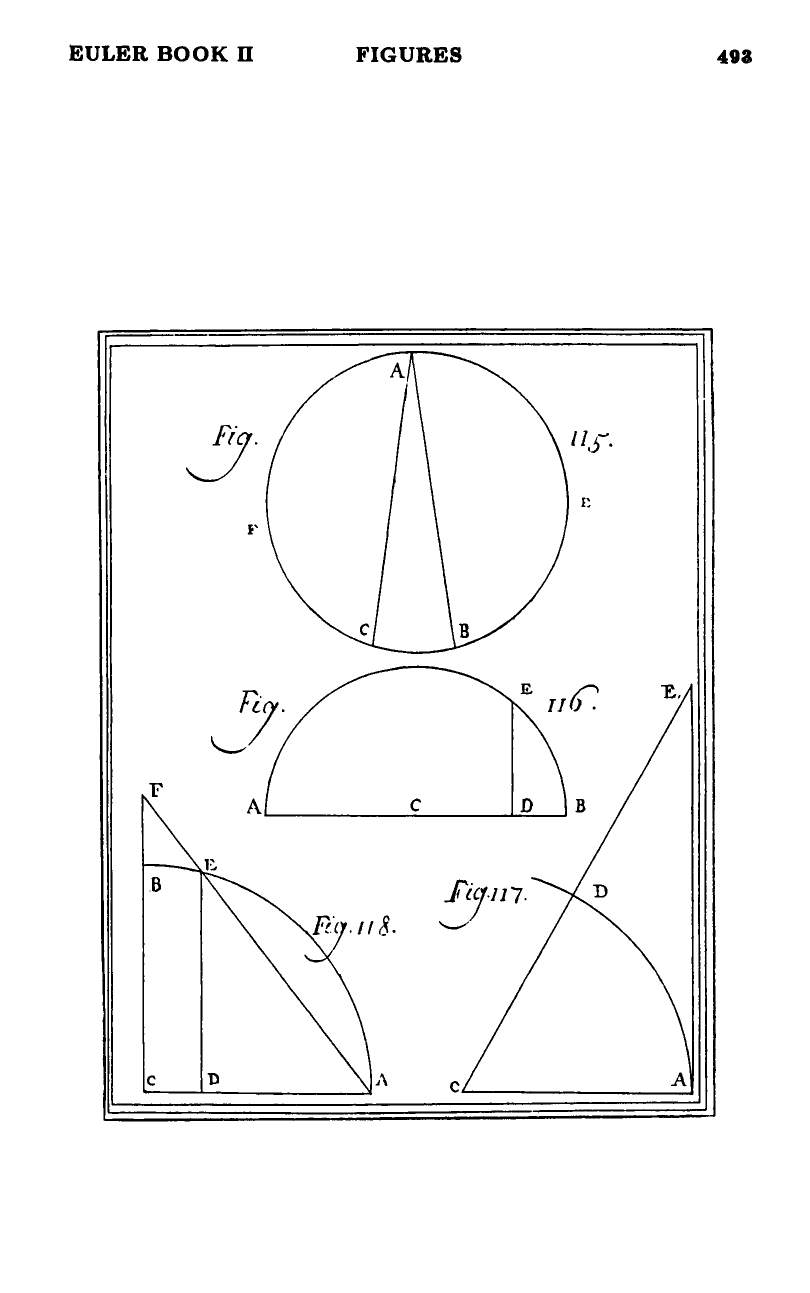 Figures 115–118
Related pages
- chapter-22-on-the-solution-to-several-problems-pertaining-to-the-circle — context.
- false-position-method — algorithm.
- quadrature-commensurability-remark — Euler’s §540 reflection turns on this problem.