Chapter 22 — On the Solution to Several Problems Pertaining to the Circle
Summary: The closing chapter of Book II. Nine numerical problems in which an arc must be found that equals some line, area, or trigonometric function attached to the circle. Each is reduced to a transcendental equation and solved by the method of false position (Problem IX uses a series instead). The chapter closes (§540) with a striking remark connecting these computations to the still-open question of the quadrature of the circle.
Sources: chapter22, §§529–540. Figures 112–118 in figures111-114 and figures115-118.
Last updated: 2026-05-12.
Setup (§§529–530)
§529–530 give a practical calculus for moving between arc length, degrees, minutes, seconds, and their (base-10) logarithms. With radius 1, an arc of degrees has length , and ; for an arc in minutes the subtracted constant is , for seconds . The “golden rule” gives the value of one radian as
with , . These constants and tables of are the apparatus the rest of the chapter rides on.
§531 contains the chapter’s only general observation: every arc exceeds its sine (except at zero), but the cosine begins at 1 (above) and reaches 0 at a right angle (below). By the intermediate-value-style argument that Euler uses without naming, some arc between and equals its cosine. Problem I is to find it.
The method (§§531, every problem after)
Every problem after the first follows the same algorithm: false-position-method. Given — typically involves together with , , or — try two values , compute the errors from log tables, and linearly interpolate so that . Iterate, narrowing the gap by an order of magnitude with each pass (degree → minute → second → third → fourth → fifth → sixth). Each problem ends with six- or seven-decimal coordinates of the point and chord lengths.
The chapter rotates through nine such problems, several of which collapse onto a single transcendental constant once their equations are rewritten.
The nine problems
| § | Figure | Problem | Equation | Reduces to |
|---|---|---|---|---|
| I (§531) | — | arc equal to its cosine | — (master) | |
| II (§532) | 112 | chord bisects sector (triangle = segment) | new | |
| III (§533) | 113 | ordinate bisects quadrant | (I), | |
| IV (§534) | 114 | chord bisects semicircle | (I), | |
| V (§535) | 115 | two chords split circle into three equal parts | new | |
| VI (§536) | 116 | arc equals versine + sine | new | |
| VII (§537) | 117 | sector = half of tangent-triangle | new | |
| VIII (§538) | 118 | arc equals chord-extension | new | |
| IX (§539) | — | all arcs equal to their tangents | series |
arc-equals-cosine is the master problem: Problems III and IV reduce to it by linear translations of the unknown ( in III, in IV), so once has been computed once it serves three of the nine. Problems II, V, VI, VII, VIII each demand a fresh false-position computation. Problem IX (the only one with infinitely many solutions) is solved differently — by inverting the arctangent series.
Problem clusters
The pages develop the problems in groups:
- arc-equals-cosine — Problem I + reduction map for III, IV.
- equal-area-bisection-problems — Problems II, III, IV: bisecting a sector, a quadrant, and a semicircle by a straight line; figures 112, 113, 114.
- circle-trisection-by-chords — Problem V; figure 115.
- arc-equals-versine-plus-sine — Problem VI with its half-angle reduction; figure 116.
- arc-equals-half-tangent — Problem VII; figure 117.
- chord-extension-equal-arc — Problem VIII; figure 118.
- arcs-equal-to-tangents-series — Problem IX, the doubly-infinite family, with the explicit series.
§540 — closing remark
After Problem IX Euler stops: the method is clear enough, and he flatly concedes that the point of the chapter was the deeper one. These problems were “made up in order that the nature of the circle might be penetrated more deeply, since attempts at these quadrature problems have been unsuccessful by all previous methods.” If by chance the sine in Problem VI had come out as exactly instead of the irrational , then would have been an algebraic quantity, and the quadrature of (the relevant arc of) the circle would have been settled. The chapter — and Book II — closes with: “if there should be such a reason [for impossibility], there does not seem to be a better method for solving the problems than that which we have given in this chapter.” See quadrature-commensurability-remark.
Position in Book II
Chapter 22 is the final chapter (the source ends “END OF THE SECOND BOOK”). It closes the algebraic-curves arc of the book (chapters 1–20) plus the transcendental-curves coda (chapter 21, chapter-21-on-transcendental-curves) with a numerical-applications coda of its own. Compare:
- Chapters 7–11 (algebraic curves at infinity): existence and species of solutions, no numerics.
- Chapter 21: catalogue of transcendental curves, mostly qualitative.
- Chapter 22: transcendental equations at concrete points on those curves, solved to six-decimal precision by log-table arithmetic.
The chapter is also the only one in Book II whose primary content is numerical. It anticipates the role that later analysis textbooks (and Euler’s own Institutiones calculi differentialis) give to Newton’s method and series inversion for transcendental equations.
Figures
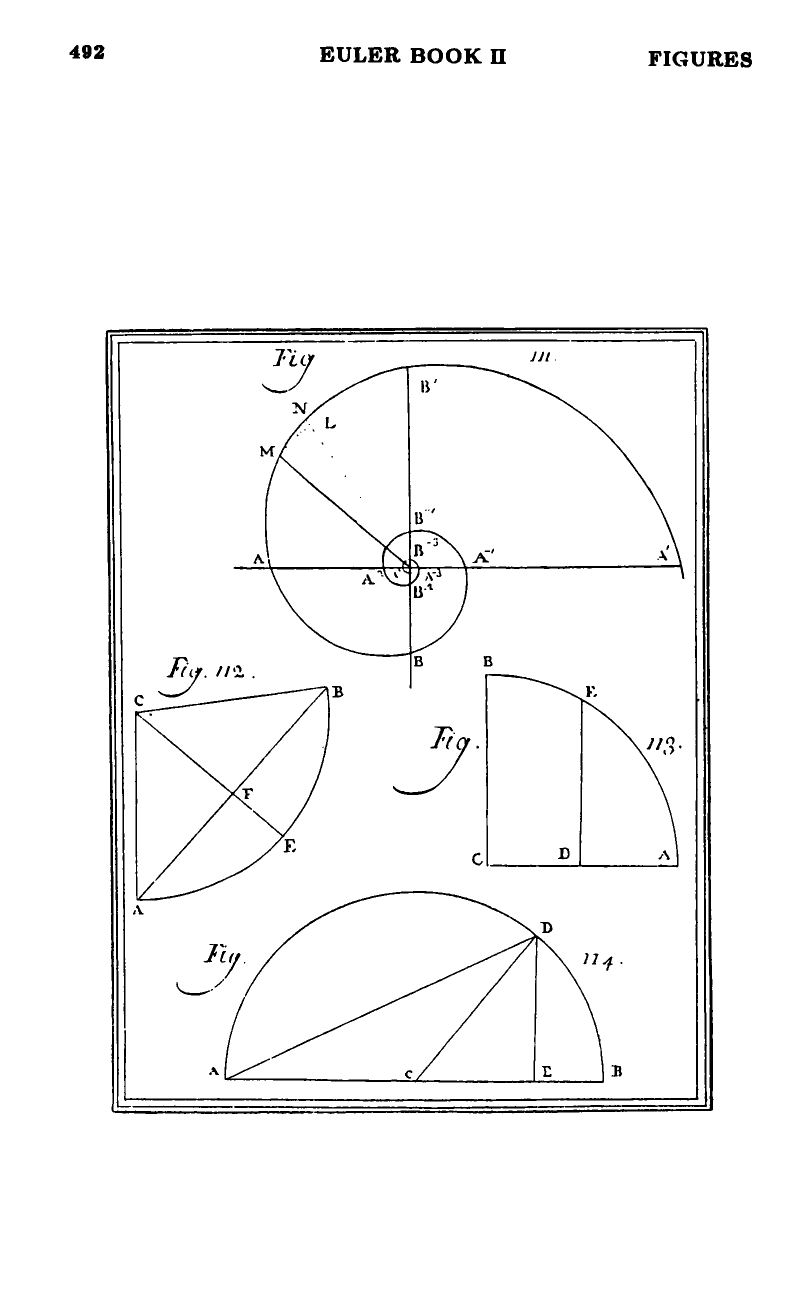 Figures 111–114
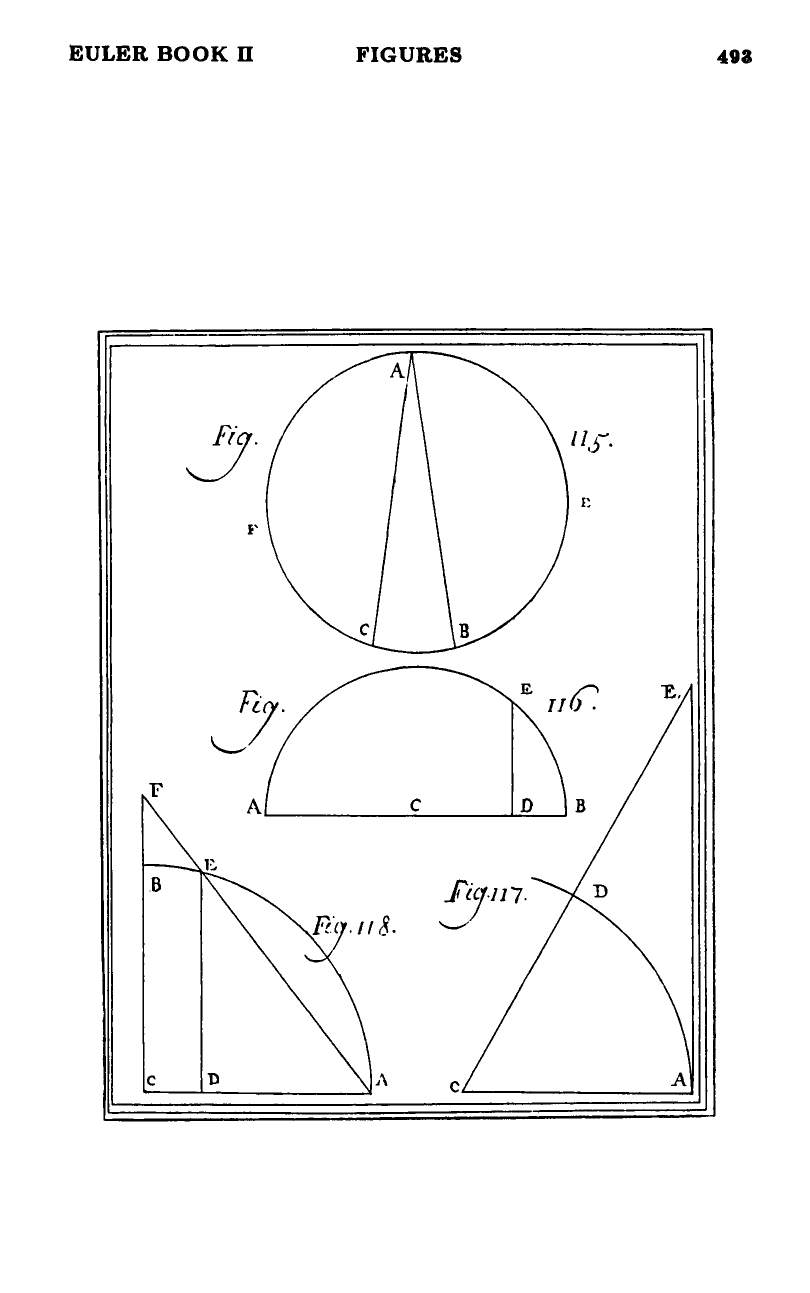 Figures 115–118
Related pages
- false-position-method — the core numerical technique used in eight of the nine problems.
- arc-equals-cosine — Problem I, the master.
- equal-area-bisection-problems, circle-trisection-by-chords, arc-equals-versine-plus-sine, arc-equals-half-tangent, chord-extension-equal-arc, arcs-equal-to-tangents-series — Problems II–IX.
- quadrature-commensurability-remark — §540.
- chapter-21-on-transcendental-curves — the curves on which the chapter 22 problems live.
- transcendental-curves — Euler’s §506 definition of the class.