Biquadratic by Circle and Parabola
Summary: A general fourth-degree (biquadratic) equation is constructed as the intersection of a circle with a parabola (§§493–495, figure 100). After removing the cubic term by a Tschirnhaus shift, the parabola’s parameter stays free and the circle’s center and radius are determined; sign analysis on shows the construction is always real, with the cubic recovered as the limit .
Sources: chapter20 (§§493–495); figure 100 in figures99-102.
Last updated: 2026-05-12.
Setup (§493, figure 100)
A circle and a parabola share an axis but the parabola’s own axis is perpendicular to . Coordinates .
Circle: center with (along axis), (perpendicular to axis), radius :
Parabola with axis perpendicular to : vertex at distance along the axis, along the parabola’s axis, parameter (latus rectum) . The relation , i.e. , gives
Elimination
Substituting into the circle’s equation,
which expands to the quartic
z^4 \;-\; 4fz^3 \;+\;& (6f^2 - 4hb - 4hg + 4h^2)z^2 \\ +\;& (4fhb + 4fhg - 4f^3 - 8ah^2)z \\ +\;& f^4 - 4f^2 h(b + g) + 4h^2(b + g)^2 + 4a^2 h^2 - 4c^2 h^2 = 0. \end{aligned}$$ The four roots are the abscissas of the (up to) four intersection points $M, m, m', m''$ of the circle and parabola. ## Matching the general biquadratic (§494) The six constants $a, b, c, f, g, h$ collapse to *five* since only the sum $b + g$ enters; set $k = b + g$. Equate with $z^4 - Az^3 + Bz^2 - Cz + D = 0$: $$4f = A \implies f = \tfrac{A}{4},$$ $$6f^2 - 4hk + 4h^2 = B \implies k = \tfrac{3A^2}{32h} + h - \tfrac{B}{4h},$$ $$4f^3 - 4fhk + 8ah^2 = C \implies a = \tfrac{A^3}{256\,h^2} + \tfrac{A}{8} - \tfrac{AB}{32h^2} + \tfrac{C}{8h^2},$$ $$(f^2 - 2hk)^2 + 4a^2 h^2 - 4c^2 h^2 = D.$$ The first three equations fix $f, k, a$ in terms of the still-free $h, c$; the fourth then relates $c$ and $h$. ## Removing the cubic term (§495) A Tschirnhaus shift $z \mapsto z + A/4$ kills the $z^3$ term, leaving the canonical form $$z^4 + Bz^2 - Cz + D = 0.$$ With $A = 0$ the determinations simplify dramatically: $$f = 0, \qquad k = h - \frac{B}{4h}, \qquad a = \frac{C}{8h^2},$$ and the fourth equation becomes $$4h^4 - 2Bh^2 + \tfrac{1}{4}B^2 + \tfrac{C^2}{16h^2} - 4c^2 h^2 = D,$$ i.e. $$8ch^2 = \sqrt{\,4h^2(B - 4h^2)^2 + C^2 - 16Dh^2\,}.$$ To force a real solution Euler parameterizes $c = h - (B + q)/(4h)$ for free $q$, reducing to $$C^2 - 16Dh^2 + 8Bh^2 q - 32h^4 q - 4h^2 q^4 = 0.$$ ### Case I: $D = E^2$ positive The equation is $z^4 + Bz^2 - Cz + E^2 = 0$. Take $q = 0$: $$c = \frac{C^2 - 4BE^2}{4CE}, \quad h^2 = \frac{C^2}{16E^2}, \quad h = \frac{C}{4E}, \quad k = c, \quad a = \frac{2E^2}{C}, \quad f = 0.$$ ### Case II: $D = -E^2$ negative The equation is $z^4 + Bz^2 - Cz - E^2 = 0$. Then $c$ is always real for any $h$: $$c = \frac{\sqrt{C^2 + 4h^2(4h^2 - B)^2 + 16E^2 h^2}}{8h^2},$$ so $h$ can be chosen freely (to make $c$ small and the figure compact, say). In either case, with the parameters set, the recipe is: $$AE = f = 0, \quad CD + EF = k = \frac{4h^2 - B}{4h}, \quad AD = a = \frac{C}{8h^2},$$ draw the parabola of parameter $2h$ with vertex at $E = A$ (since $f = 0$) and axis perpendicular to $AP$, draw the circle of center $D + b$ (height $b$ above $D$) and radius $c$, and the four intersections are the roots. ## Cubic as a limit: $E = 0$ (Bäcker's rule) If $E = 0$ — and the equation collapses to the cubic $z^3 + Bz - C = 0$ — Euler defers to "Bäcker's rule, which is sufficiently well known." The geometric content: one of the two intersections coincides with the origin and counts as $z = 0$, the spurious fourth root, leaving the three actual cubic roots as the remaining intersections. This is the standard "multiply by $z$" trick of [[general-construction-by-parabola-and-conic|§504]] in reverse. ## Why circle and parabola? By the [[intersection-product-degree-bound|joint-degree bound]], a circle (order 2) and a parabola (order 2) meet in at most $2 \times 2 = 4$ points — matching the biquadratic's four roots exactly. A *parabola* (rather than another circle) is essential: two circles cannot meet in more than 2 points, so they cannot realize a quartic. The parabola's open branches let the eliminant achieve its full degree. ## Why not higher degrees by this construction? The same circle-and-parabola construction cannot realize quintic or higher equations: the joint degree is locked at 4. For quintics, sextics, and beyond, use a curve and a parabola of *higher* order, or apply the systematic [[general-construction-by-parabola-and-conic|§§499–504]] machinery using $y = P(z)$ as one of the two curves. ## Figures <!-- figures: auto-embedded --> 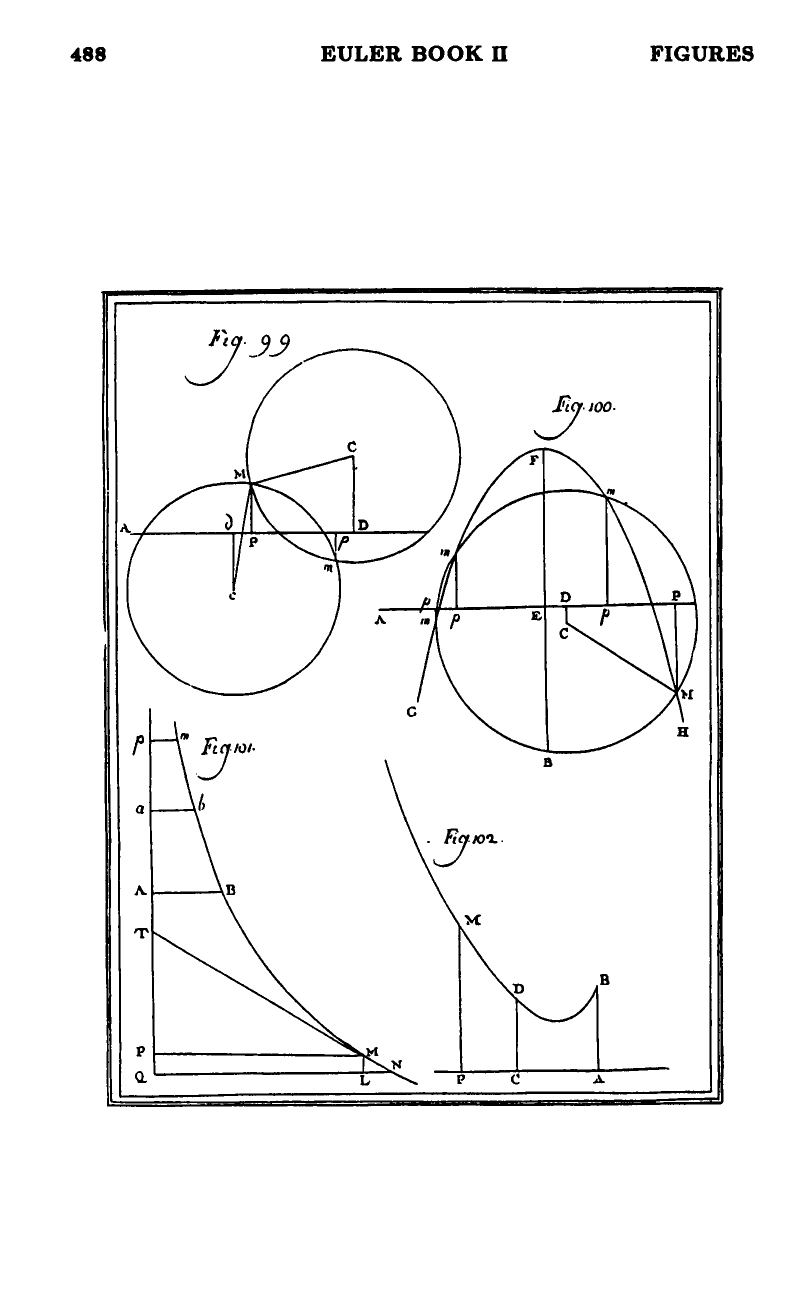 *Figures 99–102* ## Related pages - [[construction-of-equations]] - [[chapter-20-on-the-construction-of-equations]] - [[quadratic-by-line-and-circle]] - [[quadratic-by-two-circles]] - [[general-construction-by-parabola-and-conic]] - [[intersection-product-degree-bound]] - [[parabola]]