Chapter 20 — On the Construction of Equations
Summary: Chapter 20 inverts chapter 19. Where chapter 19 takes two given curves and reads off the polynomial whose roots are the abscissas of their intersection points, chapter 20 takes a given polynomial and asks for two curves whose intersections realize its roots as visible line segments. The chapter develops four sample constructions — line + line for a linear equation (§488); line + circle for a quadratic (§§489–491), and two circles as an alternative (§492); circle + parabola for a biquadratic, with the cubic as a limiting case (§§493–495) — and then a general method using a single-valued first curve to construct any equation of any degree (§§499–504). The intersection-degree bound (§§496–498) governs how to factor the target degree into orders of two construction curves.
Sources: chapter20 (§§486–505); figures 97, 98 in figures94-98; figures 99, 100 in figures99-102.
Last updated: 2026-05-12.
The chapter at a glance
Chapter 19’s elimination procedure takes two equations and and produces a polynomial whose real roots locate the real intersection abscissas. Chapter 20 reverses the arrow: given , find and . The chapter divides into three movements:
- Constructions for low degrees (§§486–495). Sample constructions for the linear, quadratic, and biquadratic equations using the simplest possible curve pairs.
- The general degree bound (§§496–498). Two curves of orders and meet in at most points; the bound dictates how to factor a target degree.
- The general construction method (§§499–505). For any equation of any degree, choose the first curve in the form (so is single-valued in and no complex intersections are possible), then solve for the second curve by substitution.
See construction-of-equations for the master concept and intersection-product-degree-bound for the joint-degree count.
1. Low-degree constructions (§§486–495)
Linear by two lines (§488, figure 97)
Two lines crossing at ; algebra gives . Any linear equation can be matched by choice of the four constants. Together with the line equation of chapter 2, this is the order entry of the eliminant table in geometric guise.
Quadratic by line and circle (§§489–491, figure 98)
A line and a circle meet in at most 2 points. Algebra produces an eliminant of degree 2, which can be matched to by choosing the circle’s center , radius , and line slope . The simplest case makes the line the axis itself, with circle center at and radius — the geometric form of the quadratic formula. To avoid the explicit square root, raise the center off the axis to and take radius .
See quadratic-by-line-and-circle.
Quadratic by two circles (§492, figure 99)
Two circles also meet in at most 2 points. The construction works algebraically but is less preferred than line + circle: it has six free constants instead of three, the radical-axis derivation is fussier, and circles cannot realize anything beyond a quadratic.
Biquadratic by circle and parabola (§§493–495, figure 100)
A circle (order 2) and a parabola (order 2) meet in at most points. Algebra produces a quartic eliminant which, after the Tschirnhaus shift removes the cubic term, leaves the canonical form . The parameters of the parabola and circle are determined up to one free length (the parabola’s parameter), with sign analysis on showing the construction is always real:
- : explicit choice , , etc.
- : free, always real.
- (i.e., ): the quartic collapses to the cubic , handled by Bäcker’s rule.
See biquadratic-by-circle-and-parabola.
2. The intersection degree bound (§§496–498)
Two algebraic curves of orders and meet in at most points. Euler verifies the bound case by case via the chapter-19 eliminant tables, and also gives a geometric proof: an order- curve can degenerate (as a complex curve) into straight lines, each of which meets an order- curve in at most points, so the union meets it in points; by continuity, the bound persists when the order- curve is irreducible.
| bound | matches | |
|---|---|---|
| line + curve, line-curve-intersection-bound | ||
| two conics, the biquadratic | ||
| conic + cubic | ||
| two cubics | ||
| two quartics |
To construct an equation of degree , choose (or when ‘s factorization is awkward; the surplus intersections are spurious roots, recognized and discarded). For prime or awkward — e.g., — choose giving a cleaner product, like , rather than the exact but visually intractable .
See intersection-product-degree-bound.
3. The general construction method (§§499–504)
For any equation of any degree, the recipe:
- Pick the first curve as , so that is single-valued and rational in . No complex intersections can arise from a curve of this form.
- Substitute this into and clear denominators. The result is the equation of the second curve.
The standard worked case is the quartic with first curve the parabola :
The two free constants give an infinite family of valid second curves. The discriminant (with added by the §501 trick of multiplying the first equation by ) classifies them by conic species: hyperbola / parabola / ellipse. The circle subcase has and .
For higher degrees, take the first curve to be a higher-order parabolic line of degree , giving a second curve of order . For awkward target degrees, multiply by to add easily-discarded zero roots — e.g., the cubic becomes the biquadratic with , ready for the circle-and-parabola construction (and the extra root is the origin).
See general-construction-by-parabola-and-conic.
4. Caveat on missed real roots (§505)
Even when no complex intersections arise (the single-valued first curve ensures this), it can happen that a real root of corresponds to a point of the second curve that lies off the visible arc — on a different branch, at infinity, or on a part of the curve outside the figure. Euler closes the chapter dismissively: this is “more a curiosity than something useful.”
Connections to the rest of Book II
- The line-curve-intersection-bound from chapter 4 is the case of the present bound, and the linear construction by two lines is the case.
- complex-intersections from chapter 19 motivates the §499 design principle that the first curve be of the form .
- The elimination tables of chapter 19 provide the algebraic engine: each table entry tells us the degree of the eliminant, hence the maximum target degree for that pair of construction curves.
- The conic discriminant from chapter 6 sorts the second curves of §502 into hyperbola, parabola, and ellipse.
- The parabola from chapter 6 is the workhorse first curve, both for the biquadratic construction (§§493–495) and for the general parabola+conic method (§§499–504).
- The forward reference: chapter 20 develops the real-affine, multiplicity-free shadow of what becomes Bézout’s theorem in projective complex geometry, where the bound becomes an equality.
Figures
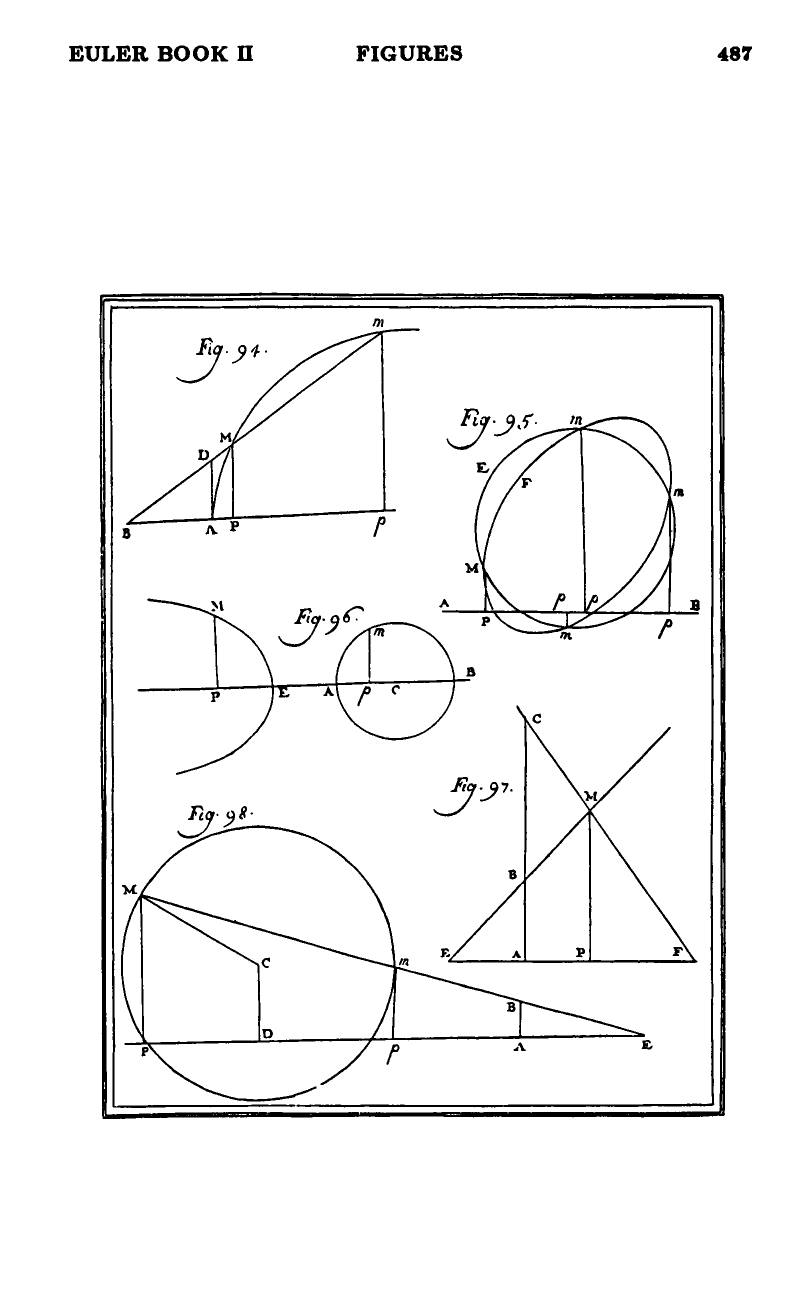 Figures 94–98
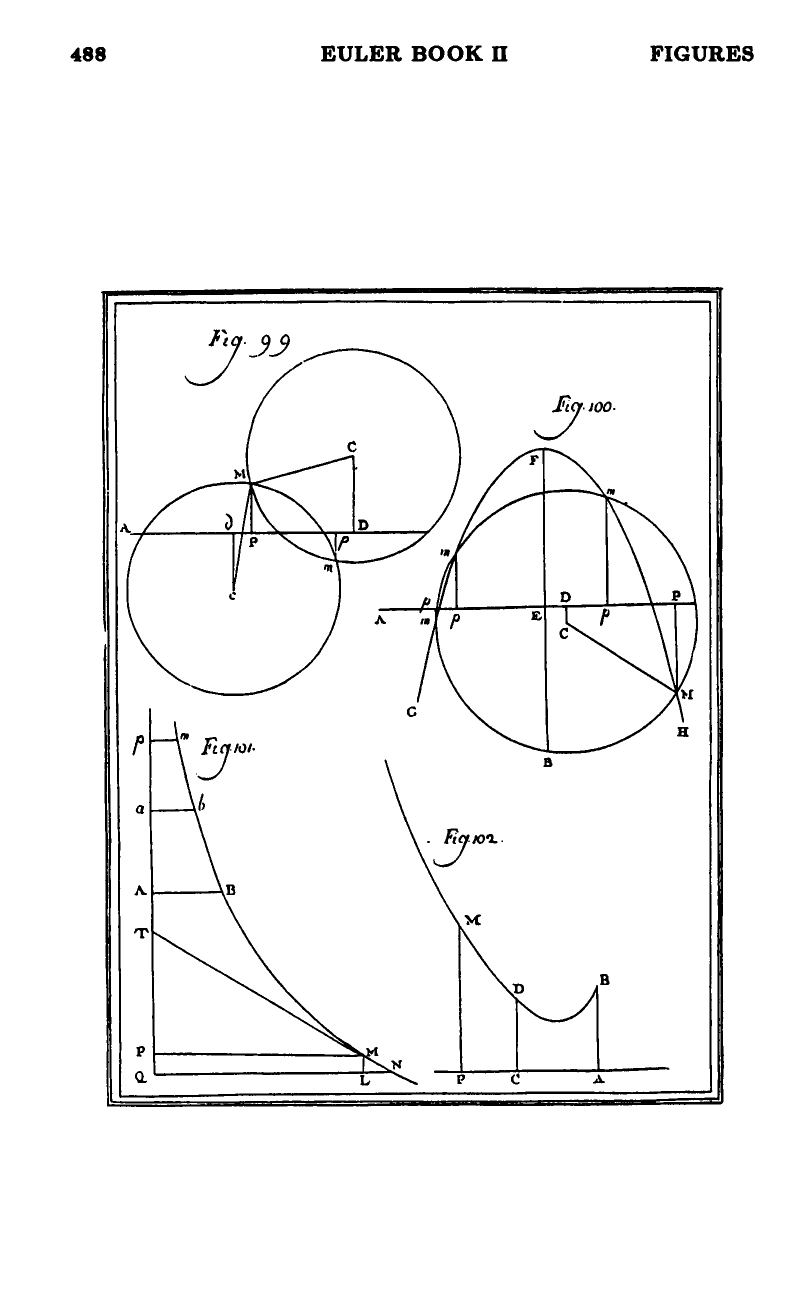 Figures 99–102
Related pages
- construction-of-equations
- quadratic-by-line-and-circle
- quadratic-by-two-circles
- biquadratic-by-circle-and-parabola
- intersection-product-degree-bound
- general-construction-by-parabola-and-conic
- chapter-19-on-the-intersection-of-curves
- intersection-of-two-curves
- complex-intersections
- elimination-of-ordinate
- line-curve-intersection-bound
- classification-of-conics
- parabola