Intersection Product Degree Bound
Summary: Two algebraic curves of orders and meet in at most points (§§496–498). Euler establishes the bound case by case — two conics (), conic and cubic (), two cubics (), two quartics () — both by algebraic elimination and by the geometric argument that a curve of order decomposes (as a complex curve) into straight lines, each of which meets the other curve in at most points. The bound governs how to factor a target equation degree for a construction: pick if possible, otherwise a slightly larger product with simpler factors.
Sources: chapter20 (§§496–498).
Last updated: 2026-05-12.
The general statement (§498)
Two curves of orders and have at most intersection points.
Euler’s bound is the real, affine, multiplicity-free shadow of what becomes Bézout’s theorem in projective complex geometry: there the count is exactly , including multiplicities and points at infinity over . The chapter-19 phenomenon of complex-intersections is the difference between Euler’s bound and Bézout’s equality.
Two derivations
Algebraic, via elimination
For two equations of -degrees and with all-degree- in , the eliminant from §§474–482 is a polynomial in of degree at most :
-
Two conics (). Write each as and with quadratic in , linear, constant. The eliminant of §479 has -degree at most 4. So two conics meet in at most 4 points (§496).
-
Conic and cubic (). Write one as and the other as with quadratic, linear, constant, cubic, quadratic, linear, constant. The §480 eliminant is sixth degree (§497).
-
Two cubics (). The §481 eliminant has degree 9.
-
Two quartics (). The §482 cascade gives degree 16.
Geometric, via complex-curve decomposition
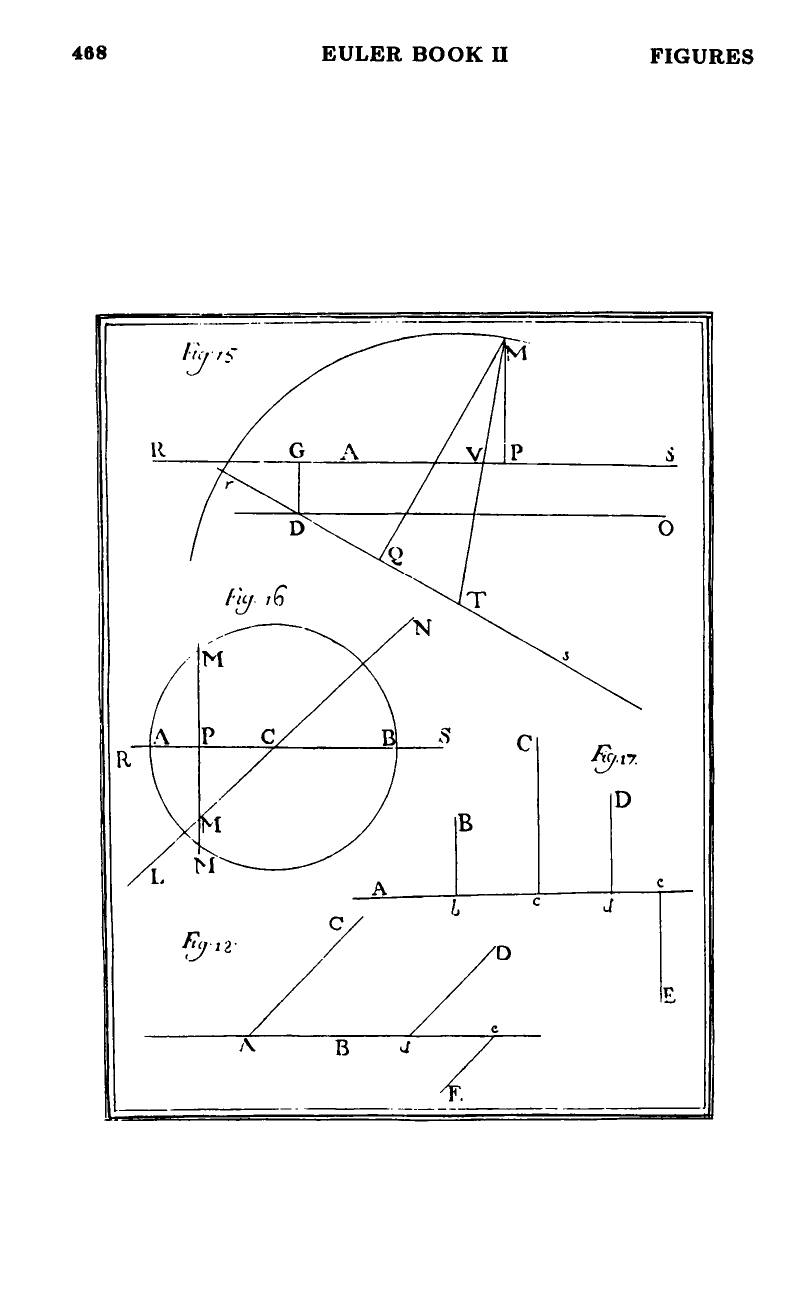
A second-order curve can be a complex curve — two straight lines (figure 16, §63). A straight line meets a curve of order in at most points (line-curve-intersection-bound); two lines, taken together as a degenerate “second-order curve,” meet a curve of order in at most points. Hence two conics (one of them possibly the degenerate two-line curve, by continuity argument) meet in at most points (§496).
Same argument for higher orders: a degenerate order- curve is a union of lines, each meeting an order- curve in at most points, so the total is . By continuity, the generic case is also bounded by .
Cumulative table
| Bound | Eliminant in §§ | Notes | |
|---|---|---|---|
| line substitution | line-curve-intersection-bound (chapter 4) | ||
| §479 | two conics — exactly the quartic case | ||
| §480 | conic ∩ cubic | ||
| §481 | two cubics | ||
| §482 | two quartics | ||
| by induction | general |
Choosing factors for a target degree
To construct an equation of degree , choose with — or, if is prime or has only awkward factorizations, and discard the excess intersections:
- factors as or or , etc. Two curves of order 10 each is one choice; one of order 5 plus one of order 20 is another.
- — the factor 13 is awkward (cubic-genera enumeration in chapter 9, quartic genera in chapter 11 — order-13 curves are unenumerated and visually intractable). Euler suggests instead choosing with : two curves of orders 6 and 7 give 42 intersections, three of which are spurious roots () that can be discarded.
- prime. Choose for the smallest giving a convenient factorization.
The general principle: lower-order curves are visually simpler and the genera (cubic species in chapter 9, quartic genera in chapter 11) are catalogued. So is a simpler construction than for , even though the latter is exact: an order-13 curve is harder to draw than an order-7 curve.
Connection to chapter 19
Chapter 19 set up the elimination tables without explicitly stating the bound: it focused on the procedure and on complex intersections. Chapter 20 names the bound, gives the geometric proof via complex-curve degeneration, and packages the result for use in construction problems.
Figures
 Figures 15–18