Circle Trisection by Two Chords
Summary: Problem V of chapter 22 (§535, figure 115). From a point on the unit circle, draw two chords and that together cut the disk into three equal-area pieces. The defining equation reduces via to , which false-position-method solves at .
Sources: chapter22, §535. Figure 115 (figures115-118 p. 493).
Last updated: 2026-05-12.
Setup
Generalize the bisecting-by-a-chord trick of Problem IV (equal-area-bisection-problems). Draw two chords and from a common point on the circumference. The picture is symmetric: by symmetry , and the chord-cut region (segments equal). We want each segment to be one-third of the disk.
Let radius = 1, so the disk has area and each segment should have area . With arc ,
Setting this to :
Reduction
Substitute , then — Euler writes it cleanly: (using ). The equation becomes
This is not Problem I in disguise. The unknown sits on both sides, but inside a sine on the right, with a fixed-angle offset. So a fresh false-position computation is needed.
False position
Existence: is less than (otherwise but makes LHS bigger). Try :
So is between and , much closer to . Refining at gives error ; combined with the error of the proportion , so .
Minutes-level pass at and refines to exactly.
Final.
with the remaining arc and chord length .
Geometric reading
The total circle gets cut into three regions:
- Segment , area , subtended arc .
- Segment , identical to (1) by symmetry.
- The lens -and-two-chords in the middle, area , containing the arc of and the triangle .
Region 3 deserves a check: its area is the whole circle minus the two segments, , as required. ✓
Why no reduction to Problem I
Problems III and IV (see equal-area-bisection-problems) reduced to because their equations had the form ” minus a sine = a multiple of or ,” and a shift converts into . Problem V has the form ”,” and a shift converts into — not a cosine of . So a fresh numerical solution is required.
Figures
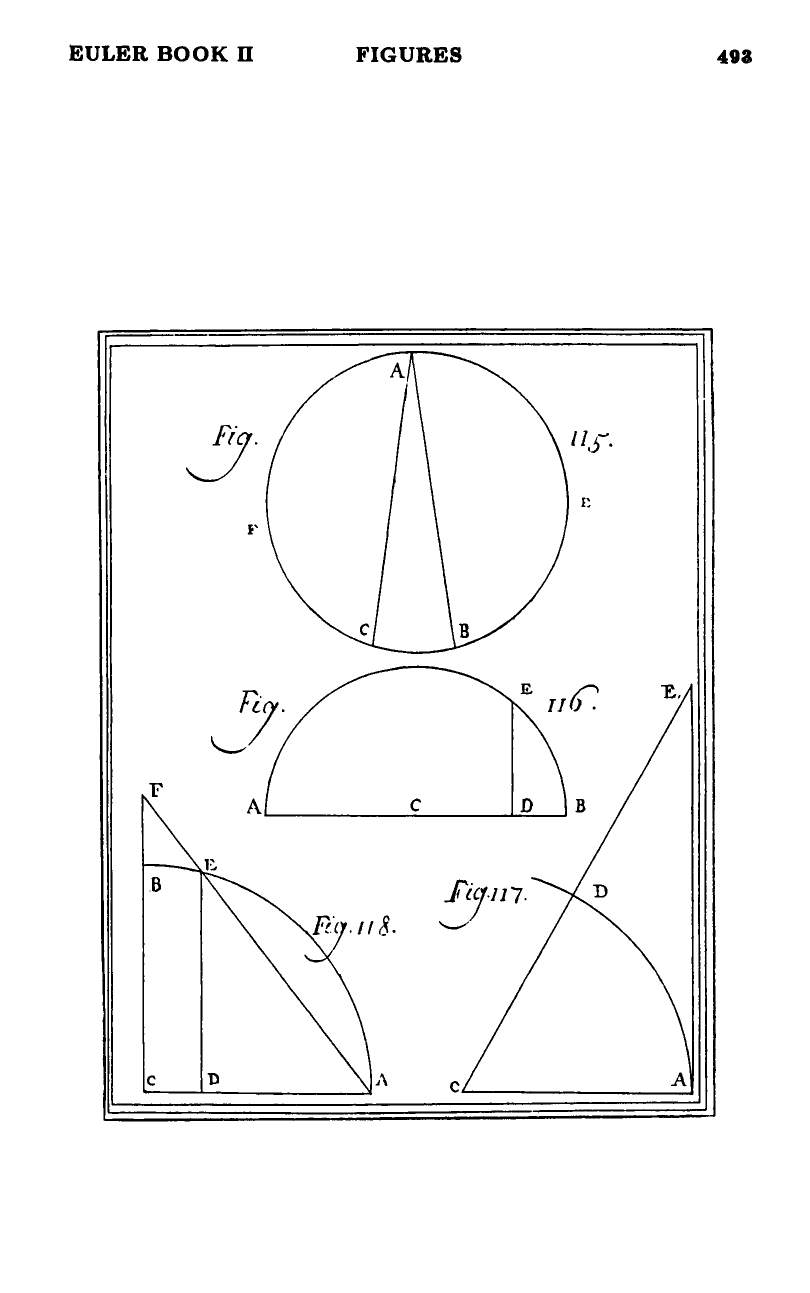 Figures 115–118
Related pages
- chapter-22-on-the-solution-to-several-problems-pertaining-to-the-circle — context.
- false-position-method — algorithm.
- equal-area-bisection-problems — Problem IV (, the two-piece analogue).