Equal-Area Bisection Problems
Summary: Three chapter-22 problems (II, III, IV) that all ask for a straight cut bisecting a curved region into two equal areas: a chord that bisects its sector (figure 112), an ordinate that bisects a quadrant (figure 113), and a chord through one end of a semicircle that bisects it (figure 114). Problems III and IV reduce to arc-equals-cosine; Problem II yields a fresh constant .
Sources: chapter22, §§532–534. Figures 112 (figures111-114 p. 492), 113 (same), 114 (same).
Last updated: 2026-05-12.
Problem II — chord bisects sector (§532, figure 112)
Setup. Sector of a unit circle is split by chord into the triangle and the segment . If is small the triangle dominates; if it is obtuse the segment does. Continuity gives an intermediate angle where the two pieces are equal.
Let , arc , so half-arc . Drop the perpendicular to the chord. With on the chord,
while the sector has area (because radius = 1). Setting sector = triangle:
Existence. rises above near (where ) and falls below it as (where ). Euler notes immediately.
False position. Three passes:
- Degrees: → between and ; proportion , suggesting .
- Minutes: (i.e., ) refines to .
- Seconds with high-precision logs ( vs ): .
Final.
with , chord , .
This is the most precise numerical answer in the chapter — six sexagesimal digits past the degree. Modern readers can recognize as roughly the chord-of-the-equal-bisecting-cut angle that appears in problems on “lunes” since antiquity.
Problem III — ordinate bisects quadrant (§533, figure 113)
Setup. Quadrant of radius 1. An ordinate from inside divides it into a region (under arc and below ordinate) and the rest. Find that makes the two regions equal.
With arc and , :
Doubled, set equal to the quadrant :
Reduction to Problem I. Substitute , then and :
This is exactly arc-equals-cosine in the doubled variable , so , giving
with arc and , , . The half-radius ordinate that bisects a quadrant is .
Aside. Repeating the construction on each half quadrant divides the whole circle into eight pieces of equal area (§533 closing).
Problem IV — chord bisects semicircle (§534, figure 114)
Setup. Semicircle of radius 1; from , draw a chord that cuts the semicircle into two equal regions.
With arc and the radius drawn,
so the segment between chord and arc is -region , equated to half the semicircle :
Reduction to Problem I. Substitute , then :
So and . The angle , complement , chord .
Geometric remark
In all three problems the unknown is an arc, but the equation is a transcendental balance between an arc (linear in , contributed by sector area ) and a trigonometric quantity (contributed by triangle area ). This is exactly the kind of equation Euler hopes might collapse into algebraic form if the trig value were lucky — see quadrature-commensurability-remark.
Across the three problems the reduction map is:
| Problem | Equation | Substitution | Reduces to |
|---|---|---|---|
| II | none (new constant) | — | |
| III | , then double | ||
| IV |
Two of three become Problem I; Problem II requires fresh false-position work because the linear and trigonometric parts don’t separate as cleanly.
Figures
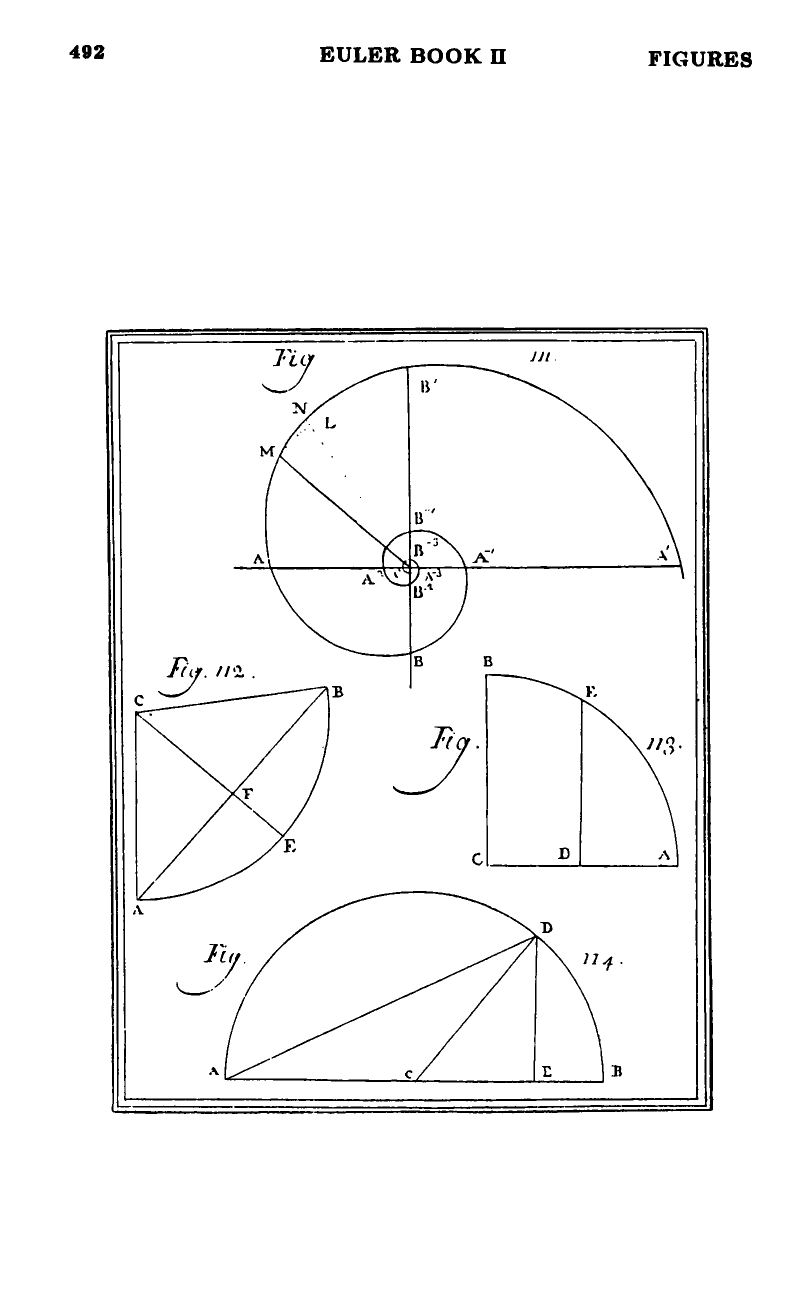 Figures 111–114
Related pages
- chapter-22-on-the-solution-to-several-problems-pertaining-to-the-circle — context.
- arc-equals-cosine — the master Problem I that III and IV reduce to.
- false-position-method — the technique used in Problem II.
- quadrature-commensurability-remark — why Euler cares.