Non-Planar Curves by Projection
Summary: §§131–136 of the Appendix on Surfaces. A non-planar (skew) curve in space requires three coordinates and cannot be captured by a single equation — it needs two equations in , each defining a surface and the curve being their intersection. The standard analytic tool is the projection onto a coordinate plane: eliminate one variable to get a 2D equation in the remaining two, which describes the foot of the perpendicular dropped from each curve point. Two projections suffice to reconstruct the curve.
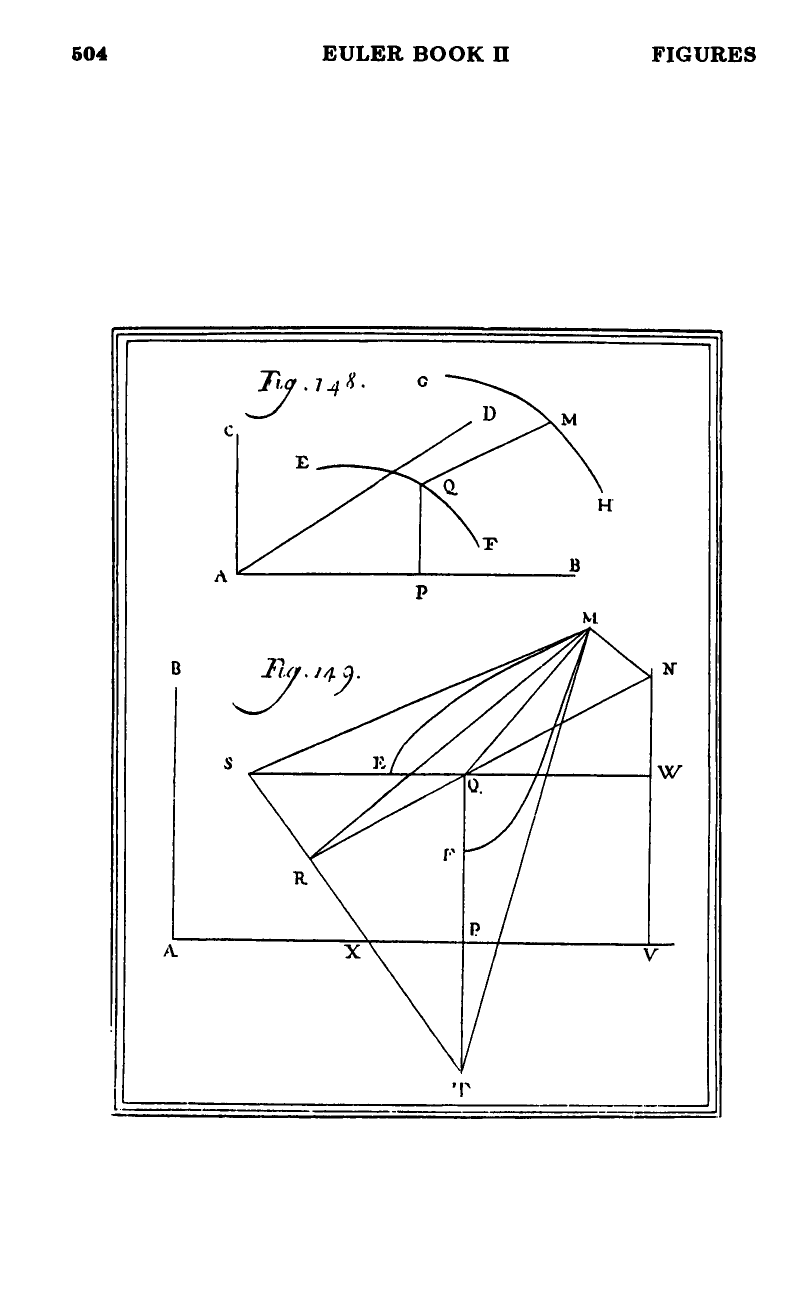
Sources: appendix6, §§131–136. Figure 148 in figures148-149.
Last updated: 2026-05-12.
§131–132 — Why one equation is not enough
A single equation in gives a surface (a 2D locus). To pin down a curve (a 1D locus), one needs two equations: each fixes a surface, and the curve is where they meet.
One equation in the three coordinates is not sufficient… For this reason, two equations are required, so that if some value is assigned to one of the variables, the other two will be determined. (source: appendix6, §132)
§§133–134 — Projecting a curve (figure 148)
Setup (figure 148): three perpendicular axes define three coordinate planes. Curve in space. From each point on the curve, drop plane . The foot has 2D coordinates in the plane — call them .
If the curve is given by two equations , eliminating between them gives an equation — the equation of the projection in plane .
§135 — Reconstructing the curve from two projections
The single projection is not sufficient to know the curve . However, if we also know, for each point , the perpendicular , then from the projection we can easily construct the curve . (source: appendix6, §135)
To recover the space curve we need:
- The projection equation (where the curve sits in the -plane),
- One additional piece of information: either the equation in (projection onto ), or in (projection onto ), or a single relation involving in addition to .
Two of the three coordinate-plane projections together determine the curve completely.
§136 — Each pair of equations expresses different things
The equation in and expresses the projection of the curve onto the plane , the equation in and expresses the projection onto the plane , and the equation in the three variables expresses the surface on which the curve lies. (source: appendix6, §136)
So the original two equations of the curve each define a surface containing it; eliminating one variable at a time gives the three projections. Algebraically: from two equations in 3 variables, eliminate any single variable → equation in the other two. Three choices of variable to eliminate, three projections.
Modern reading: implicit space curves
In modern terms, a non-planar curve is the transverse intersection of two surfaces. The projection is the result of the elimination ideal . Two projections (onto distinct coordinate planes) generically suffice because the space curve is locally a graph over its projection plus discrete branch points.
Cross-references
- Generalizes intersection-of-two-curves (Book II Chapter 19) from plane intersections to space intersections.
- The projection is computed by the same elimination procedure as in elimination-of-ordinate §§474–482 — but applied to 3-variable systems.
- The pair is a precursor to modern parametric/implicit duality for space curves.
Figures
 Figures 148–149