Oblique-Plane Section Method
Summary: §§47–50 (and again §§84–85) of the Appendix on Surfaces. The master substitution that converts a surface equation into the equation of its section by any plane. Two warm-ups (figures 128, 129) build to the full three-parameter rigid-motion substitution involving the perpendicular distance of the cutting plane from the axis, the angle the trace makes with the axis, and the inclination of the cutting plane to the base plane . Algebraic surfaces have algebraic sections, of equal or lower total degree (§50). This is the surface-level analogue of coordinate-transformations and underwrites the §51 universal-quadric-section theorem and every worked section in appendix-3-on-sections-of-cylinders-cones-and-spheres.
Sources: appendix2, §§47–50. Repetition with figure 139 in appendix3, §§84–85. Figures 128, 129 in figures128-130. Figure 139 in figures138-141.
Last updated: 2026-05-12.
§47 — The plan
We refer all sections of a surface to the base plane . Any other plane either is parallel to (in which case substitute const, §29), or meets in a straight line. The latter case admits three sub-cases by the position of that intersection line:
- Parallel to one of the principal axes or — §48;
- General position — §§49–50;
- Through the origin — section through an axis, §46.
The three sub-cases are unified by adding more rotations and translations.
§48 — Cutting line parallel to the axis (figure 128)
The cutting plane meets the base plane in the straight line , with . The plane is inclined to at angle . Take as the abscissa of the section, as the ordinate.
Then
From the inclination angle ,
so . Substituting
into the surface equation gives the section equation in .
§§49–50 — General oblique cutting plane (figure 129)
Let the cutting plane meet in the line , with , , and angle . The plane is inclined to at . Coordinates in the section plane: (along the trace), (perpendicular within the cutting plane).
Drop within . By the chain of perpendiculars (figure 129):
Combining,
Substitute these for in the surface equation to obtain the equation of the section in (source: appendix2, §49).
§50 — Algebraic sections of algebraic surfaces
If the equation for the solid is an algebraic equation in the three coordinates , then all of its sections will also be algebraic. Furthermore, since the equation for the section in the coordinates and is obtained by substituting in the equation for the solid [the formulas above], it is clear that the variables and cannot appear with a total degree higher than the total degree of the original equation in . It can happen, however, that the equation for a section may have a smaller total degree due to cancellations after the substitutions. (source: appendix2, §50)
The total degree is preserved or dropped, never increased — the surface analogue of the degree-invariance theorem for plane curves.
§§84–85 — Repetition in chapter 3 with figure 139
Chapter 3 closes the appendix with a re-derivation of the same algorithm for the general arbitrary section (source: appendix3, §§84–85). With , , and the inclination of the cutting plane to the base:
(The sign conventions differ slightly from §49 — the placement of the perpendicular relative to the origin moves between the two figures — but the structure is identical.)
This method is almost the same as that which we used before in section 50. (source: appendix3, §85)
Cross-references
- Two-dimensional analogue: coordinate-transformations (Chapter 2 §§25–34) provides the rotation+translation substitutions for plane curves.
- §50 algebraic-section-of-algebraic-surface invariance lifts degree-invariance one dimension up.
- The §51 universal-quadric-section theorem in general-quadric-surface is the first immediate corollary.
- Worked applications: every section computed in cylinder-sections, cone-sections, sphere-sections reduces to a specific instance of this substitution.
Figures
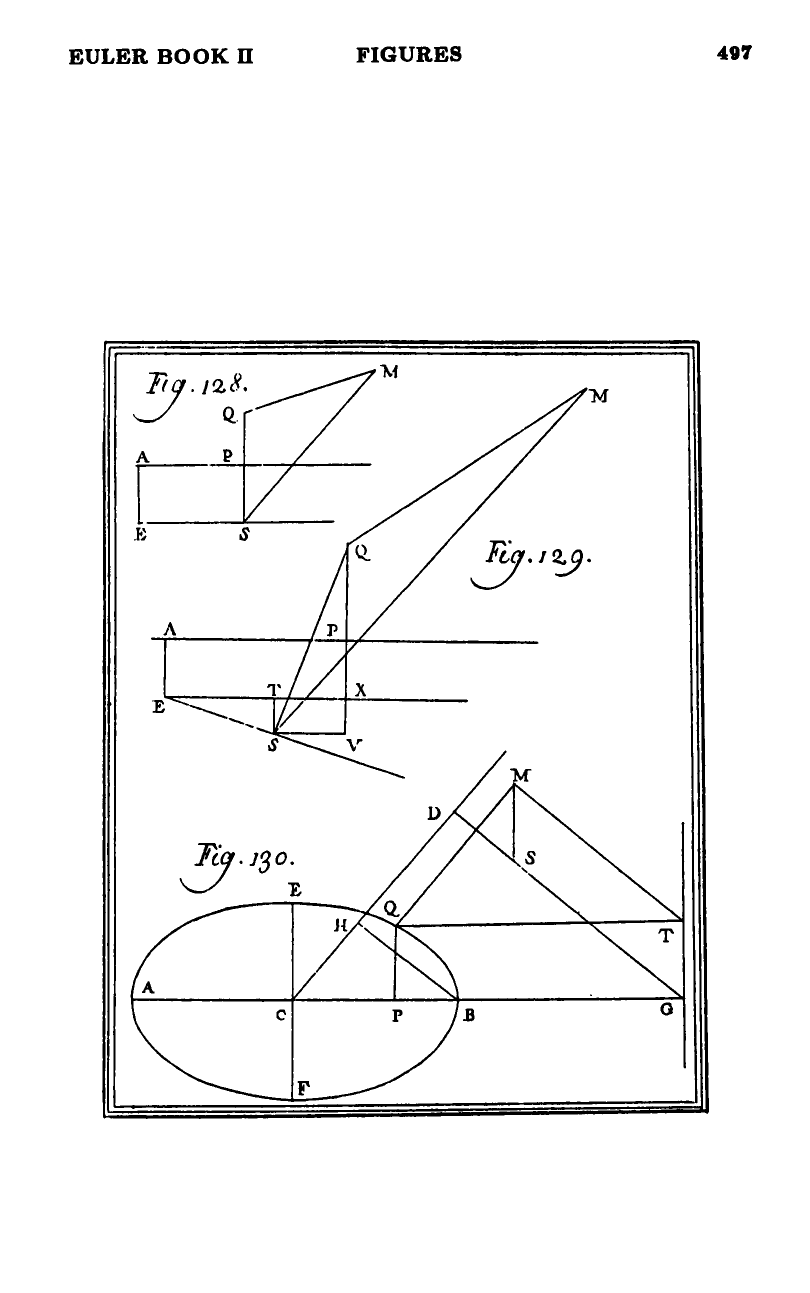 Figures 128–130
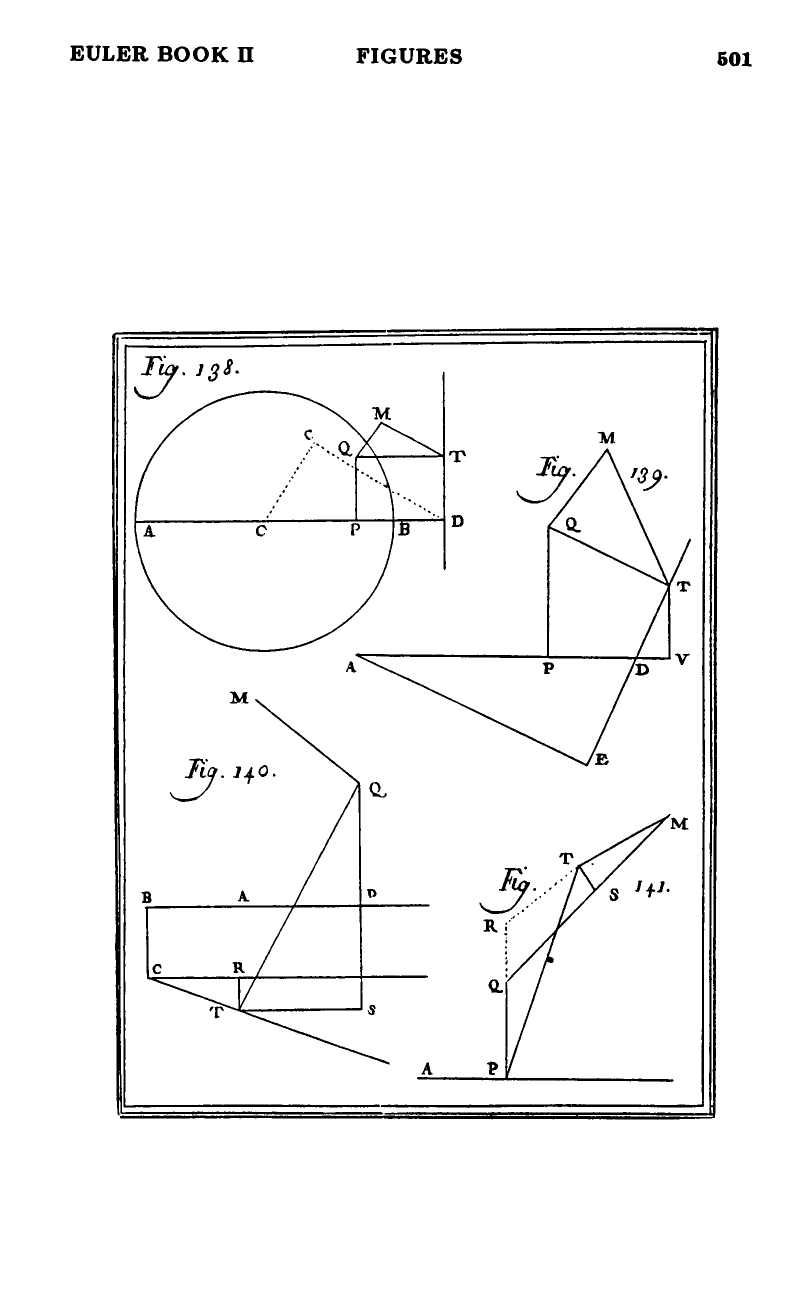 Figures 138–141