Quadratic by Two Circles
Summary: An alternative construction for the general quadratic via the intersection of two circles (§492, figure 99). The subtraction of the two circle equations is linear, so the eliminant is again quadratic in . Euler treats this as an aside — line-plus-circle (see quadratic-by-line-and-circle) is the preferred construction because it has fewer free parameters and the degree bound of two circles () is wasted on a quadratic.
Sources: chapter20 (§492); figure 99 in figures99-102.
Last updated: 2026-05-12.
Setup (§492, figure 99)
Two circles in the same coordinate system. The first has center at with and radius ; the second has center at (lowercase) with (with below the axis in the figure) and radius . Writing :
Elimination
Subtracting eliminates the quadratic terms in and :
So
which is the radical axis of the two circles — a straight line. From together with this linear relation, is eliminated to give
a quadratic in whose roots are the abscissas of the two intersection points .
The full expanded eliminant (Euler’s §492):
&\bigl(4(a - f)^2 + 4(b + g)^2\bigr)z^2 \\ &\quad + \bigl(4(a - f)(c^2 - h^2) - 4(a + f)(b + g)^2 - 4(a - f)(a^2 - f^2)\bigr)z \\ &\quad + (b + g)^4 + 2(a^2 - c^2)(b + g)^2 + 2(f^2 - h^2)(b + g)^2 + (a^2 - c^2 - f^2 + h^2)^2 = 0. \end{aligned}$$ ## Why Euler relegates this to an aside Three observations: 1. The eliminant is genuinely quadratic — two circles cannot meet in more than 2 points — so the degree is *not* the joint bound $2 \times 2 = 4$. The eliminant carries no extra information beyond what the line-circle eliminant carries. 2. There are six free constants ($a, b, c, f, g, h$), three more than the line-circle setup needs. So matching to a given $Az^2 + Bz + C = 0$ leaves "an infinite number of ways" but no canonical normalization. 3. Quadratics need to be matched to *any* line-and-circle intersection by [[quadratic-by-line-and-circle|§§489–491]], which Euler has already given in canonical form (one of the two curves is the axis itself when $b = g = 0$). The two-circle construction is harder to describe and conveys no extra power. > "Since the same quadratic equation can be interpreted as the intersection of a straight line and a circle, this is the preferred interpretation, rather than two circles." (§492) ## Hard ceiling: only quadratics The construction is *fundamentally* limited to quadratics. Two circles cannot meet in more than 2 points, so no cubic or higher equation can be matched this way. To realize a quartic, Euler must move to a circle and a parabola — see [[biquadratic-by-circle-and-parabola]]. ## Figures <!-- figures: auto-embedded --> 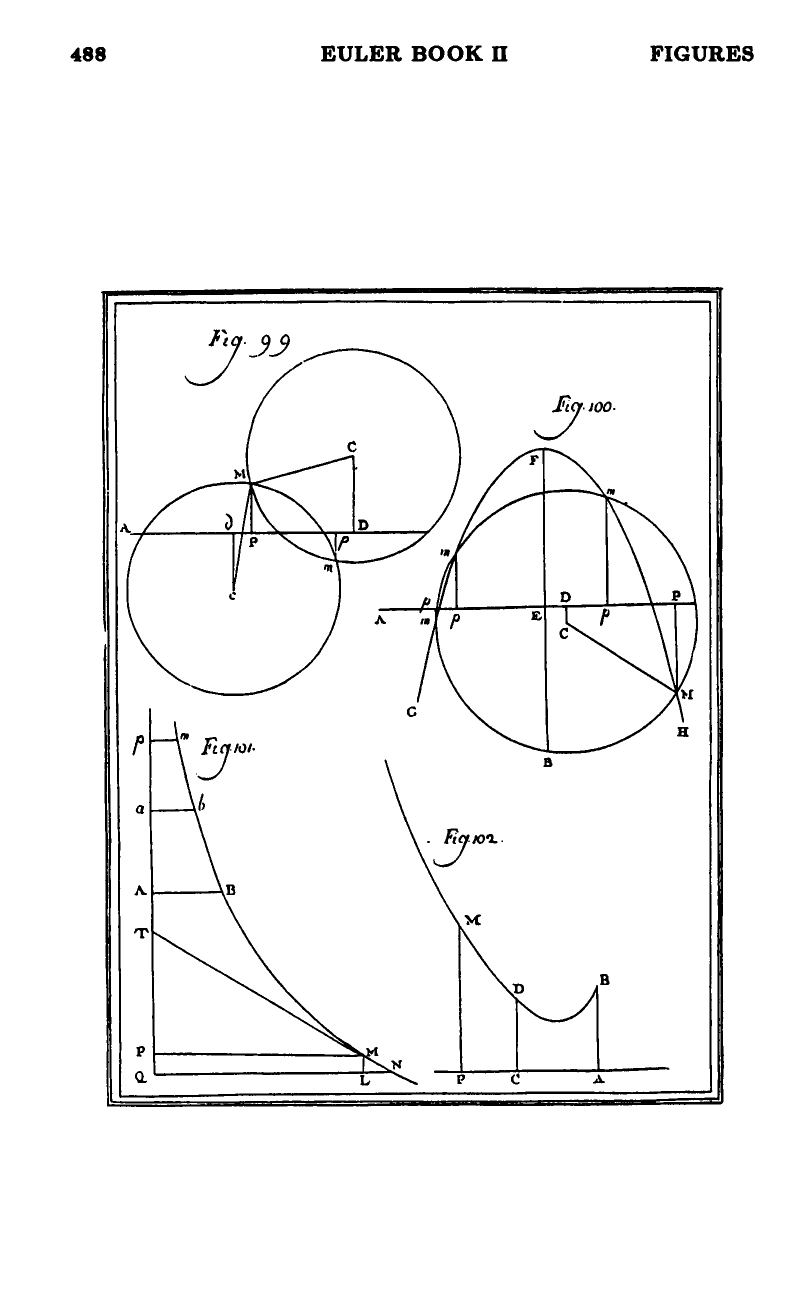 *Figures 99–102* ## Related pages - [[construction-of-equations]] - [[chapter-20-on-the-construction-of-equations]] - [[quadratic-by-line-and-circle]] - [[biquadratic-by-circle-and-parabola]] - [[intersection-product-degree-bound]]