Quadratic by Line and Circle
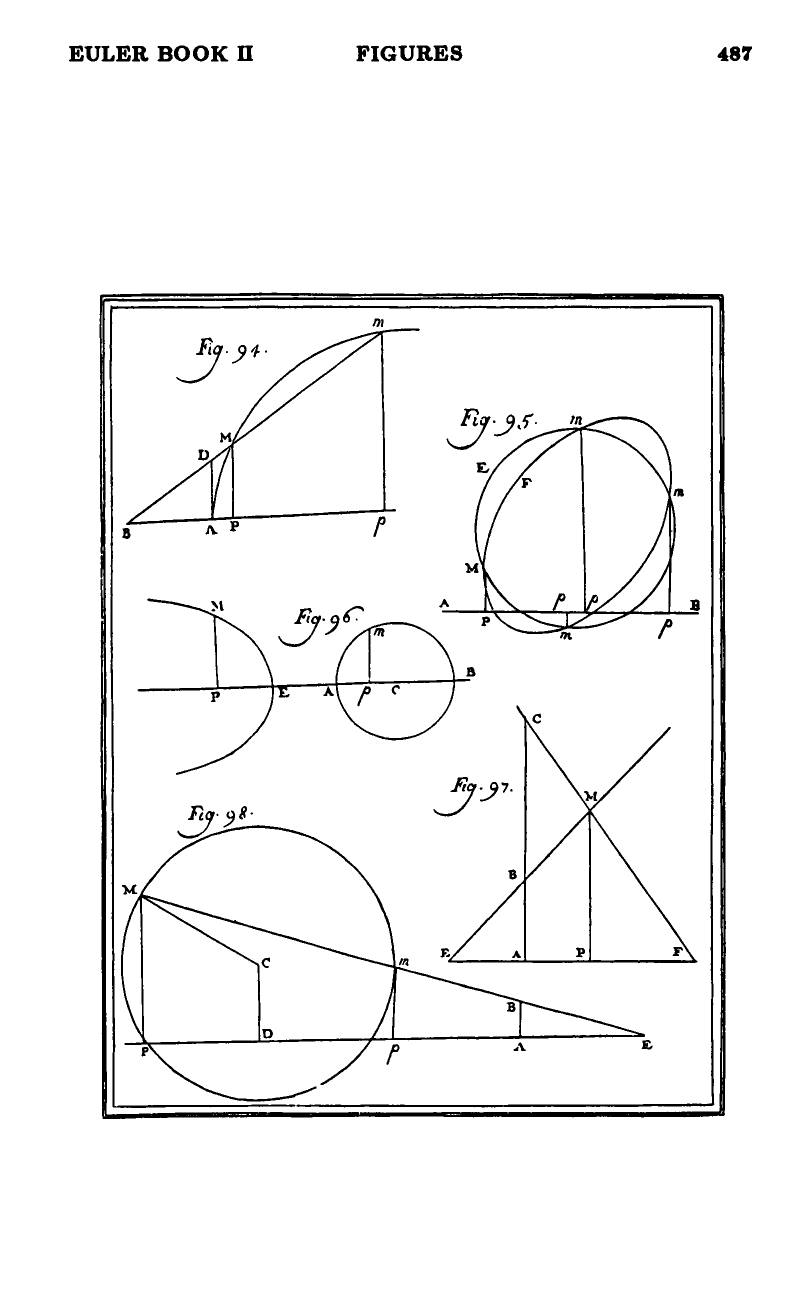
Summary: Construction of linear and quadratic equations as intersections of low-order curves. A linear equation is realized by two crossing lines (§488, figure 97); the general quadratic is realized by the intersection of a straight line and a circle (§§489–491, figure 98), and the simplest case reduces it to a circle on the axis with center at — geometric form of the quadratic formula.
Sources: chapter20 (§§488–491); figures 97, 98 in figures94-98.
Last updated: 2026-05-12.
Linear case: two lines (§488, figure 97)
Take the two lines and meeting at . Let the axis be with origin ; erect the perpendicular at , where lies on the first line and on the second. Write
Similar triangles give the two line equations:
Eliminating by yields
Any linear equation can be brought into this form by suitable choice of , so every linear equation admits a two-line construction.
Quadratic by line and circle (§489, figure 98)
Replace the second line by a circle. Keep as before (so the line is , i.e., ); drop the perpendicular from the circle’s center to the axis and let , radius . The circle’s equation is
Substituting and clearing denominators,
The two roots are the abscissas of the two intersection points and of the line and circle, perpendiculars to the axis from which give and .
Matching a general quadratic (§490)
To match the general , multiply through by and equate the coefficients of the resulting equation with the line-circle eliminant:
- coefficient of : , giving
- constant term:
Solving for :
Three free parameters remain; they must be chosen so the radicand is positive (otherwise is complex and the construction fails).
Simplest form: (§491)
Setting (the line coincides with the axis itself) collapses the construction. Then and . The radicand is positive iff , which is exactly the condition for to have real roots.
The most natural choice is to make as well, putting the center on the axis at :
The two intersections of this circle with the axis are the two roots — this is exactly the quadratic-formula picture.
Removing the square root from the construction
To avoid having to construct as a separate length, Euler introduces a free parameter via and solves for :
The most convenient choice is , giving
Center above at height , radius equal to the sum — no square root needed.
Status of the quadratic construction
By the [[intersection-product-degree-bound| bound]] a line and a circle meet in at most points, exactly matching the two roots of the quadratic. The alternative quadratic-by-two-circles (§492) construction also has joint intersection bound — but since two circles meet in at most points generically, it also fits the quadratic; Euler prefers the line+circle form because it has fewer free parameters and the parameters are more directly interpretable.
Figures
 Figures 94–98