Three Rectilinear Asymptotes of a Third Order Line
Summary: When a cubic has three rectilinear asymptotes (case 2 of cubic-species-classification), the asymptotes share the principal cubic member with the curve, so the same sum-of-roots formula applies to both. For any chord cutting curve at and asymptotes at , the curve-to-asymptote intervals satisfy (§§248–249, figure 46) — two branches converge from one side, the third from the other; figure 47 (with all three on the same side) is therefore impossible (§250). The species rates of convergence interact with this rule: a single asymptote cannot coexist with two faster asymptotes (§§251–252), and similar exclusions extend to higher-order curves.
Sources: chapter10 (§§248–252); figures 46, 47 in figures44-46 and figures47-50.
Last updated: 2026-05-02.
Curve and asymptotes share the principal member (§248)
A cubic with three rectilinear asymptotes , , would coincide with those three lines if its equation factored into three linear forms — i.e., if all of its non-principal members vanished. Since the asymptotes encode the direction at infinity, and direction is governed by the principal member alone, the equation of the three asymptotes regarded as a (reducible) cubic has the same principal member as the curve.
Writing the curve referred to the axis as the three asymptotes regarded as a single cubic have equation where are determined to make the cubic factor as a product of three linear forms. The principal members agree (the coefficients) and so do the next-highest “second members” ( coefficients via — the coefficients and on the and terms also appear in both equations). The lower-order coefficients differ.
The sum-of-ordinates rule (§249)
For an ordinate at abscissa cutting the curve in and the asymptotes in , the sum-of-roots formula applied to each cubic gives since the two cubics share their highest two terms. Therefore which Euler rewrites as the signs depending on which side of the asymptote each curve branch lies. The takeaway:
If any straight line intersects both the asymptotes and the curve in three points, then the sum of two of the intervals between the curve and the asymptotes it approaches on one side is equal to the third such interval in which the curve is approaching from the other side. (source: chapter10, §249)
Sign distribution: figure 47 ruled out (§250)
If all three branches converged to their asymptotes from the same side, then , , would all carry the same sign and their signed sum could never vanish. Hence figure 47, in which the three intervals , , are all positive, is impossible: in any cubic with three rectilinear asymptotes,
the three branches which approach the asymptotes cannot all approach from the same side, but if two converge from one side, then the third necessarily converges from the other side. (source: chapter10, §250)
Species rates of convergence (§§251–252)
The interval between curve and asymptote at abscissa behaves like for some species (see hyperbolic-and-parabolic-branches). The §249 sum rule must hold even as , which constrains the species combinations:
- A cubic cannot have two asymptotes of species together with one of species . The two faster () intervals would shrink to zero infinitely faster than the slower () one; on a chord pushed to infinity, and would become infinitely smaller than , so .
If two of the branches, and , were of the species , and the third branch of the species , then the intervals and would be infinitely smaller than the interval , so that . (source: chapter10, §251)
This is the §227 / Case-2 impossibility of signature (one + two ) re-derived geometrically.
The same reasoning extends (§252):
In lines of higher order which have the same number of asymptotes as their order, it is impossible for there to be a single asymptote of the species , while the others are of higher species, such as , , etc. If there is one asymptote of the species , then there are necessarily others of the same species. For the same reason, if there is no asymptote of the species , then there cannot be a single asymptote of the species , but there must be at least two of such asymptotes. (source: chapter10, §252)
Therefore in the classification of the species of any higher order, the impossible cases can easily be excluded and in this way some significantly difficult calculations can be avoided. (source: chapter10, §252)
This is one of the few moments where Euler explicitly tells the reader how the cubic theory generalizes to higher orders.
Figures
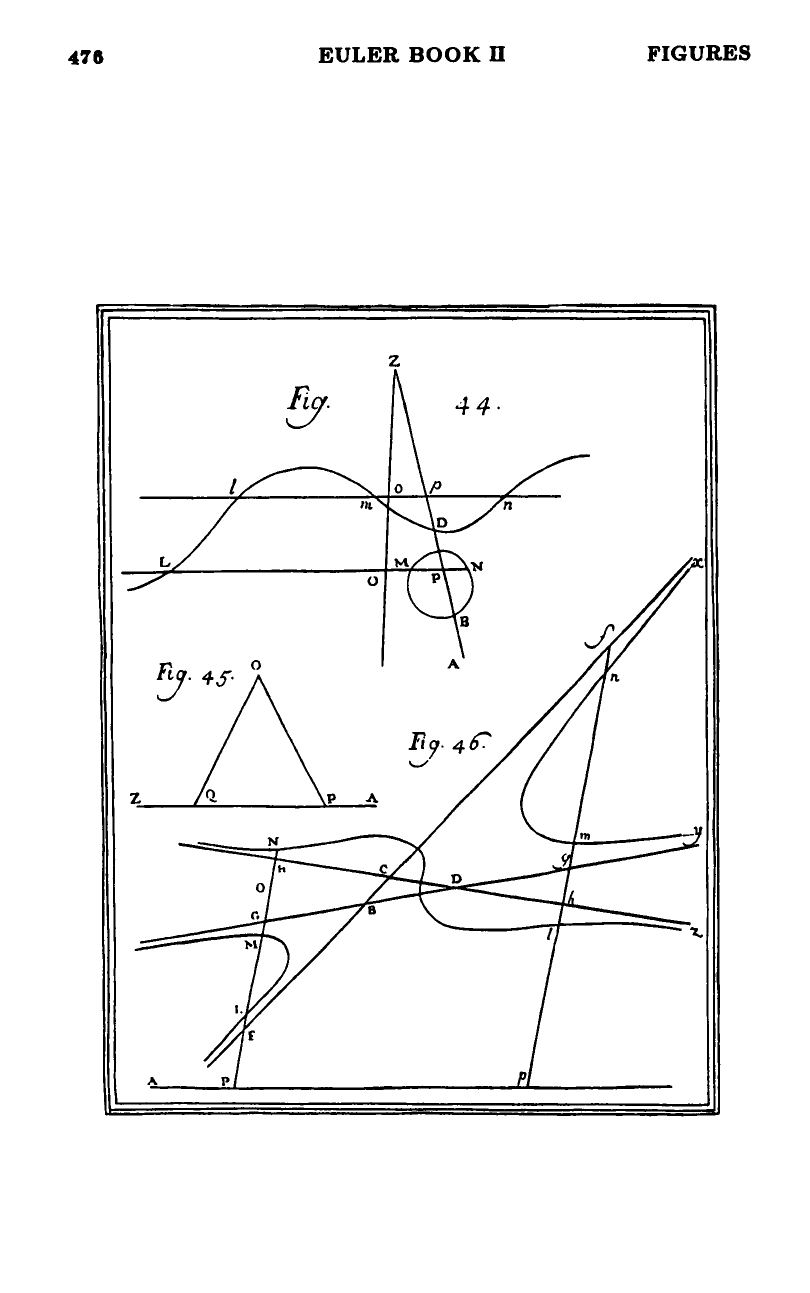 Figures 44–46
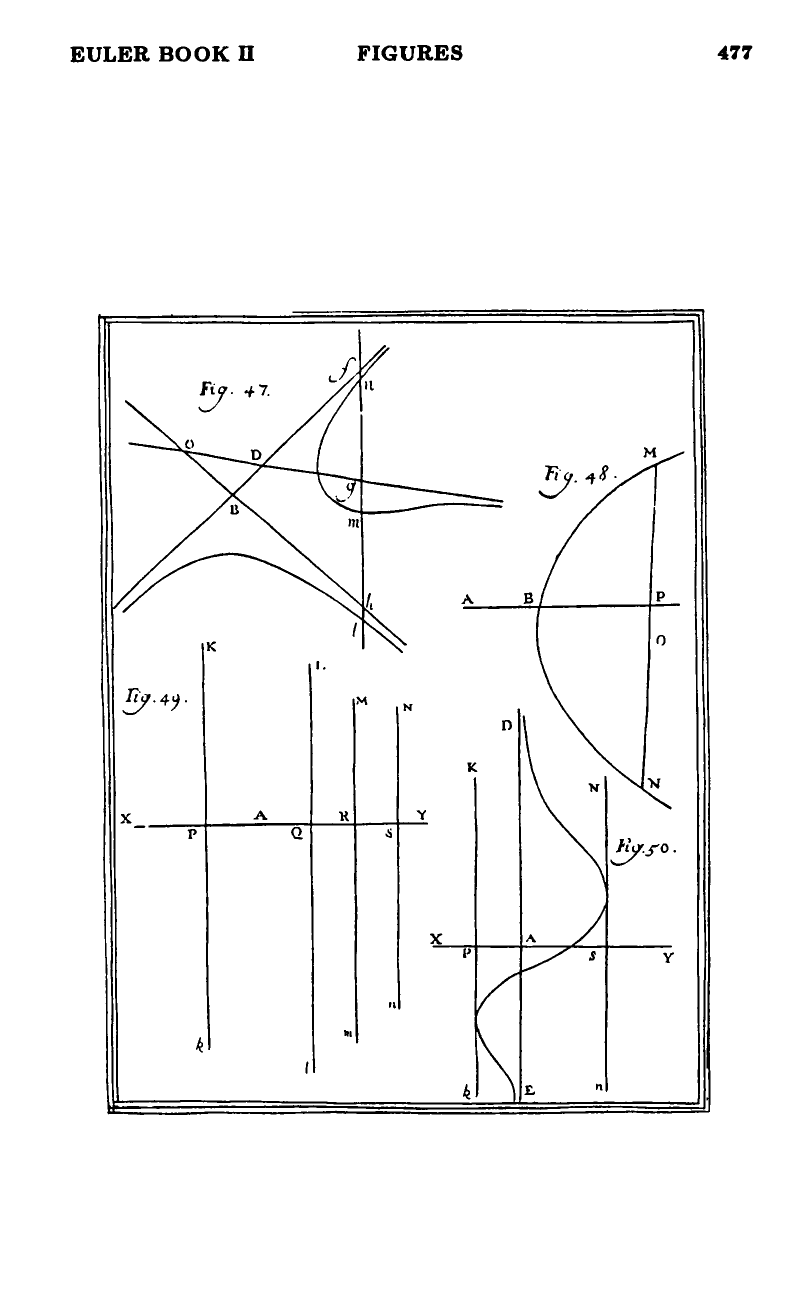 Figures 47–50
Related pages
- chapter-10-on-the-principal-properties-of-third-order-lines
- cubic-species-classification — Case 2 (§§225–227) is the species III/IV/V family with three rectilinear asymptotes.
- hyperbolic-and-parabolic-branches — the catalogue whose rates appear in §§251–252.
- diameter-and-center-of-cubic — uses the same sum-of-roots argument applied to the curve alone.
- asymptotes-of-hyperbola — second-order analogue: the hyperbola’s two asymptotes share the principal member with the curve.