Asymptotes of the Hyperbola
Summary: As the abscissa of a hyperbola grows without bound, the tangent direction approaches a fixed line through the centre with slope . These two lines — never meeting the curve, but coinciding with it at infinity — are the asymptotes, the projective analogue of the parabola’s directrix. Their angle has tangent , becoming a right angle when (the equilateral hyperbola). Taking an asymptote as axis and the parallel to the other as ordinate, the hyperbola has the simple equation . In this frame: any chord parallel to has midpoint on the curve where the tangent meets it, the rectangle between curve and asymptote is constant, and the rectangle between curve and asymptote — Apollonius’s principal asymptotic property — drops out as a one-line algebraic identity.
Sources: chapter6 §§158-165; figures 33-34 (in figures33-34)
Last updated: 2026-04-26
Tangent at infinity (§158)
In the hyperbola equation , the tangent at meets the principal axis at with . As , — the tangent passes through the centre . Its slope is
so in the limit. Erect the perpendicular at with length ; the line extended in both directions never touches the curve, but the curve approaches it as closely as we please. The line on the opposite side behaves the same way for the branches . Such a line is called an asymptote (source: chapter6, §158). The hyperbola has two asymptotes, and , crossing at .
Equilateral hyperbola (§159)
The two asymptotes make angle with the axis, both with tangent . The total angle between them has tangent . When this denominator vanishes, so — the asymptotes are perpendicular. The hyperbola is then called equilateral. In that case , so the foci coincide with the asymptote-perpendicular feet from the centre, and the perpendiculars from a focus to the asymptotes have and .
Constant rectangle on chord-asymptote intervals (§160)
Take an arbitrary chord parallel to the conjugate axis (-axis), extended to meet the asymptotes at . From the asymptote equation :
Then the curve-to-asymptote intercepts are
so
The rectangle on the two intercepts of any chord between the curve and the two asymptotes is the constant (source: chapter6, §160). This is the principal asymptotic property of the hyperbola — Apollonius’s theorem in algebraic form.
Drawing from parallel to one asymptote and along the other, the segments and satisfy
So if one extends from the line parallel to one asymptote and meeting the other at , then and . This is the principal property of the relationship between a hyperbola and its asymptotes (source: chapter6, §160).
Hyperbola in asymptote coordinates: (§161)
Take one asymptote as the axis of abscissas, the centre as origin, and ordinates parallel to the other asymptote. Let , . Then from the previous section , where . So
The hyperbola appears as an inverse-square hyperbola in this oblique frame. As , ; as , — the two asymptotes are the coordinate axes themselves (source: chapter6, §161).
This is the simplest possible equation for the hyperbola, paralleling for the parabola.
Tangent bisection at point of contact (§§161-162)
In the asymptote-coordinate frame, draw a line parallel to an arbitrary line (with also parallel to a chord direction), meeting the curve at and and the two coordinate axes at and . Let and . Setting up similar triangles and substituting into yields the quadratic
whose two roots have sum and product .
Sum of roots equals means , hence (source: chapter6, §162):
The chord and the segment between asymptotes have the same midpoint. When and coincide — i.e. the line is tangent to the curve — the tangent is bisected at the point of contact :
If is tangent to the hyperbola at , then is the midpoint of .
This gives an immediate construction of the tangent at any point : draw parallel to one asymptote, take , then the line through and is tangent at .
The tangent intercepts on the two asymptotes satisfy .
Constant rectangle property in asymptote coordinates (§163)
Since the rectangle depends only on the direction of (through the constant ), not on the position of , the rectangle on the curve-intercepts of any chord parallel to a fixed line is constant. We also have . For the tangent parallel to that direction (where , half the segment between asymptotes is ):
This is a significant property of hyperbolas drawn within their asymptotes (source: chapter6, §163).
Lines crossing both branches (§§164-165)
The hyperbola has two diametrically opposed parts and , so a line may meet not just one branch in two points but rather both branches. With , by the same similar-triangle argument:
The two roots and (the second negative because directed toward the other asymptote) have sum and product . From the sum, and — the chord between the two branches and the segment between the asymptotes still have the same midpoint. From the product:
This rectangle is constant for any line parallel to , regardless of whether the chord stays on one branch or crosses to the other (source: chapter6, §165).
Notable points
- Asymptote = tangent at infinity. Euler’s derivation in §158 makes the geometric content of “asymptote” precise: it is the limit of tangent lines as the point of contact recedes to infinity. This is consistent with the modern projective picture in which the hyperbola, tangent at infinity, and asymptote line all coincide on the line at infinity.
- Coordinate choice eliminates two parameters. In the principal-axes form the hyperbola needs and . In the asymptote frame it needs only — and even that scales out under a hyperbolic rotation . The asymptote frame is the most economical possible coordinatisation of a hyperbola.
- Apollonius’s theorem in two lines. Apollonius’s classical proof of const requires careful case analysis; Euler dispatches it from the equation for the asymptote and the equation of the curve in three lines (§160). This is a paradigmatic example of why Euler thinks analytic geometry has superseded the synthetic tradition.
- Tangent bisection is an asymptote-coordinate phenomenon. The fact that the tangent to a hyperbola is bisected by its asymptote intercepts at the point of contact (§162) follows from — the sum of roots of the quadratic in being independent of the chord position. This is a pure consequence of the form being symmetric under , and it gives the simplest tangent construction known for the hyperbola.
- Same constant across both branches. §165 shows that the rectangle property const holds whether the chord stays on one branch or crosses to the other. This unifies the two branches into a single curve from the point of view of asymptote geometry — no special case for “transverse” vs. “longitudinal” chords. The product changes sign with branch-crossing only because of an oriented-segment convention; the unsigned rectangle is constant.
- Equilateral hyperbola pairs with the circle. The equilateral hyperbola (, perpendicular asymptotes) is the analogue of the circle (, the only ellipse with all radii equal). In modern terms both are the “round” representatives of their respective genera, and both have particularly simple analytic representations: and .
Figures
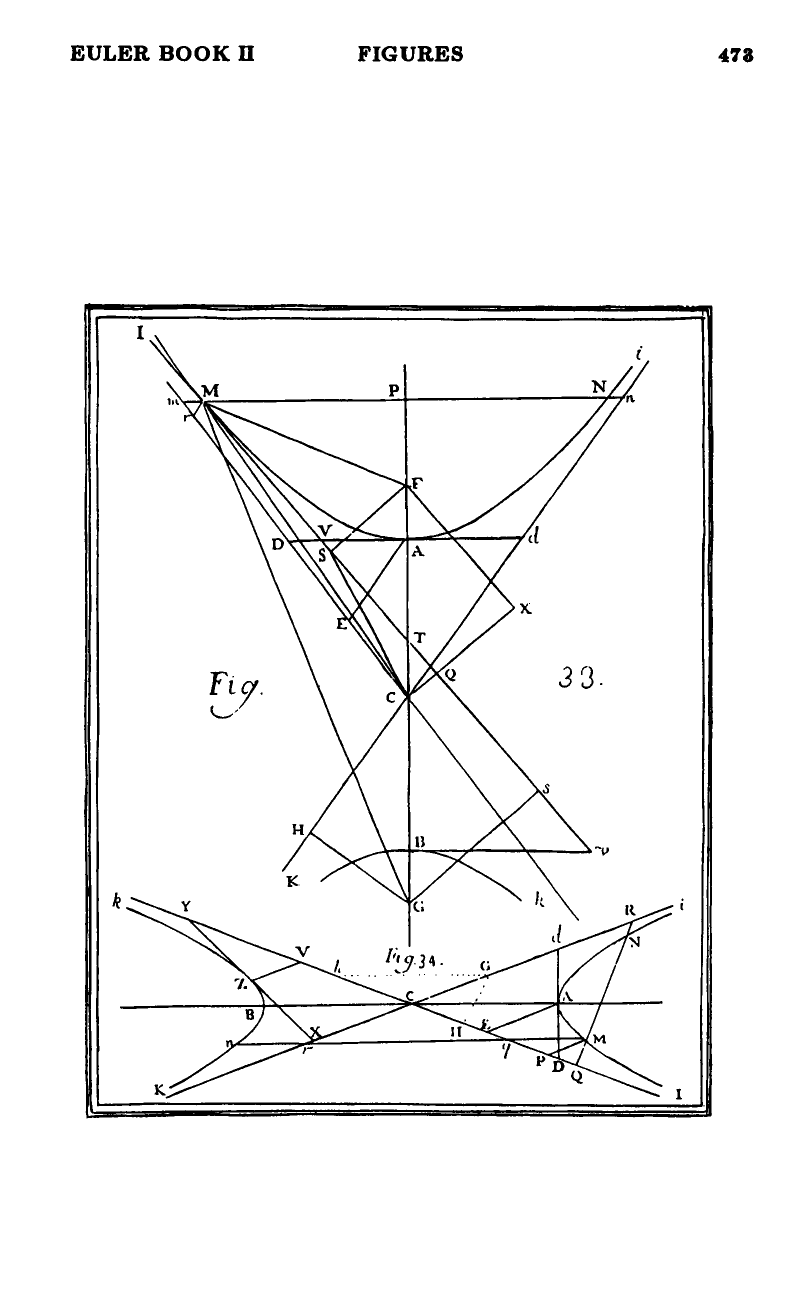 Figures 33–34