Chapter 10: On the Principal Properties of Third Order Lines
Summary: Generalizes the conic-diameter / conic-center / chord-rectangle theorems of chapter 5 to cubics. Vieta on the general cubic gives a “diameter” line of points for which , a chord-product invariant , and a three-asymptote sum rule . A genuine bisecting diameter exists only when the cubic is cut by parallel lines in two points; criteria are derived and applied to the sixteen species. Closes with the simplest oblique-coordinate equation for each species.
Sources: chapter10 (§§239–259); figures 44, 45, 46, 47, 48 in figures44-46 and figures47-50.
Last updated: 2026-05-02.
Program
Just as chapter 5 read the principal properties of conics off the general second-order equation via sum-of-roots, product-of-roots, and tangent limits, chapter 10 does the same for cubics, working from the general equation With , the three ordinate roots at fixed abscissa satisfy
Five strands
§§240–246 — Diameter and center
The sum-of-roots formula yields a generalized diameter: a straight line of points on each chord such that (figure 44). Distinct ordinate angles give distinct diameters; they concur at a single point — the center — only under an algebraic constraint on the coefficients. See diameter-and-center-of-cubic.
§247 — Chord-product invariant
The product-of-roots formula gives the cubic analogue of the conic chord-rectangle property: for parallel chords, the ratio is constant, where are the points where the curve meets the axis. See chord-product-cubic.
§§248–252 — Three rectilinear asymptotes
When a cubic has three rectilinear asymptotes (case 2 of cubic-species-classification), curve and asymptote share the principal cubic member, so the same sum-of-ordinates formula applies to both. The intervals between curve and asymptote on any chord satisfy (two on one side, one on the other). Used to exclude certain species combinations. See three-asymptotes-cubic.
§§253–257 — The genuine bisecting diameter
A cubic intersected by a line in only two points (doubled real factor in the principal member) admits the second-order kind of analysis: midpoints of parallel chords. In general they lie on a hyperbola; on a straight line iff a divisibility condition holds. Algebraic criterion derived in §§255–256, applied species by species in §257. Concludes with: “These properties of diameters were well known to Newton, and for that reason it has been a pleasure to commemorate his work in this place.” See bisecting-diameter-cubic.
§§258–259 — Simplest oblique-coordinate forms
The simplest representative equation for each of the 16 species in oblique coordinates, the cubic counterpart of simplest-cubic-equations. See simplest-oblique-cubic-forms.
Figures
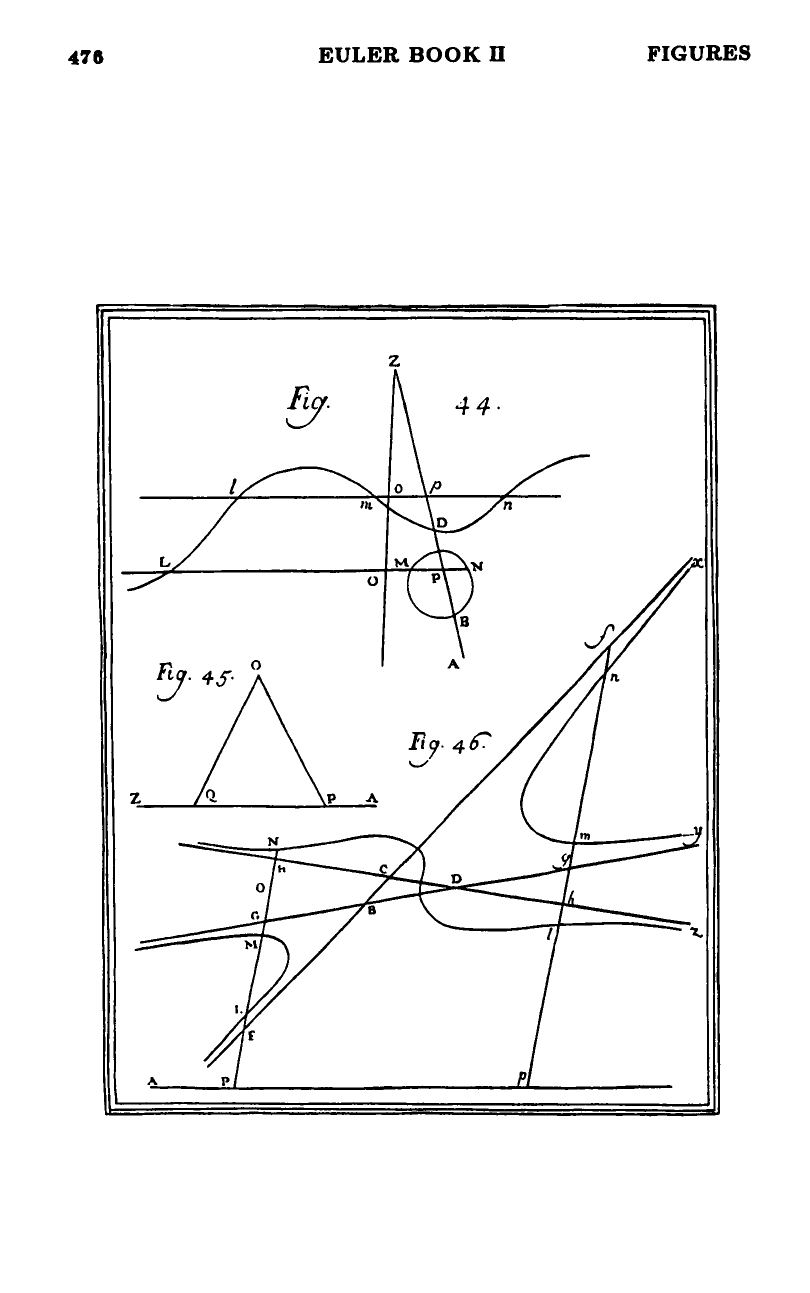 Figures 44–46
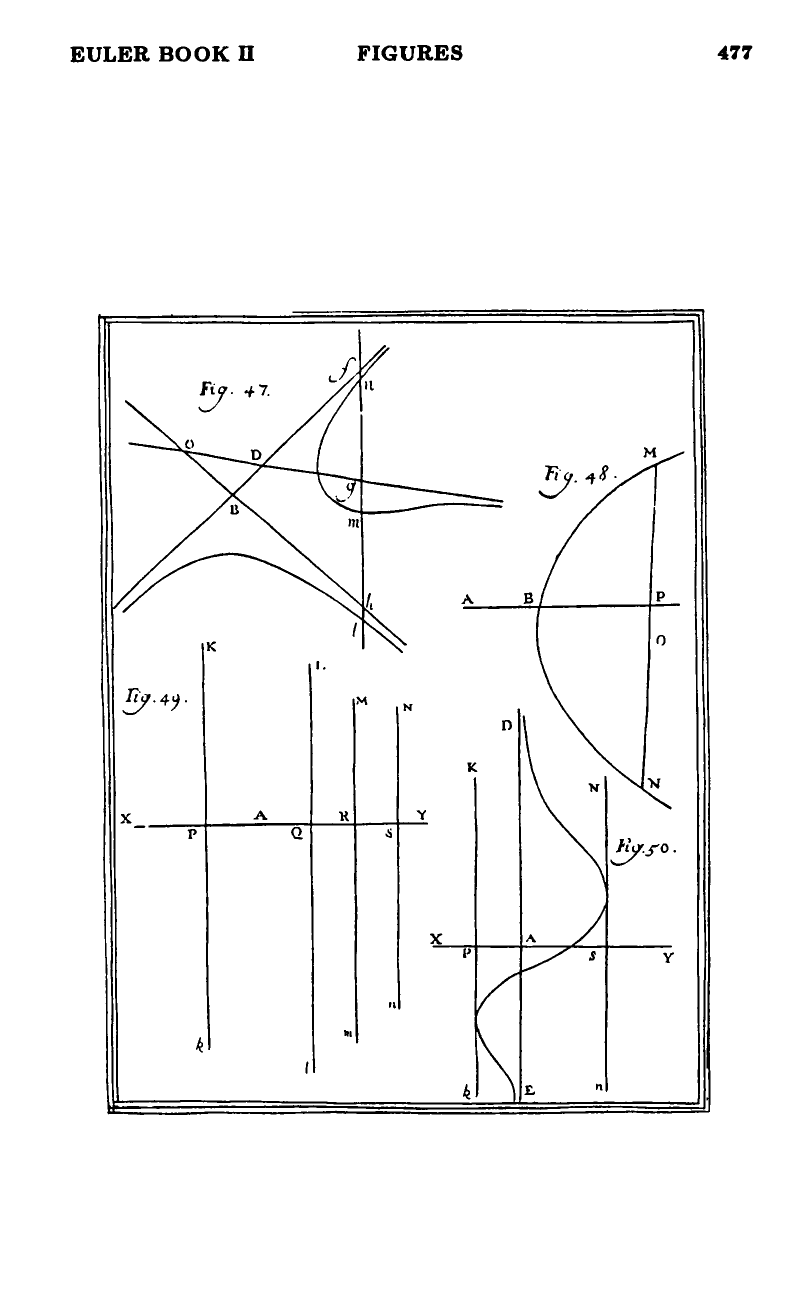 Figures 47–50
Related pages
- chapter-5-on-second-order-lines — second-order analogue. Diameter, center, chord-rectangle, conjugate diameters all generalize here.
- chapter-9-on-the-species-of-third-order-lines — sixteen-species classification used throughout §§246, 257, 259.
- diameter-and-center-of-cubic
- chord-product-cubic
- three-asymptotes-cubic
- bisecting-diameter-cubic
- simplest-oblique-cubic-forms