Diameter and Center of a Third Order Line
Summary: For a cubic with , the sum-of-roots defines a “diameter” — the locus of points on each chord such that — which is a straight line (§§240–241, figure 44). This is not a bisecting diameter, only a sum-conserving one. Different ordinate angles give different diameters; their intersection depends on the angle, so a cubic in general has no center (§§242–244). The center exists iff the coefficients satisfy a single algebraic condition (§245), which holds for species I–V (when ) and VIII–XIII (center at origin). VI–VII have no center; XIV–XVI have all triameters parallel — “center at infinity” (§246).
Sources: chapter10 (§§240–246); figures 44, 45 in figures44-46.
Last updated: 2026-05-02.
Vieta on the general cubic (§239)
The general third-order equation becomes, on dividing by and reading as a cubic in , so the three ordinate roots at abscissa satisfy
The sum-of-roots formula drives the diameter / center analysis here; the product-of-roots drives chord-product-cubic.
The lo + mo = no diameter (§241, figure 44)
Take any axis and ordinates at a fixed angle. A secant cuts the curve in three points , with two on one side of the axis and one on the other; let and write the three signed ordinates as so that . Define
Then lies “in the middle” of in the precise sense that
Because is linear in , the locus of ‘s is a straight line :
This property is analogous to the property of a diameter which each second order line possesses. (source: chapter10, §241)
In second-order theory the diameter condition was for the two ordinates on one chord; for a cubic the natural generalization is that partition the three ordinates so that one signed sum equals the other.
Multiplicity of diameters (§242, figure 45)
Different choices of ordinate angle give different diameters. Substitute , and expand: the new ordinate sum-of-roots formula gives where and . This is the diameter equation in the new oblique coordinates associated with direction .
When two diameters intersect (§243)
Let be the intersection of the two diameters — the lo+mo=no line for the original axis and the analogous line for direction . Drop a perpendicular from to , and let , , , (figure 45). The compatibility , gives , . Substituting and the analogous formula for yields a single relation in and the original coefficients.
When all diameters concur — the center condition (§§244–245)
For every choice of to give the same intersection point, the relation must be independent of . Euler isolates the terms in and separately and equates each to zero, yielding
Setting these two expressions for equal gives, after clearing denominators, so the condition for a center is
Restoring general (by the rescaling , , etc., that produced the form), and the center then sits at
(Note: the §245 OCR prints "" in the numerator, which appears to drop the small numerals "" and "" present in the §244 derivation with . The expression above is the algebraically consistent rescaling of §244.)
Wherefore, if one chord which intersects the curve in three points is divided in such a way that two of the ordinates on one side are equal to the third on the other side, then the straight line through this division point and the center will so divide all other such chords which are parallel to the first. (source: chapter10, §245)
Application to the sixteen species (§246)
Using the cubic-species-classification enumeration from chapter 9:
| Species | Behavior |
|---|---|
| I, II, III, IV, V | Center exists provided (the leading-factor rotation already places it at the origin). |
| VI, VII | No center: the coefficient cannot vanish for these species. |
| VIII, IX, X, XI, XII, XIII | Center always exists and is taken at the origin. |
| XIV, XV, XVI | ”Center at infinity” — all triameters of the curve are parallel. |
The species with three rectilinear asymptotes (III, IV, V — Case 2) and those with double-factor structure that admits a center (Case 3 sub-cases) match. Species VI, VII (parabolic asymptote + one rectilinear, Case 3 §229) are precisely the cubics without a center, mirroring the parabola’s centerlessness in the conic classification.
The diameter is sum-preserving, not bisecting
A subtle but important caveat. The §241 line satisfies , not or even midpoint. It is not a chord-bisecting diameter in the sense of diameter-of-conic. A genuine bisecting diameter requires the cubic to be cut by parallel lines in only two points — see bisecting-diameter-cubic (§§253–257).
Figures
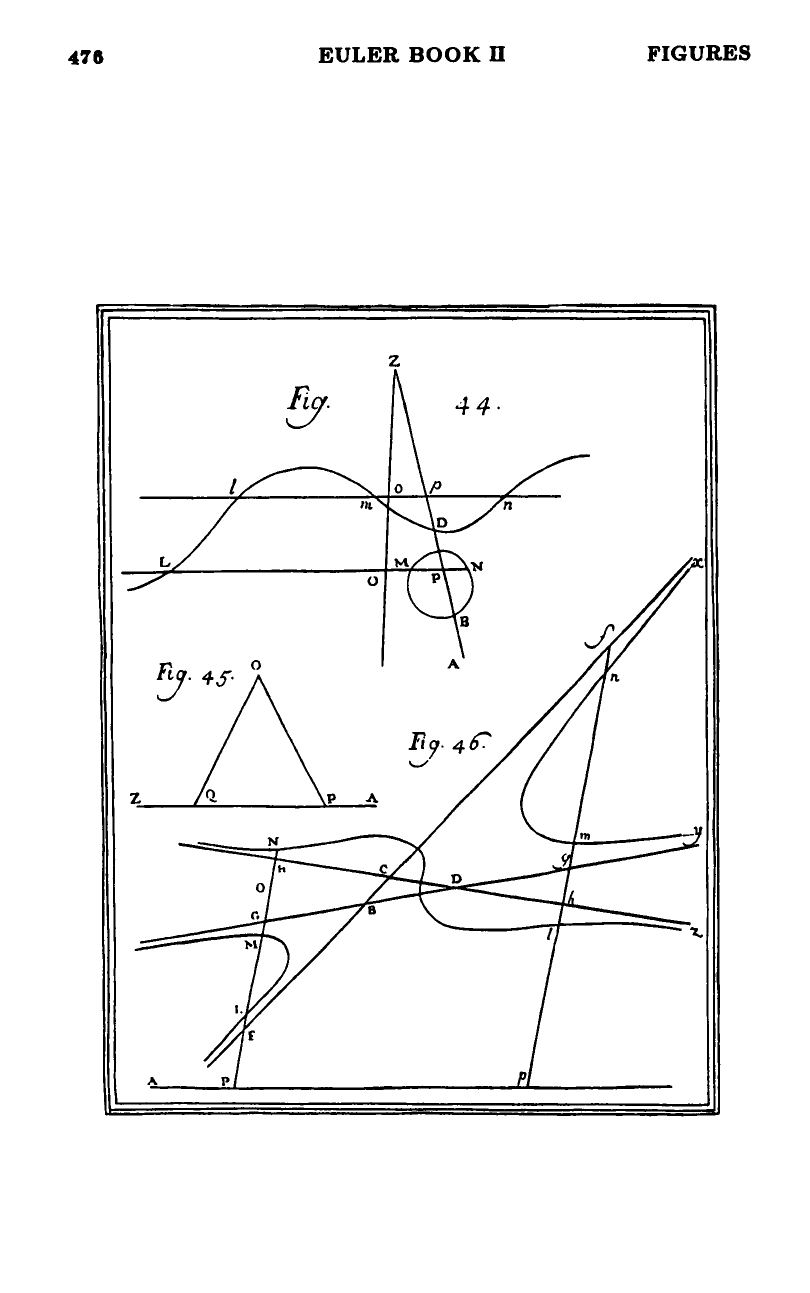 Figures 44–46
Related pages
- chapter-10-on-the-principal-properties-of-third-order-lines
- diameter-of-conic — second-order analogue. The sum-of-roots construction goes through identically; only the meaning of “midpoint” differs.
- center-of-conic — second-order analogue. The conic center exists unconditionally; the cubic center only when the §245 algebraic condition is satisfied.
- bisecting-diameter-cubic — the genuine, chord-bisecting diameter (different concept).
- chord-product-cubic — the parallel construction from product-of-roots.
- cubic-species-classification — the per-species classification used in §246.