Bisecting Diameter of a Third Order Line
Summary: A cubic admits a genuine (chord-bisecting) diameter only when it is cut by some family of parallel lines in only two points each — equivalent to the principal cubic member having a doubled real linear factor in some direction. The midpoints of such two-point chords lie on a hyperbola in general (§253, figure 48); the locus is a straight line iff (§254). Generalized algebraically (§§255–256) by demanding that, after the substitution , , the new coefficient vanish and the resulting -coefficient be divisible by the -coefficient. Per-species inventory in §257: I, III, VI, XV, XVI have none; II, VIII, X, XII, XIV have one (chords parallel to axis); IV, VII have one parallel to an asymptote; IX, XI, XIII have two; V has three. Closes with Euler’s homage to Newton.
Sources: chapter10 (§§253–257); figure 48 in figures47-50.
Last updated: 2026-05-02.
Why the cubic admits no bisecting diameter in general
The §241 “diameter” of diameter-and-center-of-cubic satisfies for chords cutting the curve in three points, but it does not bisect the chord. To get a genuine bisecting diameter — the kind that exists for every conic (diameter-of-conic) — the cubic must be cut by some family of parallel chords in two points rather than three. This happens precisely when the principal cubic member has a doubled real factor along the chord direction, so that one of the would-be three intersections has receded to infinity.
Two-ordinate setup (§253, figure 48)
When the cubic is intersected by a family of parallel lines in only two points, choose those lines as the ordinate direction. The equation, originally cubic in , has effectively dropped to a quadratic in once a factor of is divided out (the doubled-factor coefficient now plays the role of leading coefficient):
The two ordinate roots and (with the figure-48 sign convention) satisfy
Letting be the chord midpoint and , Euler obtains the relation
The midpoint locus is a hyperbola (§253)
Rewritten as , the midpoint locus is a conic of order two. The discriminant of its principal member () is , so the conic is a hyperbola.
Every which bisects a chord parallel to lies on a hyperbola, unless is divisible by , in which case the point lies on a straight line. (source: chapter10, §253)
When the locus collapses to a straight line (§254)
Polynomial division: with remainder . The locus is straight iff , i.e.,
When this holds, the cubic has a diameter: the bisecting locus
General algebraic criterion (§§255–256)
Now drop the assumption that the doubled factor lies along the original ordinate direction. Substitute , (with giving a new ordinate angle relative to the same axis) and expand the §239 cubic:
For the new ordinate to admit only two values per abscissa — the prerequisite for bisecting — the leading coefficient must vanish:
This is exactly the condition that be a real linear factor direction of the principal cubic member — confirming the geometric reading.
For the bisecting line to be straight, the coefficient of must additionally be divisible by the coefficient of as polynomials in :
- Coefficient of : .
- Coefficient of : .
Divisibility means the -coefficient must vanish at the root of the -coefficient, giving an explicit equation for (§256) in terms of the other coefficients and .
Per-species inventory (§257)
Apply the criterion to each of the 16 species enumerated in cubic-species-classification:
| Species | Bisecting diameter |
|---|---|
| I | none |
| II | one — bisects chords parallel to the axis from which abscissas are taken |
| III | none |
| IV | one — bisects chords parallel to one of the asymptotes |
| V | three — one bisecting chords parallel to each asymptote |
| VI | none |
| VII | one — for chords parallel to the asymptote arising from the factor |
| VIII | one — for chords parallel to the axis |
| IX | two — one for chords parallel to the axis, one for chords parallel to the other asymptote |
| X | one (like VIII) |
| XI | two (like IX) |
| XII | one (like VIII) |
| XIII | two (like IX) |
| XIV | one — for chords parallel to the axis |
| XV | none — no chords meet the curve in only two points |
| XVI | none — no chords meet the curve in only two points |
The pattern matches the asymptote structure: species with three rectilinear asymptotes give up to three diameters (V); species with a parabolic asymptote and a rectilinear one give one diameter parallel to the rectilinear (IV, VII); species with parallel asymptotes and a transversal pick up two; the parabolic-only species (XV, XVI) give none because every line meets the curve in three points (or one).
Closing remark (§257)
These properties of diameters were well known to Newton, and for that reason it has been a pleasure to commemorate his work in this place. (source: chapter10, §257)
A graceful sign-off, paralleling the §124 acknowledgment of Newton’s conic-tangent properties in tangent-properties-conic.
Figures
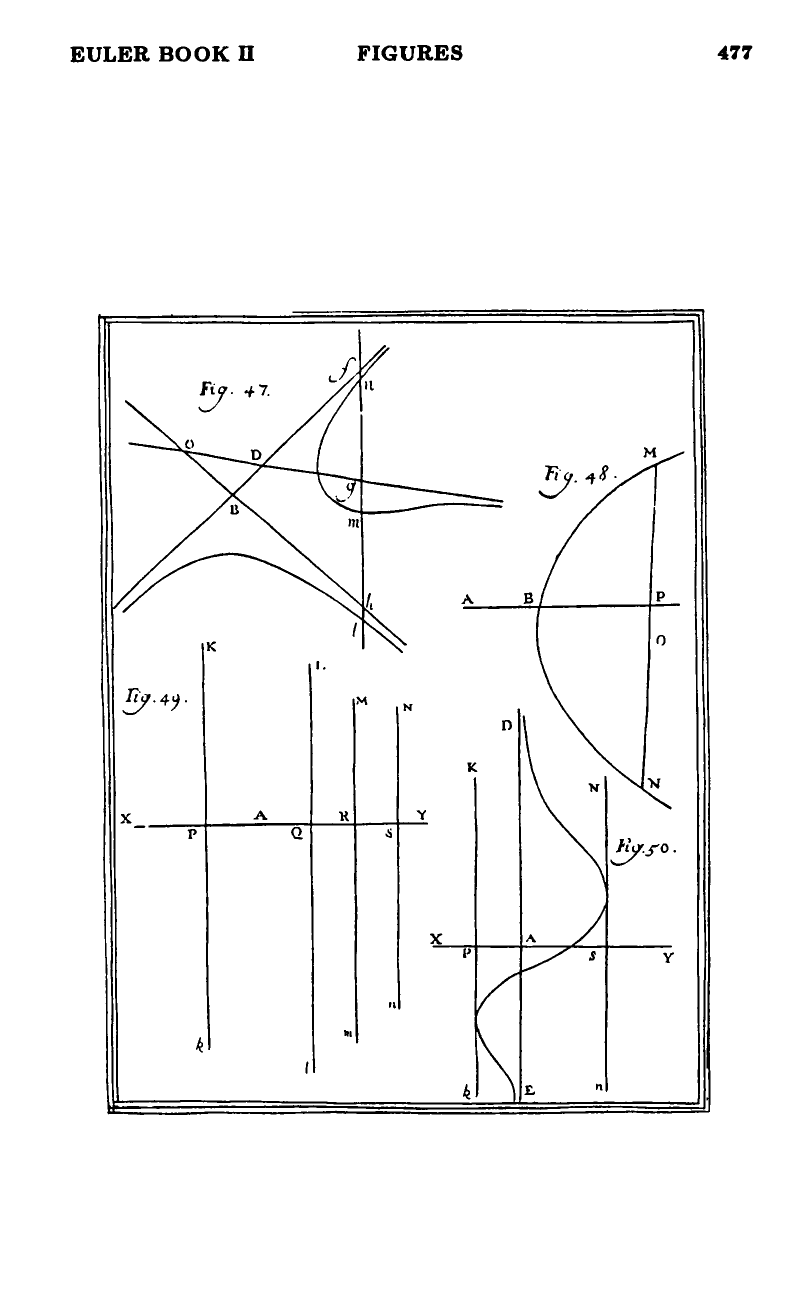 Figures 47–50
Related pages
- chapter-10-on-the-principal-properties-of-third-order-lines
- diameter-and-center-of-cubic — the lo+mo=no construction (different, weaker, unconditional sense of “diameter” for cubics).
- diameter-of-conic — second-order analogue. Every conic has a diameter for every chord direction; for cubics only special directions and only with extra coefficient conditions.
- cubic-species-classification — the 16-species enumeration used in §257.
- branches-at-infinity — the §255 condition is the criterion for to give an infinite branch.
- tangent-properties-conic — earlier acknowledgment of Newton’s prior work on the conic case.