Diameter of a Conic Section
Summary: A diameter of a second-order line is any straight line that bisects all chords drawn parallel to a fixed direction (§90). Every conic has innumerably many diameters — one per direction. The construction comes directly from the sum of roots of the conic’s quadratic-in- equation: for parallel chords and at abscissas and , the difference of midpoint heights is the constant times the difference of abscissas, so the midpoints lie on a single straight line (§§87–89). Where a diameter meets the curve, the tangent at that point is parallel to the chords the diameter bisects.
Sources: chapter5 §§87–91, figures19-22 (figures 19, 20)
Last updated: 2026-04-25
The general equation as a quadratic in (§86)
The general second-order equation divided through by becomes For each abscissa this is a quadratic in ; its two roots are the two ordinates of the chord through perpendicular to the axis (or oblique, if the coordinate system is oblique). The roots are real, equal (tangent), or complex.
The case collapses one ordinate to infinity but does not affect the diameter analysis (§86).
Sum of roots and the diameter direction (§87, figure 19)
For a chord at abscissa , Pick a parallel chord at abscissa . Subtracting,
Drawing parallel to the axis to the original ordinate , That is, the midpoint of one chord lies higher than the midpoint of the other by — a fixed multiple of the horizontal separation.
Crucially, “this ratio is the same, no matter where on the curve the straight lines and may be drawn, provided only that they meet the axis with the given angle” (source: chapter5, §87). The ratio depends only on the direction of the chords, not on which two chords are picked.
The bisection lemma (§§88–89, figure 20)
If we slide the ordinate until and coincide, the chord becomes the tangent to the curve, with point of contact . Draw a “chord ordinate” through parallel to the chosen chord direction. From the parallel chord ratios, with the intervals on opposite sides of taken with opposite signs:
Now (§89) pick the parallel chords so that . This means each chord is drawn to make vanish — i.e., the chord midpoint lies on the line from the tangent contact that bisects . The same condition forces , hence , i.e., also bisects the parallel chord .
Conclusion (§89): the line — drawn from the point of contact of the tangent, bisecting one chord — bisects every chord parallel to that one.
Definition and abundance (§90)
Since the straight line cuts all ordinates parallel to the tangent into two equal parts, this line is usually called the DIAMETER of the second order line or the conic section. (source: chapter5, §90)
A conic has innumerably many diameters — one for each tangent direction at a point of the curve. Concretely: pick any point on the curve and the tangent there; draw any chord parallel to that tangent and bisect it at ; then extended is the diameter for that family of parallel chords.
Dual construction: midpoints of two parallel chords (§91)
The construction above starts from a point of tangency. The same diameter can be reached from any two parallel chords:
If a straight line bisects any two parallel ordinates and , then it also bisects all the other ordinates which are parallel to these. (source: chapter5, §91)
So another method is: pick any two parallel chord ordinates , bisect them at , then is a diameter and bisects every chord parallel to . Where extended meets the curve at a point , the tangent at is parallel to .
This duality — point-of-contact ↔ midpoint of any chord in the family — is the key construction of conic geometry. Both descriptions select the same line.
Why diameters bisect: the algebra
The “magic” of the diameter property reduces to the formula . The midpoint of the chord has ordinate This is a linear function of — and the locus of points with is a straight line. That straight line is the diameter for chords drawn at the angle of the given coordinate system.
If the coordinate system’s ordinate angle is changed, the formula transforms but stays linear in the new abscissa (cf. §103–105 in center-of-conic) — so a new diameter is obtained for the new chord direction. Different obliquity, different diameter; but always a straight line.
Tangent at the endpoint of a diameter
When a diameter extended meets the curve, it does so at one or two points. Each such point is a point of tangency for the chord direction the diameter bisects: the tangent at is parallel to the chords. This is the converse of the §89 construction:
- §89: tangent at → diameter as bisector locus.
- §91: bisector locus of parallel chords → meets curve at points where the tangent is parallel to the chords.
Both converge on the same line through .
Special-case behavior of
When , the equation becomes linear in : each abscissa has one ordinate, the second has receded to infinity. The diameter formalism still applies — the “midpoint of a chord at infinity” makes sense projectively — but Euler postpones the parabolic case. Only when does the formula give a finite line of midpoints.
Figures
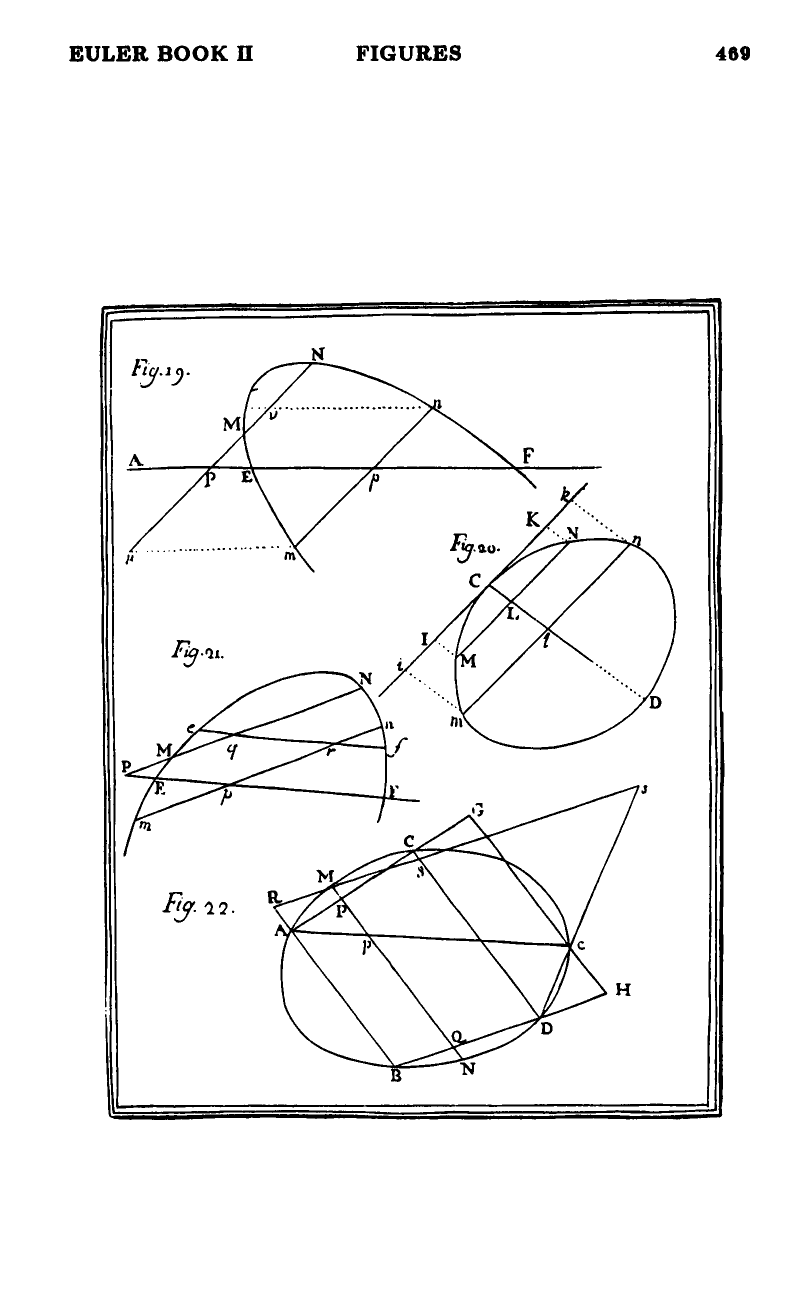 Figures 19–22
Related pages
- chapter-5-on-second-order-lines
- chord-rectangle-property — the product of roots gives the next strand of conic geometry
- center-of-conic — all diameters of a conic meet in one point
- conjugate-diameters — every diameter has a partner that bisects chords parallel to itself
- oblique-coordinates
- general-equation-of-order-n