Tangent Properties of a Conic (Newton’s Lemmas)
Summary: Take any diameter of a conic with conjugate , and draw tangents at the diameter’s two endpoints (both parallel to , by conjugate-diameters §111). For any third tangent at any point of the curve, intersecting the two given tangents at and , the rectangle property reads (§122). Adding a fourth tangent further intersecting at on , one obtains (§123). And any straight line cutting two of the tangents in a fixed ratio cuts the third in the same ratio (§124). Euler concludes: “These are the main properties of conic sections from which NEWTON found the solution to many important problems in his Principia” (source: chapter5, §122).
Sources: chapter5 §§121–125, figures26-29 (figures 28, 29), figures30-32 (figure 30)
Last updated: 2026-04-25
Setup (§121, figure 28)
Take any diameter of the conic, with center at its midpoint and conjugate diameter . The tangents at the endpoints are both parallel to (a consequence of the conjugate-pair structure — conjugate-diameters §111).
Pick any point on the curve and draw the tangent at , extending it until it meets at and at . Drop the ordinate from to the diameter , with parallel to (so is parallel to both and ).
The first ratio: (from §118)
From the tangent-construction theorem of conjugate-diameters §118, one has Equivalently since . By componendo / dividendo on the proportion :
- .
- .
So
(Algebra works out because on one side and etc. on the other; sign conventions follow Euler.)
Tangent intercept ratios (§121)
By similar triangles (with bases on the same diameter and parallel sides ): But also from the formulas above (dividing them). Hence:
Furthermore, by similar triangles: Combining:
(§122)
Multiply:
But by the chord-rectangle-property (specialized: at the diameter , the chord at abscissa from the center has half-length , and the “axis-chord” is with ), (This is the conjugate-diameter form of the rectangle ratio: has become after referring everything to the principal-pair-like center frame.)
Therefore:
From this there follows the outstanding property . (source: chapter5, §122)
The product of the lengths the third tangent cuts off on the two end-tangents is the square of the conjugate semidiameter — and is therefore the same for every choice of .
Equivalent forms (§122)
Several immediate corollaries:
The last identity, , says that the point on the tangent line divides in the same ratio as — i.e., the contact point divides the third tangent in the same ratio that the third tangent divides the two end-tangents (in opposite senses). This is one of the key projective lemmas Newton uses.
Two further tangents and four-tangent ratios (§123)
Take a fourth point on the curve with tangent meeting at and at . The same identity gives . Hence:
Now if the two tangents meet at , then by similar triangles
These are the main properties of conic sections from which NEWTON found the solution to many important problems in his Principia. (source: chapter5, §122–123)
The four-tangent harmonic identity (§§123–124, figure 30)
If the tangent is extended to a point such that , then is the point where the tangent on the other side, parallel to , intersects — and likewise on the other side. So tangents extended to create a configuration where, for any third tangent at points :
Hence . Adding a fourth tangent intersecting at :
If are bisecting points (each cutting their respective tangent in the same fixed ratio ), then the line through them cuts in the same ratio. In particular: the line through the midpoints of and bisects — and therefore passes through the center of the conic (because is the midpoint of when is set to make the configuration symmetric about ).
If the lines and are bisected, the straight line through the two bisecting points will also bisect the straight line . For this reason it will also pass through the center of the conic section. (source: chapter5, §123)
Geometric proof of the ratio invariance (§124, figure 30)
Euler’s geometric proof reduces to the ratio (the prescribed division ratio of ) by the law of sines applied twice in triangles and :
Cross-multiplying and using ,
The conclusion (§124):
If the straight line divides both and in the ratio , the straight line through the two division points divides the straight line in the same ratio. (paraphrased from chapter5, §124)
Why these are “Newton’s lemmas”
In the Principia, Newton derives Kepler’s equal-area law and the inverse-square force from the conic’s tangent structure. The pivotal property he uses repeatedly is precisely §122’s , applied to areas of inscribed triangles and tangent-quadrilaterals. The §123–124 ratio invariances are how Newton transports the area-ratio argument across different chords of the orbit.
Euler’s reference to Newton in §122 is no afterthought — the chapter is in part a clean algebraic derivation of the synthetic conic geometry Newton used. By the end of §124 Euler has, in fewer than a dozen pages, produced the full toolkit Newton spent the Principia’s opening sections developing.
Connection to the chord-rectangle property
The tangent property is the limiting case of the chord-rectangle-property’s tangent-rectangle form being constant (§94), specialized to the configuration where are the endpoints of a diameter and the tangents at meet the third tangent at . Both rest on the algebraic fact that the product of roots of the conic’s quadratic-in- equation factors cleanly (§92).
Figures
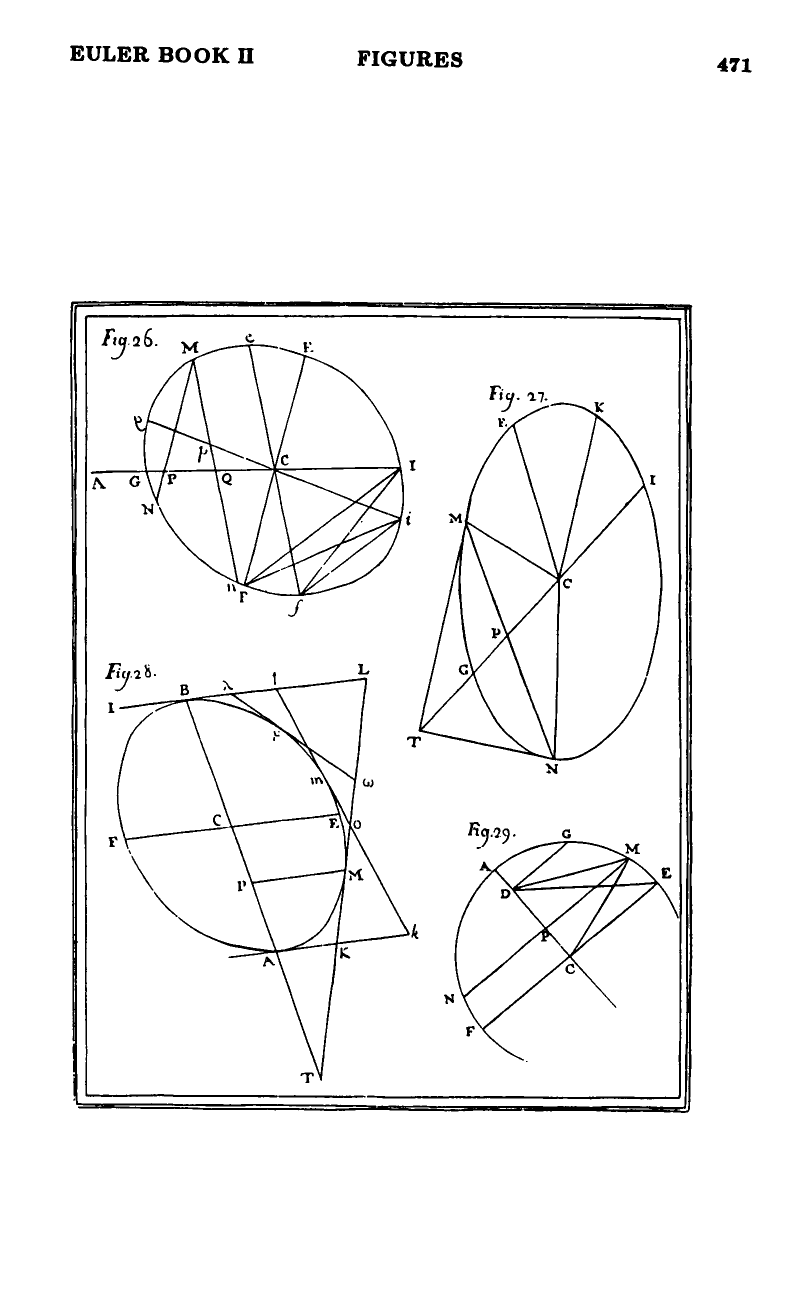 Figures 26–29
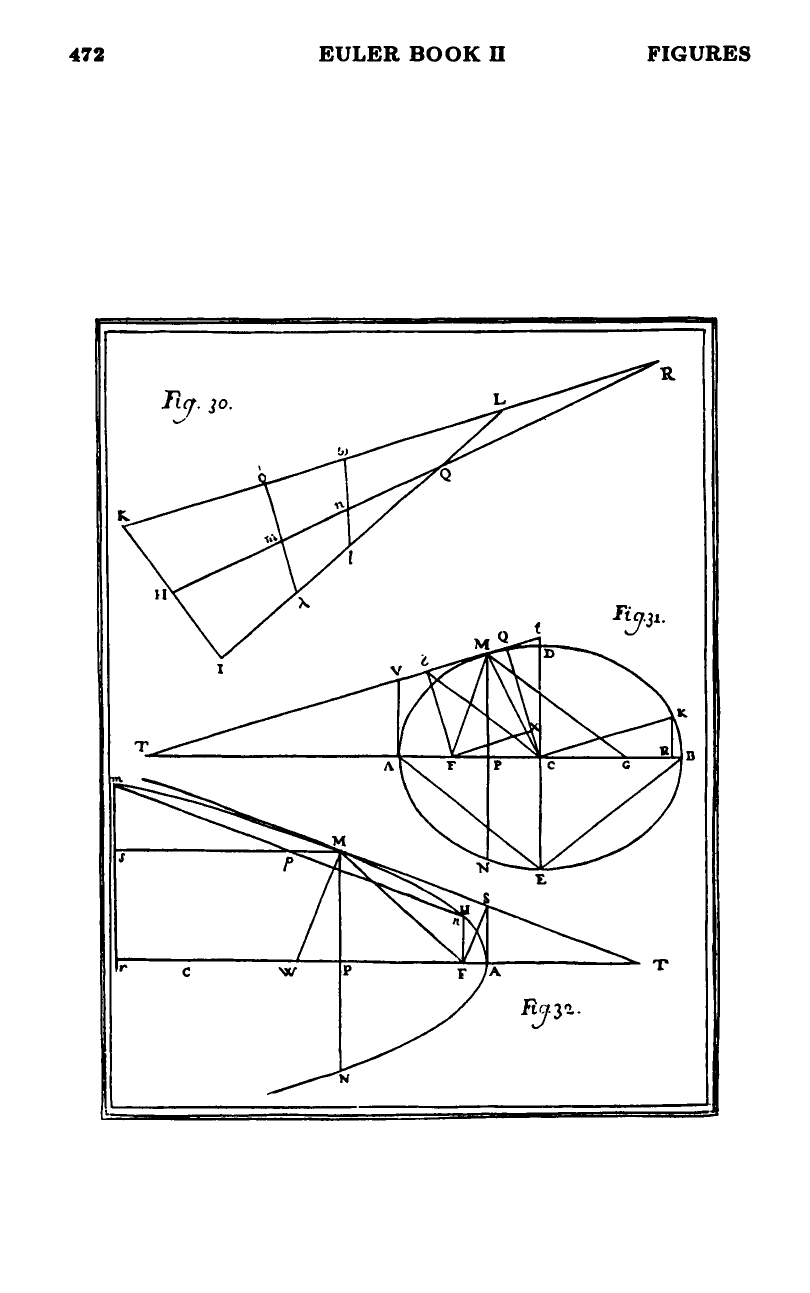 Figures 30–32
Related pages
- chapter-5-on-second-order-lines
- chord-rectangle-property — the tangent-rectangle theorem that specializes to this property
- conjugate-diameters — tangents at the endpoints of a diameter are parallel to the conjugate diameter
- principal-axes-and-foci — applying these tangent ratios in the orthogonal-pair frame
- diameter-of-conic