Chapter 18 — On the Similarities and Affinities of Curves
Summary: After fifteen chapters of classifying curves, Euler turns to the relations between curves: when do two equations describe the same shape up to scale (similarity), up to independent horizontal and vertical scalings (affinity), or up to rigid motion (equal curves in different positions)? The answer hinges on what Euler calls thread constants — the dimensional bookkeeping of an equation. A single equation with a varying constant always describes either an infinite family of similar curves, or an infinite family of congruent copies positioned along a directrix.
Sources: chapter18 (§§435–456); figures 88–89 in figures86-89; figures 90–93 in figures90-93.
Last updated: 2026-05-12.
The chapter at a glance
Chapter 18 is short — twenty-two sections — and structurally simple. It is built around a single algebraic device, thread-degree homogeneity, applied in three increasingly elaborate situations:
- one varying constant, equation homogeneous in → similar curves;
- two independent scaling ratios for and → affine curves;
- one varying constant not appearing homogeneously → infinitely many congruent copies of the same curve in different positions.
The first two are classification statements (when do two curves stand in a given relation). The third is a construction statement: given a “directrix” along which the vertex of a curve travels, write one equation that captures all positions of the curve simultaneously.
1. Thread constants and homogeneity (§435)
In any equation , the variables and the constants are all “threads”; in every term the total thread degree (variables + constants) must be the same, on pain of comparing heterogeneous magnitudes. If no constants appear, and alone must be equidegreed in every term — but such an equation is homogeneous and represents a bundle of straight lines through the origin, not a proper curve.
See thread-constants.
2. Similar curves (§§436–441, 447–448)
A single varying thread constant plus variables traces out an infinite family of curves differing only in size. They are similar:
- Geometric criterion (§§437–438): ; tangents make equal angles with their axes; arcs scale by the parameter ratio, areas by its square, osculating radii by the ratio itself.
- Algebraic criterion (§§439, 441): is a first-degree homogeneous function of and ; equivalently, after and clearing , the equation is unchanged.
- Examples: circles , parabolas .
- Construction (§440): pantograph-style — either point-by-point with and , or via a fixed point with and .
See similar-curves.
3. Affine curves (§§442–446)
If the abscissa ratio and ordinate ratio are allowed to be different, similarity is lost but a weaker relation survives: affinity. Affinity contains similarity as the special case .
- Algebraic recipe (§443): substitute in the original to get as a zero-degree function of and .
- Important asymmetry (§444): similarity is intrinsic to the curve (one similar pair is similar with respect to any axis or homologous point), but affinity is only with respect to the chosen axis. Affine curves do share order and genus.
- Headline example (§445): every ellipse is affine to a circle; every ellipse is affine to every other ellipse; equal-axis-ratio ellipses are similar.
- Degenerate case (§446): for two-term equations , , , , etc., affinity collapses back to similarity — all affine images of a parabola are still parabolas.
See affine-curves.
4. Infinite copies of one curve (§§448–456)
If a single equation contains a varying constant and the equation is not homogeneous in , the curves it describes are no longer similar — they may even be all congruent. The same shape, drawn many times in different positions, can be packaged in one equation.
Euler builds this in three stages:
-
§449 — translation along a straight axis, illustrated by circles of radius with vertices sliding along a directrix curve , axis kept parallel to : , where is the directrix ordinate at abscissa . (figure 90)
-
§§450 — same construction for an arbitrary curve with vertex-equation replaced by any : substitute .
-
§§451–452 — rotation: vertex on a fixed circle of radius , axis kept directed through the center . Substitute , . (figure 91)
-
§§453–454 — most general: vertex on directrix and axis rotating, both governed by . With ,
(figure 92)
-
§456 — closing example: infinite circles through fixed point with centers on line (the meridian-circles of geographical maps), . (figure 93)
§455 records the criterion: if the equation in has no constants, the curves are all equal (congruent); if it has a constant depending on such that is first-degree homogeneous in and that constant, the curves are similar; otherwise dissimilar.
Connections to earlier chapters
- The “circle as parabola with infinite axis / ellipse with ” passages in chapter 6 (classification-of-conics) are special cases of the affinity recipe of §445.
- The diameter / center analyses in chapter 15 (diameter-and-center-from-equation) read parity of exponents in ; chapter 18 reads parity of thread exponents in the joint variables and constants.
- The substitution used here is the scaling subcase of the general coordinate transformation from chapter 2 (coordinate-transformations); the §453–454 substitution combines that scaling with translation and rotation.
Figures
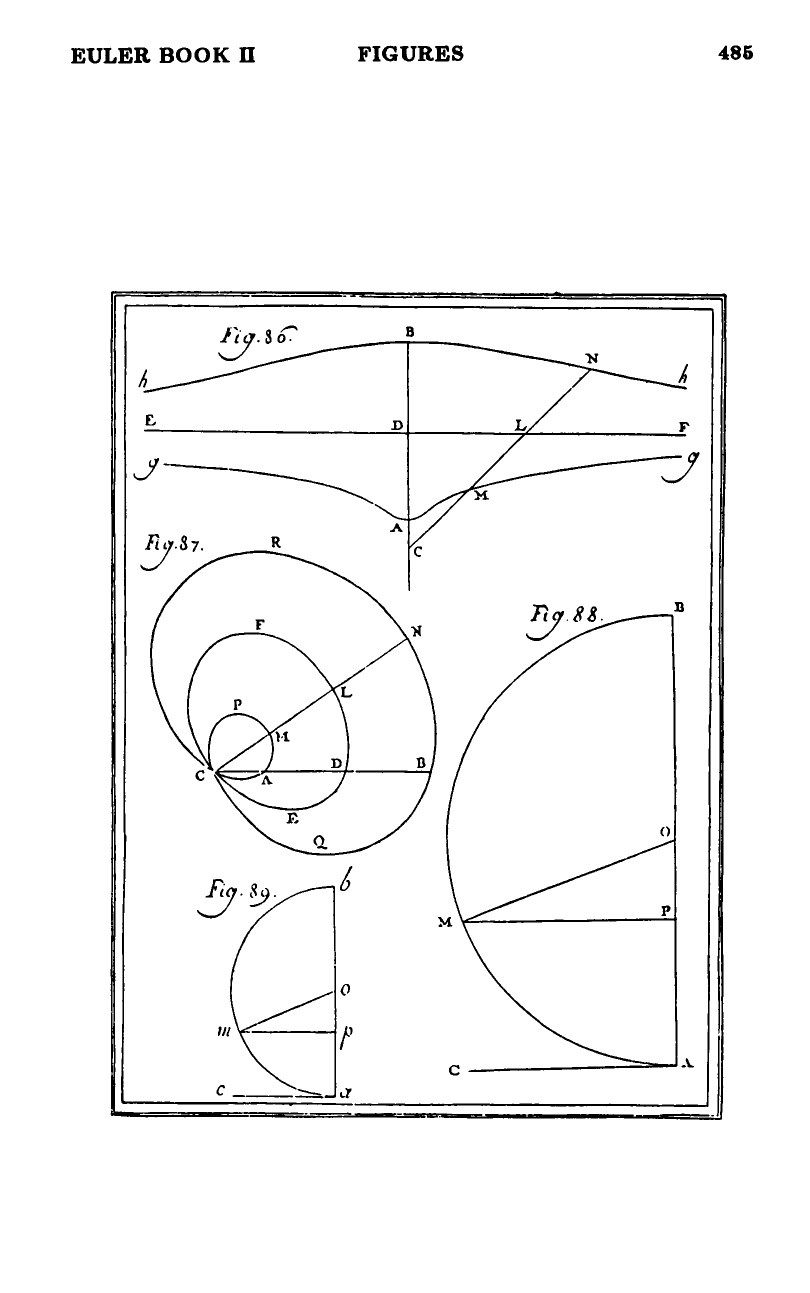 Figures 86–89
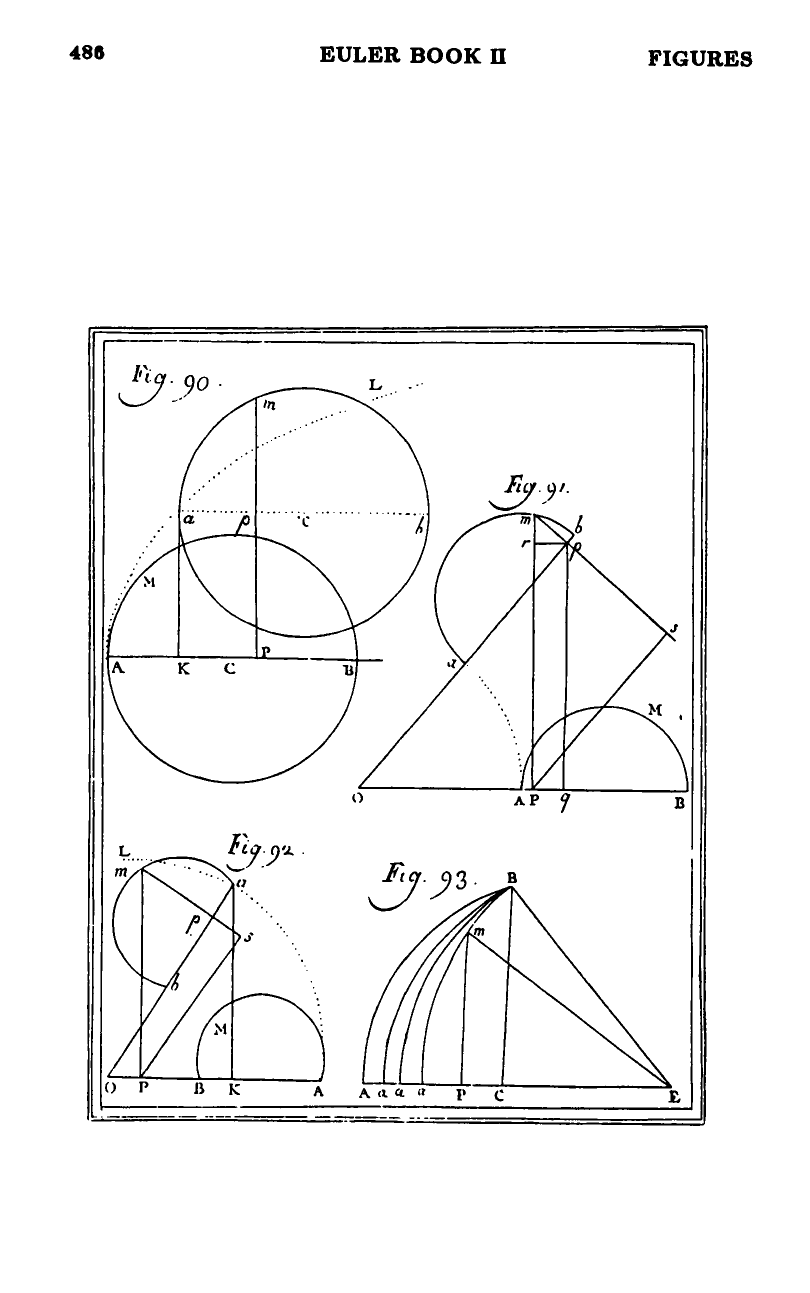 Figures 90–93