Infinite Copies of One Curve in Different Positions
Summary: A single equation can encode an entire infinite family of congruent copies of one curve, placed in the plane according to some law (a directrix, a rotation, or both). The technique is to write the curve in body-fixed coordinates and substitute the rigid-motion expressions for in terms of laboratory coordinates and a varying constant . Examples: circles of fixed radius with vertices on a directrix (figure 90); rotated copies around a center (figure 91); the most general “vertex on directrix + rotating axis” hybrid (figure 92); meridian circles through a fixed point (figure 93).
Sources: chapter18 §§448–456; figures 90–93 in figures90-93.
Last updated: 2026-05-12.
The setup (§§448–449)
§447 introduces the data: an equation with one varying constant + variables . If the constant appears with the right thread-degree, the resulting curves are similar (similar-curves). §448 notes an alternative: with the same equation, the curves obtained may instead be equal (congruent), differing only in position.
The chapter’s introductory example: is a family of equal circles of radius whose centers slide along the perpendicular to the axis as varies (§448).
§449 inverts the question: given the same shape drawn many times in different positions according to some law, find a single equation that captures the family.
1. Translation along a directrix (§449, figure 90)
Take a circle of radius to be drawn with its vertex sliding along a given curve (the directrix), with the diameter kept parallel to the principal axis .
Construction:
- Let (abscissa of vertex on the directrix);
- — a known function of , determined by the directrix.
- From , draw parallel to — the diameter of the placed circle.
- For a generic point of the placed circle, drop perpendicular to with .
In body-fixed coordinates : , , and the circle satisfies . Substituting: For each value of (with a function of via the directrix), this gives one positioned circle; letting vary recovers the whole family.
2. Arbitrary curve on a directrix (§450)
The same construction works with any curve whose body-fixed equation is . Substituting where encodes the directrix gives the family equation.
Example: parabola on directrix , axes parallel to , yields
3. Pure rotation about a fixed center (§§451–452, figure 91)
Now keep the vertex on a circle of radius around center , and let the body’s axis always point through . The body-frame transformation is then a rotation by angle .
With and angle varying:
(Derivation: drop parallel to meeting the extended ordinate at ; then , , , .)
Substituting these into the body equation gives one equation in whose parameter traces out all rotated copies.
4. Directrix + rotation combined (§§453–454, figure 92)
The fully general case: vertex on a directrix , axis tilting through angle as the vertex moves. With , , and from the geometry , , Euler derives:
which can be rewritten compactly as
This is a translation by followed by a rotation by — a general planar rigid motion governed by one parameter . Substituting into the body equation packages every positioned copy in one equation.
The §455 trichotomy
If the body equation has no further constants, the family is of equal (congruent) curves.
If it has a constant that also depends on , and the equation is such that is a first-degree homogeneous function of and that constant, the family is of similar curves (recovering similar-curves as a sub-case).
Otherwise the family is of dissimilar curves, but still derivable from one body-frame curve placed in many positions and scales.
§456 worked example: meridian circles (figure 93)
A practical case from cartography: infinite circles all passing through a fixed point with centers on the line — the meridian circles of map projections.
Let (a fixed perpendicular), (so circle has center and radius ). Then and for a generic point at , the radius condition gives:
hence
Letting (renaming the variable interval) simplifies to the one-parameter family of meridian circles.
The closing remark (§456): “any infinite set of curves which follow some rule can be included in a single equation provided we carefully distinguish between variable and invariable constants.” Chapter 18 ends on this dimensional-bookkeeping principle.
Figures
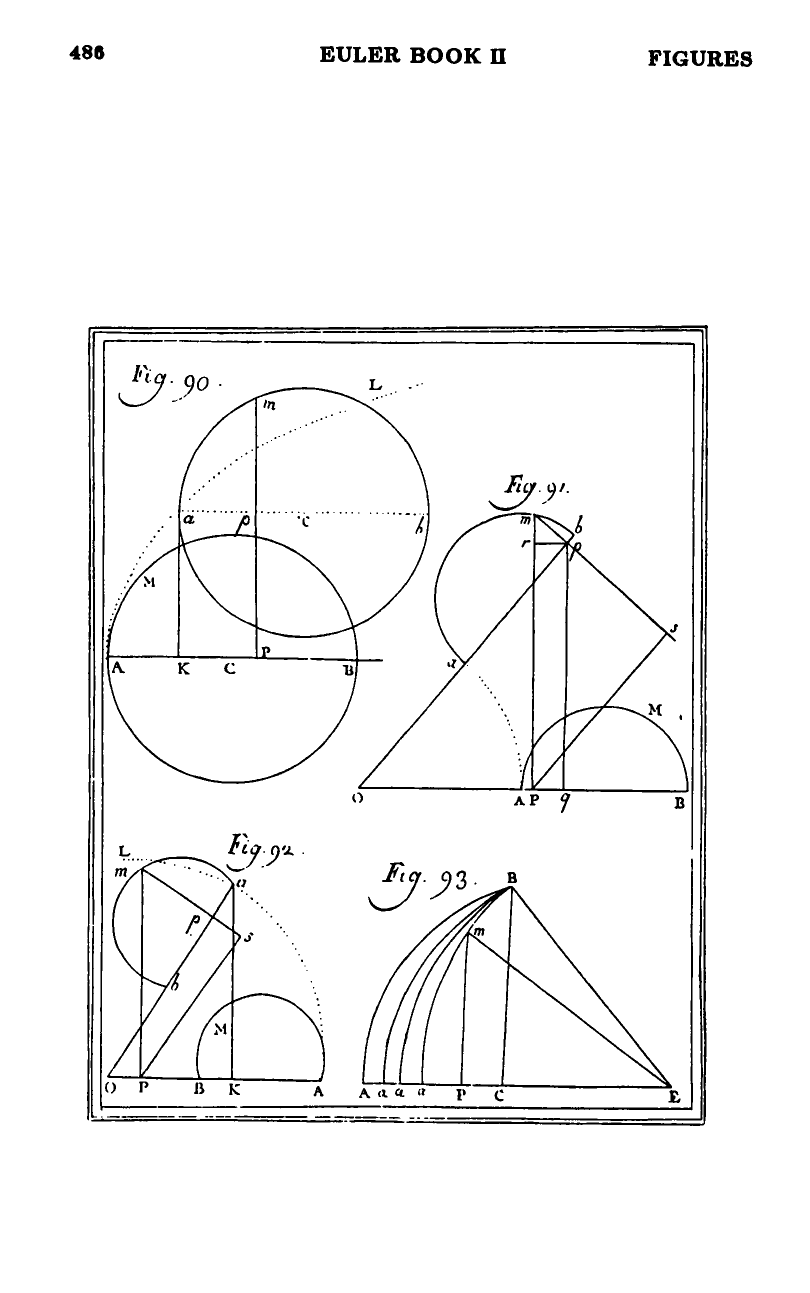 Figures 90–93
Related pages
- similar-curves — the special case when is first-degree homogeneous in and a varying constant.
- affine-curves — the orthogonal variation where scalings rather than positions differ.
- thread-constants — the framework of §455’s trichotomy.
- coordinate-transformations — the rigid-motion substitution used in §§451–454.
- chapter-18-on-the-similarities-and-affinities-of-curves