Similar Curves
Summary: Two curves are similar when their equations have the same form up to a common scaling of variables and parameter. Algebraically: is a first-degree homogeneous function of and the parameter . Geometrically: homologous abscissas and ordinates scale by the same ratio, tangent angles are preserved, arcs scale linearly, areas quadratically, osculating radii linearly. The chapter-18 generalization of “all circles are similar” or “all parabolas are similar”.
Sources: chapter18 §§436–441, §§447–448; figures 88–89 in figures86-89.
Last updated: 2026-05-12.
Definition by one varying constant (§§436–437)
Take an equation with one thread constant and variables , with each term of the same thread degree (see thread-constants). Different values of give different curves; Euler says these curves are similar to each other, and there is no more difference between them than between two circles of different radius (§436).
The chapter’s working example (§437, figure 88): Every term has thread degree 3. Setting , , gives curve . Setting , , gives curve (figure 89). Substituting in the equation yields each term divided by , so the equation is unchanged: satisfies the same equation as .
Geometric properties (§438)
If (homologous abscissas), then (homologous ordinates), so — the right triangles and are similar in the geometric sense.
Beyond corresponding coordinates, all “similarly drawn” lines preserve the ratio:
- arc lengths scale as ;
- areas scale as ;
- for any two homologous points with and angle , the chords ;
- tangents at homologous points make equal angles with the axis;
- osculating radii (from chapter 14, osculating-circle) scale as .
Algebraic criterion: first-degree homogeneity (§§439, 441)
§439 states the criterion compactly: the equations whose curves are similar are exactly those for which is a first-degree homogeneous function of and . Conversely, given any equation with first-degree homogeneous in its arguments, assigning successive values to generates an infinite family of similar curves.
§441 packages this as a substitution test: in the original equation in , substitute to get an equation in ; multiply through to clear the denominators. The resulting equation has each term of equal thread degree in , recovering the §435 form. The criterion is: variables and varying constant appear in the same degree everywhere.
Examples
- Circles (§439): . Substituting : , so — a circle of diameter . All circles are similar.
- Parabolas (§439): . Each parabola similar to every other.
- Ellipse vs circle (§445): (circle) becomes under similarity scaling — still a circle, larger by factor . To produce an ellipse we need an independent scaling of and : see affine-curves.
Construction (§440)
Given with rectangular coordinates and a chosen ratio , the similar curve can be built in two ways:
- Coordinate method: on a parallel axis , mark and erect . The locus of as traces is .
- Polar/pantograph method: pick any fixed point , find the corresponding homologous point , and for each on produce with and .
The second method is the principle behind mechanical instruments for drawing similar figures of any prescribed size.
Infinitely many similar curves (§§447–448)
With one thread constant varying, the family is one-parameter; with two thread constants each varying, the family is two-parameter (“infinity of infinities”); and so on.
§448 makes a topological observation: the one-parameter family of similar curves fills the plane — through every point of the plane passes one curve of the family. The infinity is “the right size” for a single point to pin down a member.
A similar curve family can also be a family of equal (congruent) curves differing only in position: e.g. is an infinite family of circles with equal radius whose centers slide along the perpendicular to the axis. This sits between similarity and the directrix construction of infinite-copies-of-curve.
Figures
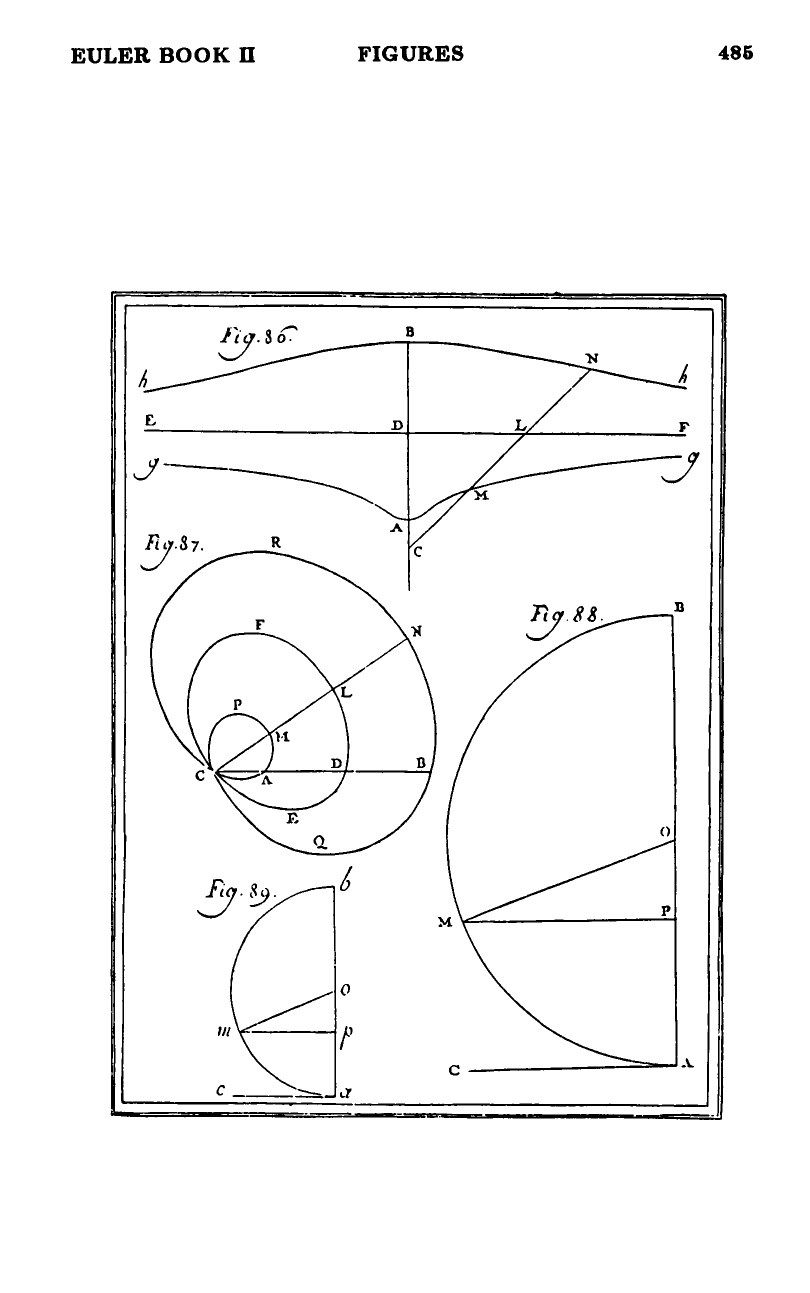 Figures 86–89
Related pages
- thread-constants — the algebraic prerequisite.
- affine-curves — the looser relation when and scale independently.
- infinite-copies-of-curve — same-shape, different-position constructions.
- chapter-18-on-the-similarities-and-affinities-of-curves
- osculating-circle — the curvature radius that scales linearly with the parameter ratio.