Diameter and Center from the Equation
Summary: Three reflective / point-symmetry conditions read directly off the parity of exponents in the curve equation (§§337–343). Even powers of only () → the abscissa axis is an orthogonal diameter, dividing the curve into two equal parts (§338). Even powers of only () → is a diameter (§339). Substitution leaving the equation invariant → a center , where every line through is bisected by ; the equation is a sum of homogeneous parts all of even degree (curve has diameters) or all of odd degree (curve has only a center) (§§340–341). Even powers of both and () → two perpendicular diameters , and the curve belongs to an even order (§§342–343).
Sources: chapter15 (§§336–343); figure 68 in figures68-71.
Last updated: 2026-05-11.
Setup: four quadrants split by two perpendicular lines (§337, figure 68)
Take rectangular coordinates with the four quadrants labelled — formed by the two perpendicular lines (horizontal, the abscissa axis) and (vertical), intersecting at . Sign conventions:
| Quadrant | ||
|---|---|---|
The three cases below ask which substitution leaves the equation unchanged.
Diameter : only even powers of (§338)
The portions of the curve in quadrants and are equal and similar (reflections across ) iff — i.e., contains no odd powers of . Equivalently is a “non-irrational function of and .” Then is a diameter: every chord perpendicular to is bisected by . The general equation of this kind is
Note that the same symmetry makes the pair also equal — reflection across acts simultaneously on both sides of .
Diameter : only even powers of (§339)
Symmetrically, and are equal iff — i.e., is a non-irrational function of and . Then is the diameter, and the general equation has the form
Center : invariance under (§340)
The portions in opposite quadrants and are equal iff . Let be the decomposition into homogeneous parts. Substituting multiplies each by . The invariance condition holds in two distinct ways:
- All homogeneous parts have even degree. Then every is unchanged, and identically. The general equation:
- All homogeneous parts have odd degree. Then each , so , and the equation is still satisfied — although itself is not invariant, the zero set of is. The general equation:
A mixed-parity would not have the symmetry, since the even- and odd-degree pieces transform differently.
Diametrically equal vs. alternately equal (§341)
Euler distinguishes two ways a curve can have two equal parts:
| Kind | Geometric description | Symmetry | Read off from |
|---|---|---|---|
| Diametrically equal | parts on opposite sides of a straight line; every orthogonal chord bisected by that line | reflection across a diameter | even- or even- exponents (cases above) |
| Alternately equal | parts in opposite quadrants / or /; every straight line through divides the curve into two parts that are alternately equal | rotation about | the §340 form (only odd-degree homogeneous parts) |
The first kind is the classical diameter. The second kind is a new feature — the curve has a center , but no axis of reflection. The simplest example is the cubic : rotating about the origin sends the curve to itself, but no line of reflection works.
When all parts in opposite quadrants are equal and the curve is built only of even-degree homogeneous parts, the curve has both a diameter and a center.
Two perpendicular diameters (§§342–343)
If has even exponents on both and — i.e., — then both substitutions and leave unchanged. Both and are diameters, and they are mutually perpendicular. The general equation has the form
Even order only. Because every term has even total degree, the equation is of degree — never odd. Consequently no curve of odd order can have two mutually perpendicular diameters.
Center as a consequence. Two perpendicular diameters force a center at their intersection, since the §342 form is a special case of the §340 (all-even-degree) form. Hence in this case all four quadrants carry equal and similar portions of the curve.
Such curves include the ellipse and hyperbola (order 2), most quartics with both reflective symmetries, and the higher-order generalizations developed in n-diameters-by-cos-ns.
Relation to the chapter-13 / chapter-12 picture
The symmetries here are global — they relate the curve to itself across all of the plane, not to a single point on the curve. Compare:
- multiple-points-on-curves: a singular point is a local symmetry (the curve passes through one point in two or more directions).
- center-of-conic: every conic with two diameters automatically has a center. The chapter 5 derivation came from sum-of-roots on the quadratic-in-; the chapter 15 derivation comes from substitution invariance. Both reach the same conclusion.
- diameter-and-center-of-cubic: third-order curves have a “sum-preserving” diameter but only sometimes a center (when an algebraic condition on the coefficients holds). The chapter 15 framework restricts attention to orthogonal diameters — the genuine bisecting kind — and asks when an equation in standard rectangular coordinates already has them.
Figures
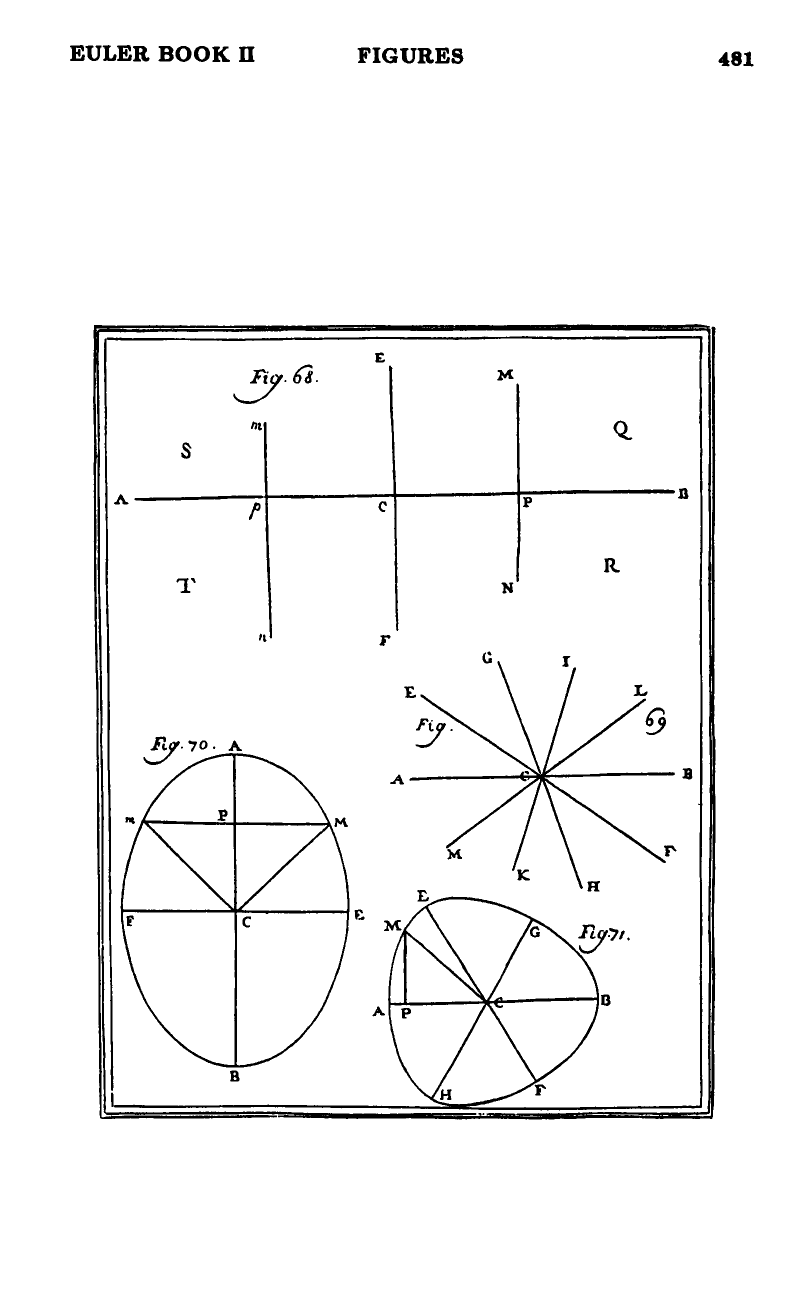 Figures 68–71
Related pages
- chapter-15-on-curves-with-one-or-several-diameters
- diameter-of-conic — the §90 prototype: a diameter as bisecting locus of parallel chords.
- center-of-conic — every conic with two diameters has a center.
- concurrence-of-diameters — what happens with more than two diameters.
- n-diameters-by-cos-ns — extending these symmetries to diameters at angle .