Ellipsoid
Summary: §§116–118 of the Appendix on Surfaces. Genus 1 of second-order surfaces — the only bounded genus. Canonical equation with all three coefficients positive (figure 143). Three principal sections are ellipses with semiaxes ; once these three are known the surface is determined. Three species: sphere (, all sections circles), spheroid prolate or oblate ( or two coefficients equal, one principal section a circle), and the general triaxial ellipsoid (all three coefficients distinct).
Sources: appendix5, §§116–118. Figure 143 in figures142-144.
Last updated: 2026-05-12.
§116 — Canonical equation and three principal sections
The center sits at the origin of ; are the three principal axes along which are measured.
Setting one variable to zero gives the three principal sections (in figure 143):
- : section is an ellipse with semiaxes .
- : section is an ellipse with semiaxes .
- : section is an ellipse with semiaxes .
When we know these three principal sections, or even their semiaxes …, the nature of this solid is determined and known. This first genus of surfaces of the second order is usually called an ellipsoid, since the three principal sections are ellipses. (source: appendix5, §117)
§117 — Three pairwise-perpendicular diametral planes
The three coordinate planes — that is, the planes , , — are mutually perpendicular diametral planes through the center. Each bisects the solid into two congruent halves: replacing , , or leaves the equation invariant. Compare diametral-plane for the parity calculus and quadric-canonical-form for the general statement.
§118 — Three species
Three sub-cases of genus 1, classified by which axes coincide:
| Species | Condition | Equation | Sections |
|---|---|---|---|
| Sphere | all three are circles | ||
| Spheroid | two coefficients equal | one section is a circle | |
| Triaxial ellipsoid | all coefficients distinct | as in §116 | all three sections are ellipses, no two congruent |
Within the spheroid species, prolate means the unique axis is longer than the other two (, i.e., football-shaped); oblate means it is shorter (, i.e., M&M-shaped).
The third species consists of those solids in which the three coefficients are all unequal, and so these retain the general name of ellipsoids. (source: appendix5, §118)
Cross-references
- The only bounded genus of second-order surfaces. See bounded-quadric-criterion for the necessary-and-sufficient conditions.
- 3D analogue of the ellipse from Book II Chapter 6. Where the ellipse has two principal axes, the ellipsoid has three; where the ellipse has the sum-of-squares law for conjugate diameters, the ellipsoid extends this to a sum-of-squares law in three conjugate directions.
- The spheroid species are the surfaces-of-revolution obtained by rotating an ellipse about its major (prolate) or minor (oblate) axis.
- The sphere is the limit of the spheroid as the eccentricity vanishes. It is also the limit of the ellipsoid as and approach — and the only second-order surface where every plane section is the simplest conic (a circle).
Figures
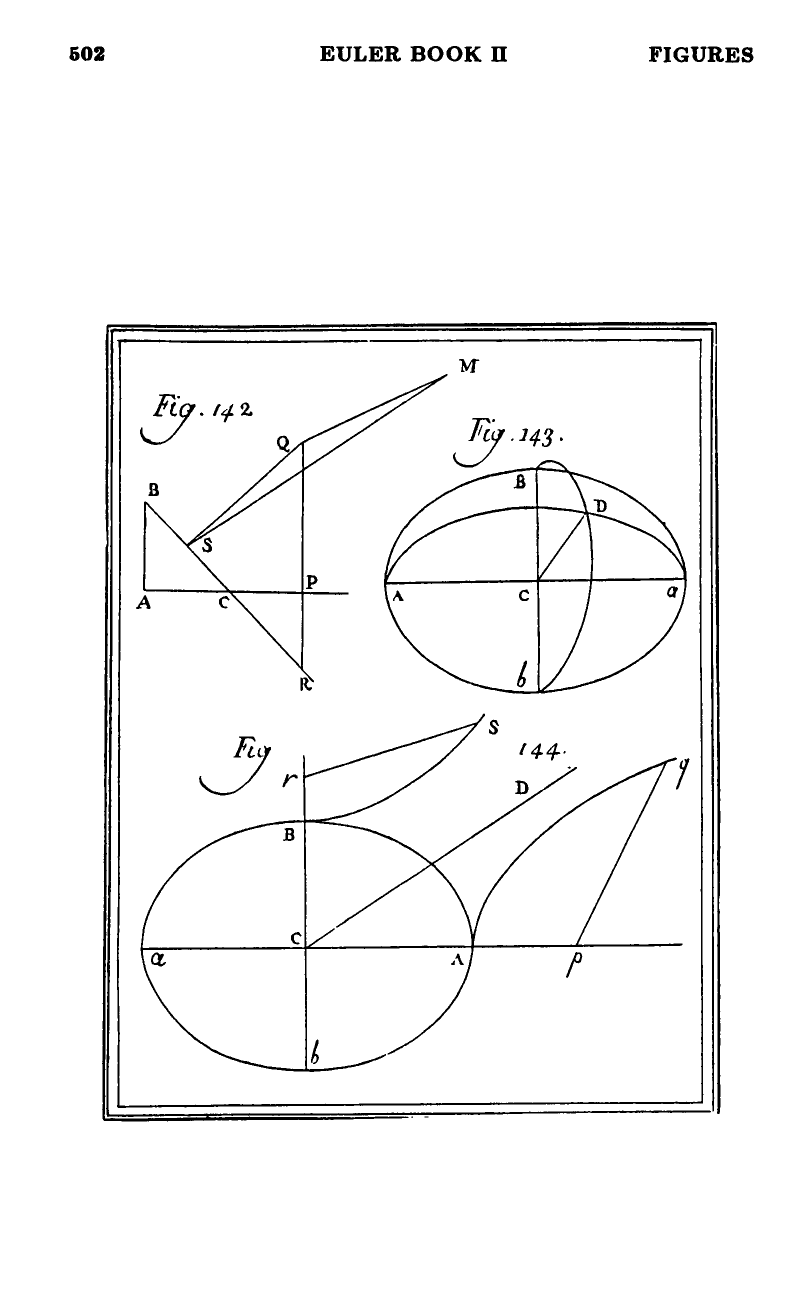 Figures 142–144