Ellipse
Summary: With the centre as origin and the principal axis as -axis, the ellipse has equation . The two foci on the major axis at distance from the centre satisfy for every point on the curve; the tangent at makes equal angles with the focal radii and . Conjugate semidiameters at angle obey and . Moving the origin to the vertex gives with the semilatus rectum and the vertex-focus distance.
Sources: chapter6 §§138-147; figure 31 (in figures30-32)
Last updated: 2026-04-26
Set-up: centre as origin (§138)
Starting from (with since the sign convention for an ellipse makes the leading coefficient negative), translate the abscissa by so the centre becomes the origin. The equation becomes
Setting gives — the curve crosses the axis at two points with . Setting gives — two more points with . Outside the ordinate is imaginary, so the curve is bounded.
Write the principal semiaxis and the conjugate semiaxis . Then and , giving the canonical form (source: chapter6, §138):
When the ellipse degenerates to a circle ; otherwise it is oblong. By convention the major axis is taken as the -axis: .
Foci and the sum-of-distances property (§§139-140)
The foci and lie on the major axis at distance from the centre. The semilatus rectum (semiparameter) is the ordinate at either focus:
For any point on the curve, the focal radii are
so
The sum of the focal radii at any point of the ellipse equals the major axis. This is the famous string-construction property — pin string of length to the two foci, trace with a pencil keeping the string taut, and one obtains the ellipse exactly (source: chapter6, §140).
Tangent and the equal-focal-angle property (§§141-142)
The tangent at meets the major axis at and the minor axis at . From the conic tangent ratio one gets , and analogously . Then
with the corresponding sine, cosine, and tangent of following directly. From and Euler obtains the central focal property (source: chapter6, §142):
so the tangent at makes equal angles with the two focal radii and . (Reflection law: a ray from one focus reflects off the curve toward the other.)
Auxiliary tangent constructions (§§143-144)
- meeting the tangent at gives — the segment of any line through the centre parallel to a focal radius and stopped at the tangent equals the principal semiaxis.
- The perpendicular from a focus to the tangent and the perpendicular from the other focus satisfy — the rectangle on the focal perpendiculars to the tangent equals , the square of the minor semiaxis.
- perpendicular to the tangent satisfies .
Conjugate diameter laws (§§145-146)
For a point on the curve, let be the semidiameter through and the conjugate semidiameter (parallel to the tangent at ), with included angle . Then (source: chapter6, §145):
The first identity is the constant sum of squares of conjugate semidiameters; the second says that the parallelogram inscribed around a conjugate pair has constant area . The orthogonal pair (the principal axes themselves) is the unique pair with , and that pair maximises — i.e. the orthogonal conjugates differ from each other the most (source: chapter6, §146).
The equal-conjugate pair is found by setting : then , . The semi-angles satisfy , and the equal conjugate semidiameters are parallel to the chords and joining vertex to minor-axis endpoint.
Vertex-origin form and the latus rectum (§147)
Take instead the vertex as origin: substitute for . The equation becomes
The coefficient is called the parameter or latus rectum of the ellipse. Writing for the semilatus rectum and for the vertex-focus distance, one gets and the vertex form (source: chapter6, §147):
For real ellipses always, since must be positive.
The vertex form is the version Euler will degenerate to a parabola in the next section by setting .
Notable points
- Algebraic, not metric, foundation. The foci are not introduced as the points whose distance-sum is constant; they are derived (§139) by computing from the canonical equation. The distance-sum property (§140) is then a consequence. This inverts the modern “metric definition first” pedagogy and matches Euler’s earlier definition of foci in chapter 5 §128 as the points from which is rational in .
- The two conjugate-diameter identities are the heart of ellipse geometry. and together let any conjugate-pair calculation be reduced to the principal axes. They generalise Pythagoras (which is the case , , ) and the rectangle-on-axes ( is the area of the principal rectangle, that of the conjugate-aligned parallelogram).
- Equal focal perpendiculars give . is the projective analogue of const: although the focal radii vary, the perpendiculars from the foci to the tangent multiply to a constant. This is the foundation of the Newtonian focal-chord constructions.
- Vertex form bridges to the parabola. Writing the equation about the vertex with parameter and vertex-focus distance pulls off-stage. The substitution — equivalent to — collapses the equation to , the parabola. So the parabola is literally an ellipse with infinite major axis (source: chapter6, §148).
Figures
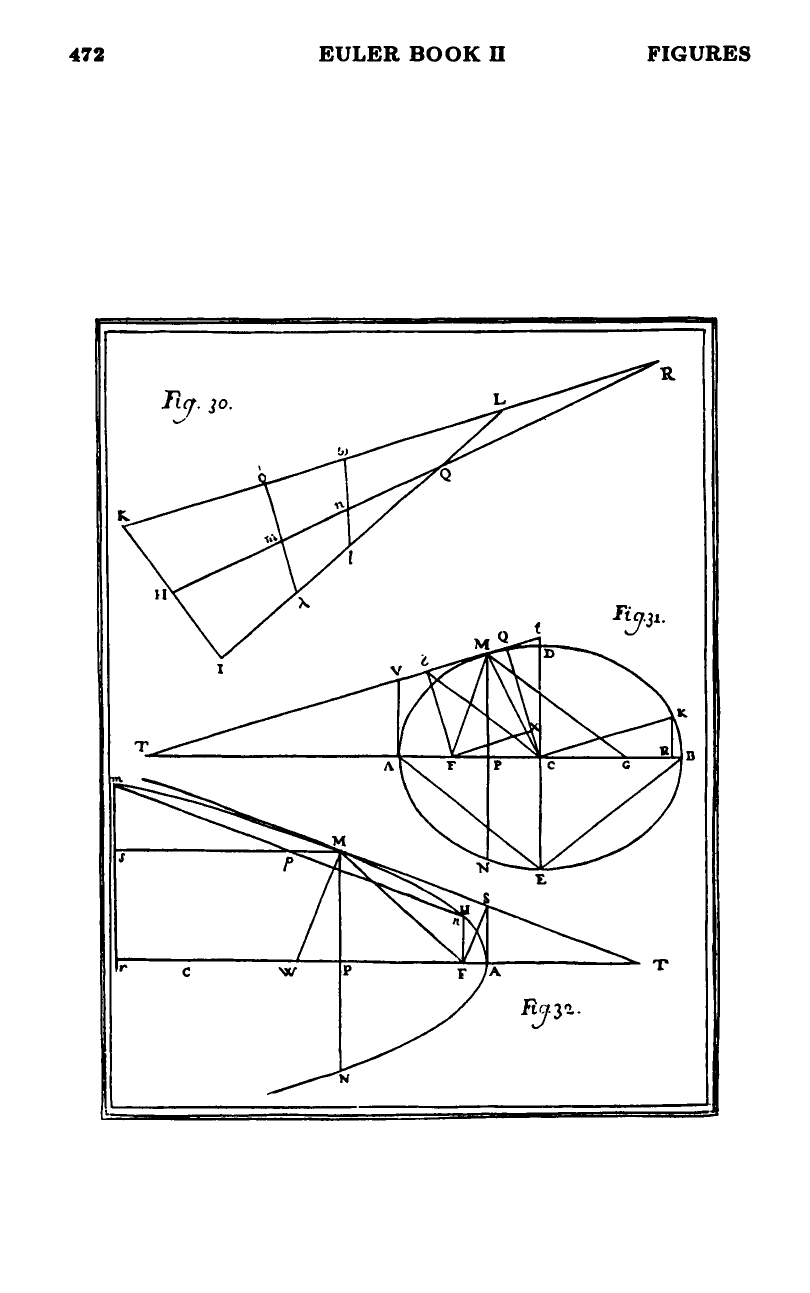 Figures 30–32