Elliptic and Hyperbolic Hyperboloids
Summary: §§119–122 of the Appendix on Surfaces. The two genera with a real asymptotic cone. Genus 2 = elliptic hyperboloid (figure 144) — one negative coefficient, one ellipse section + two hyperbolic sections, circumscribes its asymptotic cone (one-sheeted in modern terminology). Genus 3 = hyperbolic hyperboloid (figure 145) — two negative coefficients, two hyperbolic sections + one complex section, inscribed inside its asymptotic cone (two-sheeted). The asymptotic cone is itself the limit species of either genus.
Sources: appendix5, §§119–122. Figures 144, 145 in figures142-144 and figures145-147.
Last updated: 2026-05-12.
§§119–121 — Genus 2: elliptic hyperboloid (figure 144)
One negative coefficient (or two — equivalent by signs):
Principal sections:
- : ellipse with semiaxes .
- : hyperbola with transverse semiaxis and conjugate semiaxis .
- : hyperbola with transverse semiaxis and conjugate semiaxis .
The surface goes to infinity along the two branches of each hyperbola.
Asymptotic cone: , vertex at center , right (if ) or scalene (otherwise), axis perpendicular to plane . All sections perpendicular to are ellipses similar to ; all sections perpendicular to are hyperbolas. The surface lies outside the cone, circumscribing it asymptotically.
Hence these surfaces are usually called elliptic hyperboloids circumscribed about their asymptotic cone. (source: appendix5, §120)
Species:
- : ellipse shrinks to a point, hyperbolas become straight lines — the surface becomes the asymptotic cone itself. So this species “contains all cones, both right and scalene” (§121).
- : ellipse becomes a circle — surface is turned (a surface of revolution), generated by rotating a hyperbola about its conjugate axis.
- General: all coefficients distinct.
§122 — Genus 3: hyperbolic hyperboloid (figure 145)
Two negative coefficients:
Principal sections:
- : hyperbola with center , transverse semiaxis , conjugate semiaxis .
- : hyperbola , same transverse semiaxis , conjugate semiaxis .
- : section complex — the equation has no real solutions.
The surface has two disjoint sheets opening along direction (two-sheeted in modern terminology).
Asymptotic cone: , same as for genus 2 but the surface lies inside the cone — inscribed in the asymptotic cone.
The whole of this surface lies inside the asymptotic cone. For this reason this genus can be called hyperbolic hyperboloid inscribed in the asymptotic cone. (source: appendix5, §122)
Species:
- : the two negative coefficients are equal — surface is turned, generated by revolving a hyperbola about its transverse axis.
- : surface degenerates to the asymptotic cone again (same as genus 2’s limit).
The cone as the common limit
Both genera collapse to the same family of asymptotic cones as . Hence in Euler’s framework the cones (including both right and scalene) are subsumed under genus 2 — they appear as the boundary species. Surfaces inscribed in (genus 3) and circumscribed about (genus 2) the same cone are the two real “thickenings” of the cone obtained by shifting the level set away from zero.
Cross-references
- The same equation with replaced by gives the asymptotic cone (asymptotic-cone). Genus 2 surfaces sit outside it, Genus 3 inside.
- 3D lift of the hyperbola and its asymptotes-of-hyperbola: the hyperbola sits between its two asymptotes, much as the hyperboloid sits between or inside its asymptotic cone.
- Both surfaces are unbounded (fail bounded-quadric-criterion) but their cones are non-degenerate (distinguishing them from paraboloids-and-parabolic-hyperboloid).
Figures
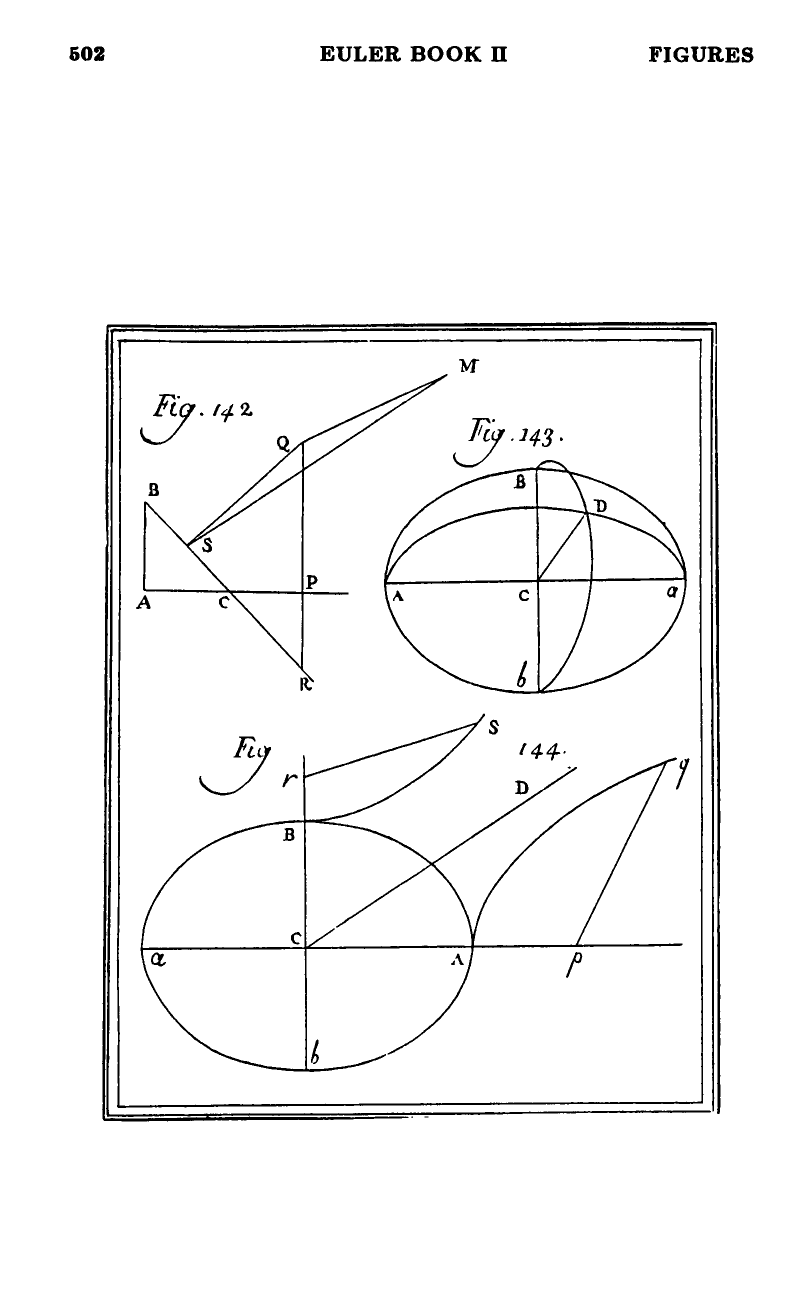 Figures 142–144
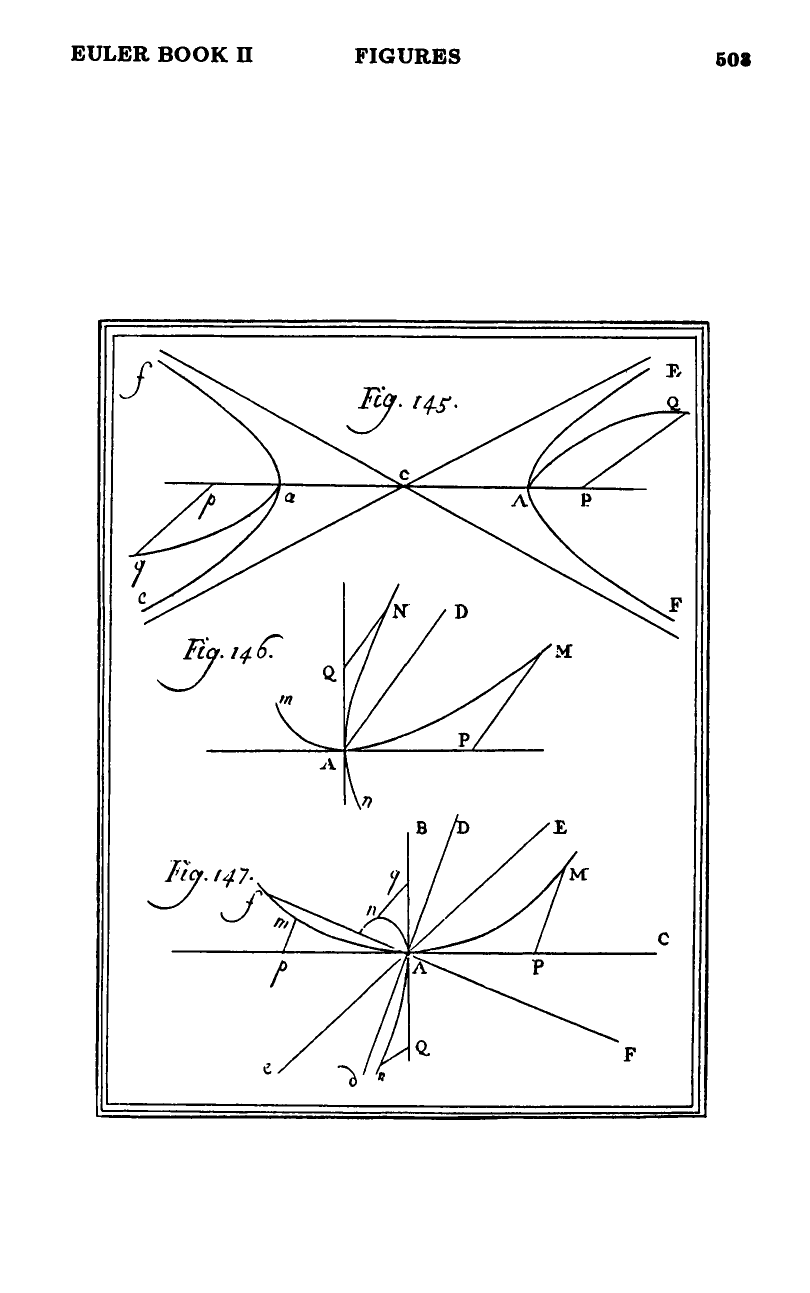 Figures 145–147