Appendix Chapter 5 — On Second Order Surfaces
Summary: Classification of the surfaces . The principal tool is the asymptotic cone — the homogeneous degree-2 part — whose factorization or non-factorization controls whether the surface is bounded, hyperbolic, or parabolic. Reduction by rotation + translation gives the canonical form (§§113–115). Six genera, each with figure: ellipsoid (genus 1, figure 143), elliptic hyperboloid circumscribing its cone (genus 2, figure 144), hyperbolic hyperboloid inscribed in its cone (genus 3, figure 145), elliptic paraboloid (genus 4, figure 146), parabolic hyperboloid with two asymptotic planes (genus 5, figure 147), parabolic cylinder (genus 6, with parallel-planes quasi-species). Closing §§127–130: read the genus directly off the original equation’s six second-degree terms; brief preview of third-order surfaces.
Sources: appendix5, §§101–130. Figures 143, 144 in figures142-144. Figures 145, 146, 147 in figures145-147.
Last updated: 2026-05-12.
§§101–104 — The general equation, two main classes, and the part going to infinity
No matter what three coordinates may be chosen, the equation always has this form. (source: appendix5, §102)
Surfaces split into bounded and going-to-infinity classes (§103) — no odd-order surface is bounded, since any plane section of an odd-order surface is odd-order and hence unbounded. To capture the infinite part, set : the linear and constant terms are negligible relative to the degree-2 terms, leaving (§104) the homogeneous part
§§105–107 — The asymptotic cone
Solving §105’s homogeneous equation for :
This is a cone with vertex at the origin — the surface’s behaviour at infinity is congruent with this cone’s. Whether the cone is real or complex distinguishes the bounded class from the unbounded one. See asymptotic-cone.
§§108–110 — Bounded criterion
For the asymptotic cone to be reduced to a single point (real solutions only at the vertex):
and additionally
A surface satisfying all four is bounded — Genus 1, the ellipsoid family (the sphere trivially satisfies them with ). See bounded-quadric-criterion.
§§111–112 — Three genera going to infinity
When the asymptotic cone is real, it factors as the product of two real lines through the origin (the “linear-factor” case §112) iff
This is the intermediate case — between bounded and inscribed-in-cone. The two linear factors can be real (genus 5), complex (genus 4), or coincident (genus 6). So altogether: bounded (1), inscribed in real cone (3), circumscribing real cone (2), two real asymptotic planes (5), two complex asymptotic planes (4), one double asymptotic plane (6). Five-plus-one = six genera.
§§113–115 — Canonical reduction
Apply change-of-coordinates-3d (§92) with three angles to kill the three cross-terms , giving . A translation then kills the linear terms (if all of are nonzero), leaving the canonical form
with three mutually perpendicular diametral planes through the center (§115). The center can lie at infinity in degenerate cases (paraboloids and cylinders). See quadric-canonical-form.
§§116–118 — Genus 1: ellipsoid (figure 143)
, all three coefficients positive. Three principal sections are ellipses with semiaxes — call them . Three species:
- Sphere (, sections are circles):
- Spheroid (two coefficients equal): prolate () or oblate ()
- Triaxial ellipsoid (all coefficients distinct): the general member
See ellipsoid.
§§119–122 — Genera 2 and 3: hyperboloids (figures 144, 145)
Genus 2 — one negative coefficient: (figure 144). One principal section () is an ellipse ; the other two are hyperbolas with conjugate semiaxis . Surface is unbounded along both branches of the hyperbola, circumscribes its asymptotic cone . Species: cone (, both genera collapse together); round (); general.
Genus 3 — two negative coefficients: (figure 145). Two principal sections are hyperbolas with transverse semiaxis ; third section is complex (i.e., empty in real coordinates). Surface lies inscribed inside its asymptotic cone.
See elliptic-and-hyperbolic-hyperboloids.
§§123–125 — Genera 4 and 5: paraboloids (figures 146, 147)
When in the canonical form, the translation kills but leaves , giving .
Genus 4 — both (figure 146): elliptic paraboloid . Sections perpendicular to the axis are ellipses; sections containing it are parabolas. Species: parabolic cone (, round); elliptic cylinder (, ).
Genus 5 — opposite signs (figure 147): parabolic hyperboloid . Principal section is two straight lines ; the two perpendicular planes through these lines are asymptotic planes. Other principal sections are parabolas. Species: hyperbolic cylinder (); two asymptotic planes ().
See paraboloids-and-parabolic-hyperboloid.
§126 — Genus 6: parabolic cylinder (figure 147)
When two coefficients vanish: — a parabolic cylinder whose perpendicular sections are congruent parabolas. Special quasi-species gives two parallel planes, analogous to how two parallel lines are a degenerate parabola in the conic classification. See parabolic-cylinder-quadric.
§§127–128 — Algorithm: read genus from the original equation
We make our decision from the second degree terms. (source: appendix5, §127)
Given the full equation in , look only at :
| Test | Genus |
|---|---|
| , , , and | 1 (ellipsoid) |
| Some inequality fails, | 2 or 3 (hyperboloid: circumscribing or inscribed in cone) |
| , two complex linear factors of the homogeneous part | 4 (elliptic paraboloid) |
| Same equality, two real linear factors | 5 (parabolic hyperboloid) |
| Same equality, double linear factor | 6 (parabolic cylinder) |
The §128 caveat: distinguishing genera 2 and 3 from a generic equation is harder, since either can morph into the other by perspective rearrangement; the canonical reduction (§§113–115) settles it. See quadric-classification-algorithm.
§§129–130 — Higher-order outlook
For a third-order surface, look at the third-degree terms . Either the expression factors into linear pieces (giving asymptotic planes) or it doesn’t (giving a third-order asymptotic cone). Among third-order cones there is much greater variety than among second-order ones — there are right and scalene cones but the third-order family has many distinct types. No third-order surface lies in a bounded region — any odd-order surface has odd-order sections, which are themselves unbounded. See higher-order-surface-cones.
Cross-references
- The Genus-1 ↔ Genus-2 ↔ Genus-3 ↔ Genus-4/5 split is the 3D analogue of the classification-of-conics trichotomy (ellipse / parabola / hyperbola). Six genera correspond to the conic four (ellipse, parabola, hyperbola, two parallel lines as a quasi-parabola, two intersecting lines as a quasi-hyperbola) lifted to surfaces.
- Canonical reduction by rotation depends on change-of-coordinates-3d §92.
- Each genus’s principal sections are conics — Genus 1 has three ellipses, Genus 4 has one ellipse + two parabolas, etc. — concretely realizing §51’s general-quadric-surface theorem.
Figures
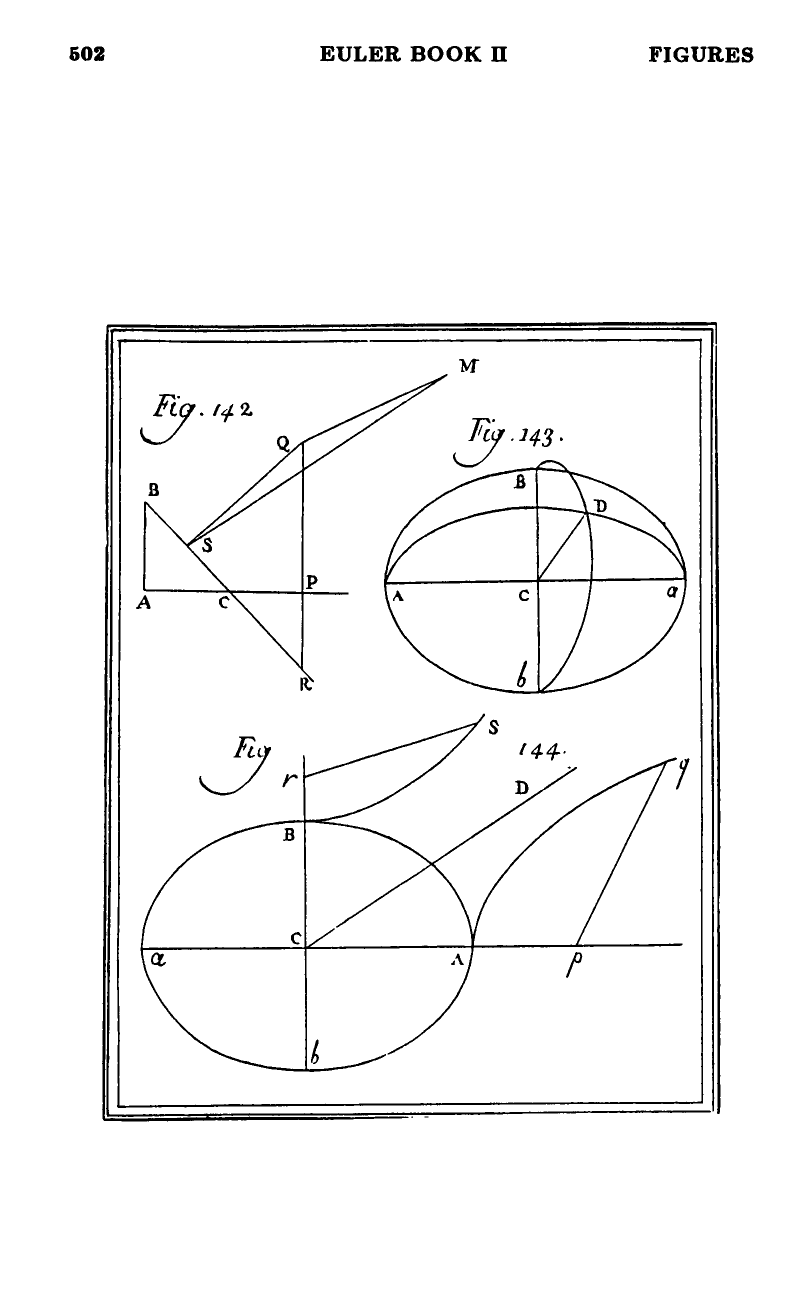 Figures 142–144
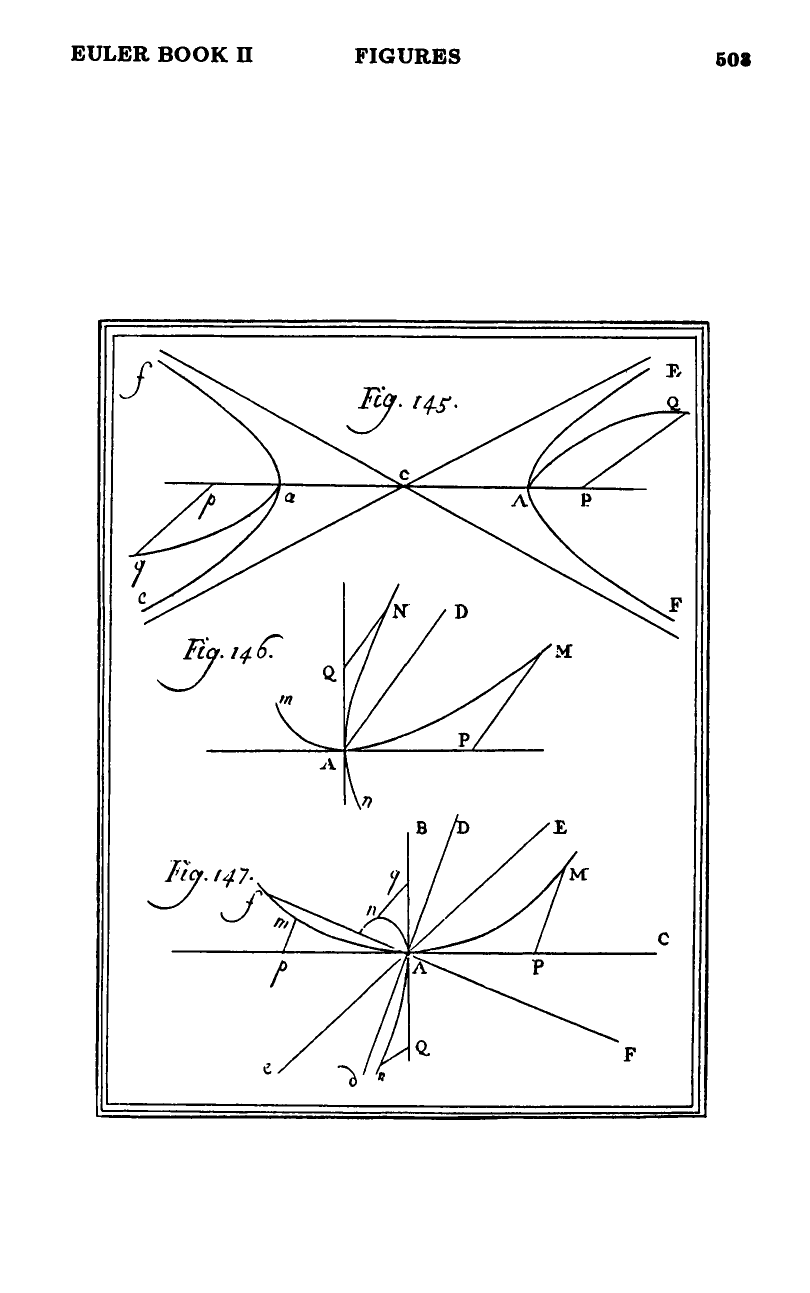 Figures 145–147
Related pages
- asymptotic-cone
- bounded-quadric-criterion
- quadric-canonical-form
- ellipsoid
- elliptic-and-hyperbolic-hyperboloids
- paraboloids-and-parabolic-hyperboloid
- parabolic-cylinder-quadric
- quadric-classification-algorithm
- higher-order-surface-cones
- appendix-4-on-the-change-of-coordinates
- appendix-6-on-the-intersection-of-two-surfaces
- general-quadric-surface
- classification-of-conics