Example — Bounded Curve with Eight Ordinates
Summary: §284 worked example for the configuration program. Euler considers , which gives eight values of the ordinate at every abscissa in (the interval where all three radicands are nonnegative). A six-column table from to in unit steps yields enough sample points to draw figure 54: a bounded figure-eight-like configuration in two pieces, with two cusps at the and extremes and four self-intersections.
Sources: chapter12 (§284). Figure 54 (in figures51-54).
Last updated: 2026-05-04.
The equation
§284 — “We will illustrate these remarks with an example in which the degree is higher, but the values of can still be expressed by quadratic roots.” The equation is
Each of the three radicals takes a sign independently, so there are choices of signs and hence eight ordinates per abscissa. Compared to the chapter 8 worked example (which has eight branches at infinity), this one has eight ordinates in a bounded region.
The bounded interval
For real ordinates the three radicands need to be simultaneously :
- .
- or .
- .
Intersection: . So the curve is wholly contained in the strip .
The table of values
Sampling integer abscissas from to :
| sum | ||||
|---|---|---|---|---|
| 0 | 0.000 | 0.000 | 6.000 | 6.000 |
| 1 | 2.235 | 2.645 | 5.916 | 10.796 |
| 2 | 2.828 | 4.000 | 5.656 | 12.484 |
| 3 | 3.000 | 5.196 | 5.196 | 13.392 |
| 4 | 2.828 | 6.324 | 4.470 | 13.622 |
| 5 | 2.235 | 7.416 | 3.316 | 12.967 |
| 6 | 0.000 | 8.484 | 0.000 | 8.484 |
The eight ordinates are then obtained from the four sign-pattern rows (the other four rows are negatives of these):
| 3.000 | 5.398 | 6.242 | 6.696 | 6.811 | 6.483 | 4.242 | |
| 3.000 | 3.163 | 3.414 | 3.696 | 3.983 | 4.248 | 4.242 | |
| 3.000 | 2.753 | 2.242 | 1.500 | 0.487 | 0.933 | ||
| 0.586 | 1.500 | 2.341 | 3.167 | 4.242 |
(The values are halved because of the leading .) The remaining four sign patterns give the negatives.
Two observations from the table.
- Endpoint collisions. At two of the three radicals vanish, so the eight ordinates collapse to just (each value taken with multiplicity four). At the same thing happens — two radicals vanish, ordinates collapse to . These four-into-one collisions at the left and right edges of the bounded interval are the source of the singular points of the figure.
- Interior coincidence at . The second and third radicands are equal (), so the and rows give the same value . This is a self-intersection — a node where two of the eight branches cross.
The picture (figure 54)
“to each value of the abscissa we have corresponding eight values of the ordinate, which are shown in figure 54. The curve consists of two parts: and . It has two cusps, at and , it has two double points or self-intersections at four points, and .”
So Euler reads the curve as two interlocking oval-like loops, joined at the cusps and (lying on the -axis at ) and crossing themselves at four nodes . The vertex symbols trace the two complete loops.
The figure is essentially a bounded figure-eight knot drawing — visually it sits as two ovals (one with cusps and on the axis, one with cusps and below) sharing a four-self-intersection scaffolding through the interior.
Why this matters
The example is Euler’s existence proof that the configuration program of the chapter can in principle be carried out for higher-degree curves: even when the equation is too unwieldy to factor symbolically, a finite table of sample abscissas with the resulting ordinates pinned down by the discriminant-collision rules is enough to draw the curve faithfully. This is the bounded-region counterpart to the chapter-8 eight-branches-at-infinity example.
Figures
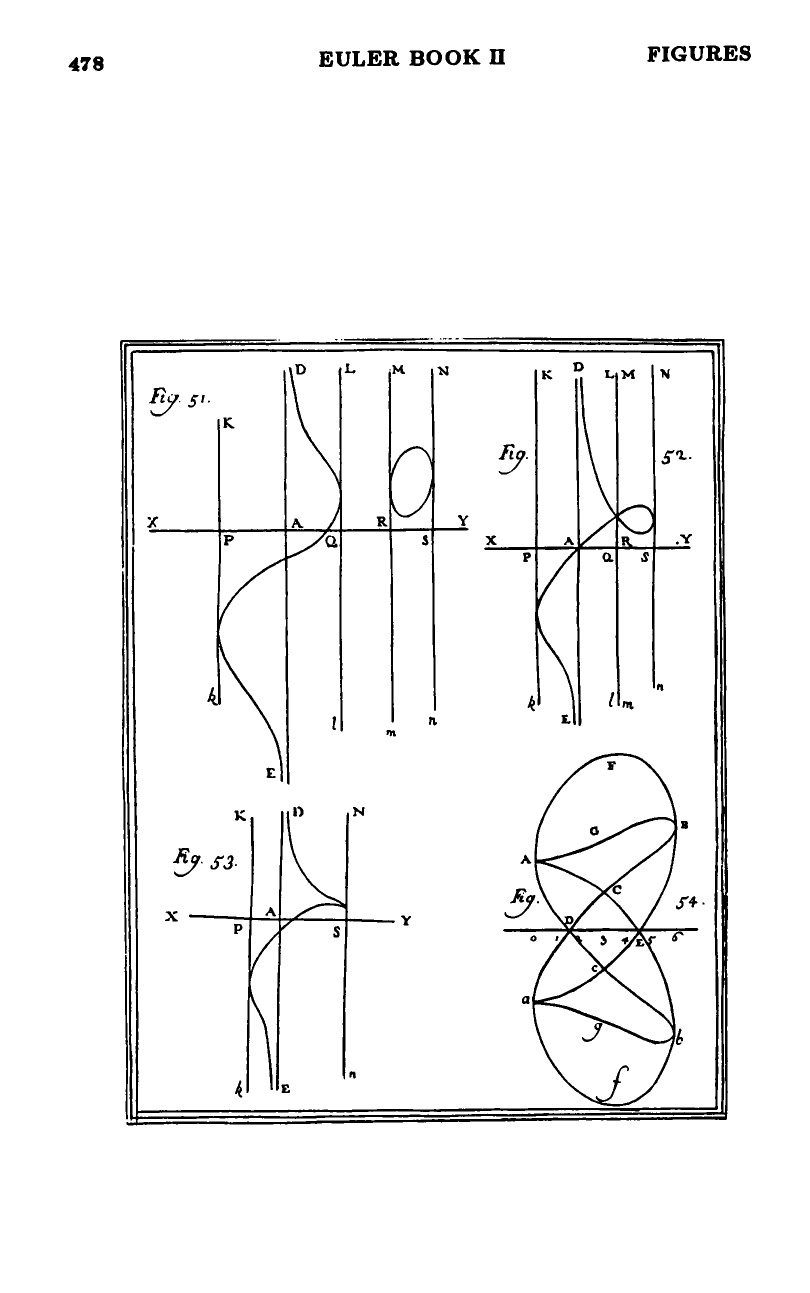 Figures 51–54
Related pages
- chapter-12-on-the-investigation-of-the-configuration-of-curves — chapter summary.
- configuration-from-discriminant — the general method this worked example exercises.
- multiple-points-on-curves — node, cusp, conjugate point classification used to read figure 54.
- example-curve-eight-branches — the chapter 8 dual example (eight branches at infinity rather than eight ordinates in bounded region).