Chapter 12: On the Investigation of the Configuration of Curves
Summary: Counterpart to chapters 7–11: where those treated branches at infinity, this chapter asks how the curve behaves in the bounded region. The tool throughout is to write the equation as a quadratic in one coordinate — — and read the configuration off the discriminant , whose real roots mark the points where two ordinates collapse into one and beyond which they go complex. From this Euler reads off ovals, conjugate ovals, conjugate points, nodes, and cusps as the standard repertoire of singular points.
Sources: chapter12 (§§272–284). Figures 49, 50, 51, 52, 53 (in figures47-50, figures51-54); figure 54 (in figures51-54).
Last updated: 2026-05-04.
The problem
§272 — solving for all real ordinates over the whole axis is in general beyond known analysis. But the equation can be brought to a tractable form by the same coordinate moves used in chapter-9-on-the-species-of-third-order-lines and chapter-10-on-the-principal-properties-of-third-order-lines: rotate so that one variable enters with the lowest possible degree, and keep that variable as the ordinate. Then for each abscissa the ordinate is determined by an equation whose degree controls the difficulty.
The cleanest case is when the equation is quadratic in . Writing it as
with polynomials in , the configuration is governed by the discriminant as a polynomial in .
The five varieties of the first cubic species
§§273–277 work the program out completely for the first species of cubic from §258. The simplest representative form is
with , . The quartic discriminant under the radical determines everything; see first-species-cubic-configurations for the five varieties (asymptotic-with-loop, conjugate oval, conjugate point, node, cusp) and the figures 49–53 attached to them. Newton counted each as its own species; Euler counts them as varieties of one.
Other species and the general program
§§278–280 — for the other species the same idea applies in the easier setting where the equation is linear or quadratic in one coordinate.
- (rational): the ordinate is single-valued; vanishing of the denominator marks straight-line asymptotes ( for simple poles, for double poles, sign-changing again for triple, recovering the chapter 7 catalogue).
- : two ordinates where , none where , one (a tangent or a pinch) where . Real roots of partition the axis into alternating real and complex intervals — so the curve breaks into as many connected pieces as there are alternations. This is the source of conjugate ovals.
Multiple points
§§281–282 read the singular points off as collisions of the discriminant’s roots; see multiple-points-on-curves. Two equal roots either pinch a real interval shut (node) or collapse a complex interval to nothing (vanishing oval = conjugate point); three give a cusp; four either collide two ovals at a point, or graft a node onto a cusp, or join two cusps tip-to-tip; five give a cusp with two ovals attached. Beyond five there is nothing new. This is also Euler’s working definition of double point (a node), triple point (two doubles coinciding), and conjugate point (a vanishing oval).
Higher degree
§283 — when the equation is cubic or higher in , the number of real ordinates over each abscissa changes only by 2, 4, … at a time, and at each such transition two values become equal. Every such transition has the form already classified, so a finite point-by-point sample of -values at chosen suffices to draw the curve.
§284 illustrates this with a worked octic — see example-bounded-curve-eight-ordinates for the table of values and figure 54.
Figures
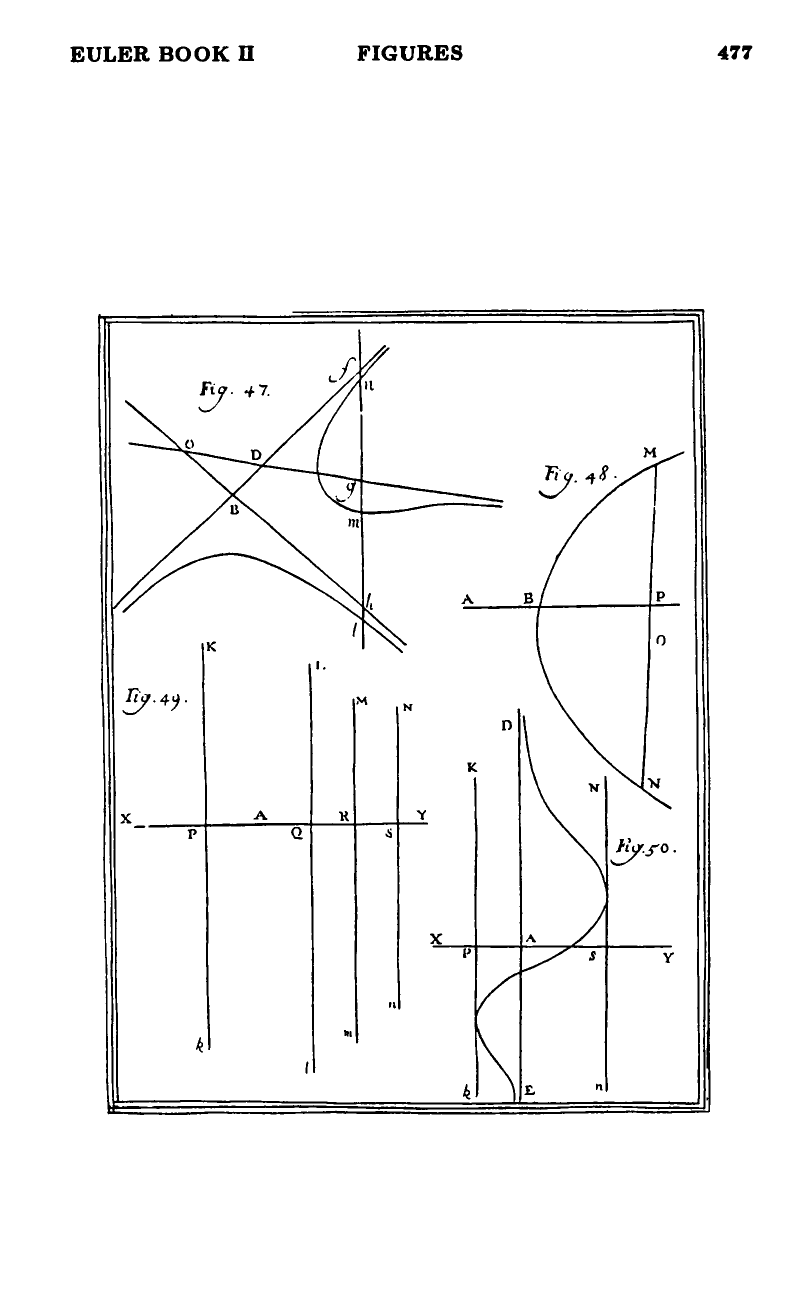 Figures 47–50
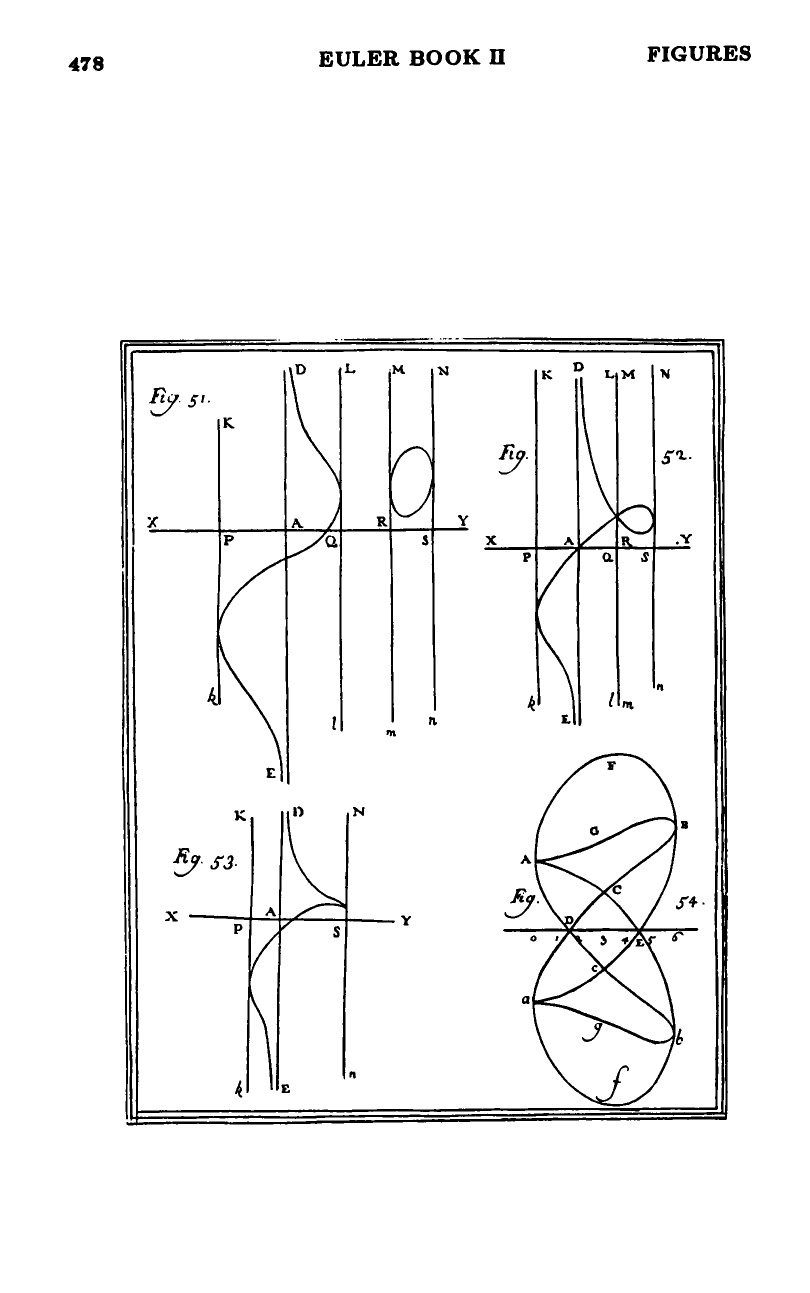 Figures 51–54
Related pages
- chapter-7-on-the-investigation-of-branches-which-go-to-infinity — the dual problem (behavior at infinity).
- chapter-9-on-the-species-of-third-order-lines — supplies the §258 simplest first-species cubic that this chapter unpacks.
- chapter-10-on-the-principal-properties-of-third-order-lines — the §258 oblique forms used throughout §273.
- configuration-from-discriminant — the general method.
- first-species-cubic-configurations — the five varieties of §§275–277.
- multiple-points-on-curves — node, cusp, conjugate point as collisions of discriminant roots.
- example-bounded-curve-eight-ordinates — §284 worked example.
- euler-vs-newton-cubic-species — Newton’s “different species” vs. Euler’s “varieties of one species” choice.