Example: Eight-Branch Curve
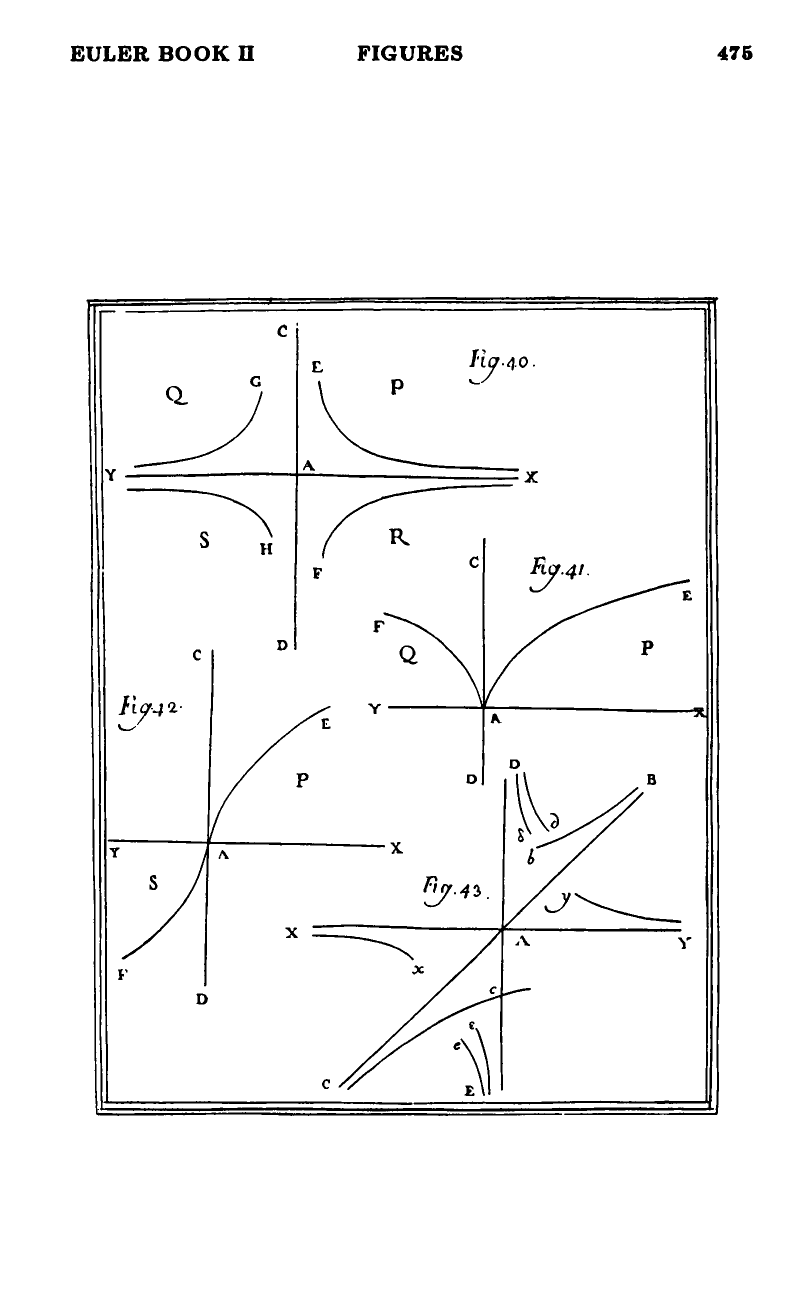
Summary: Euler’s worked example closing chapter 8. The sextic curve has principal member , which factors with three different multiplicities — single , double , triple — exercising in one curve every case from §§200–214. Each factor is treated by the chapter’s refinement procedure: the single factor produces a hyperbolic-rate curvilinear asymptote along the line (2 branches); the double factor produces a parabolic-rate asymptote and a pair of asymptotes along the -axis (4 branches); the triple factor produces a single asymptote along the -axis (2 branches). Total: 8 branches at infinity, drawn as figure 43.
Sources: chapter8 (§§215–217), figures40-43 (figure 43).
Last updated: 2026-04-28
The curve
§215. The given equation is
The principal member (highest member, degree 6) is . Its real-linear-factor decomposition is
three different real factors with multiplicities . By branches-at-infinity, each contributes branches at infinity; by curvilinear-asymptote-refinement, double-factor-asymptote-cases, and triple-factor-asymptote-cases, the asymptote shapes are read off in turn. The curve has, in total, 8 branches going to infinity, displayed as figure 43.
Single factor (§215, simple-factor case)
The factor has multiplicity 1, so this is a curvilinear-asymptote-refinement / rectilinear-asymptote-from-equation case.
Quick refinement. Since is a single factor, isolate it from the equation and substitute in the remainder. From , solve for :
Substitute in the right-hand side:
At infinity () the second term vanishes faster, leaving
i.e. straight-line asymptote refined to curvilinear asymptote .
Geometric placement. The straight-line asymptote is the line in figure 43 — the diagonal making an angle of (half a right angle) with the original axis , through the origin .
Coordinate change to the asymptote axis. To verify and study the branches, rotate axes onto the asymptote direction. Set , , so
Substituting into the equation:
(after collecting and using … Euler’s expansion). Multiplying by 4 and reorganising:
At with , only the terms avoid vanishing. The leading equation is
This is the curvilinear asymptote along the diagonal — a hyperbolic-rate refinement, in the curvilinear-asymptote-refinement catalogue. By the parity rule (§203), odd → branches in opposite quadrants of the asymptote. Two branches and in figure 43, on opposite sides of .
Double factor (§216, double-factor case)
The factor has multiplicity 2, so this is a double-factor-asymptote-cases case. The asymptote direction is the vertical — perpendicular to the axis — so the new axis is in figure 43.
Set , (the new abscissa is along , the original -axis; the new ordinate is along the original -axis). The equation becomes
(One can derive this directly: , — but the cross-term has lower degree than at infinity, so on Euler’s normalisation it goes into the higher-power category. Euler’s printed form is the expansion above.)
At the leading equation is
a quadratic in with -dependent coefficients. Treating it as a quadratic in :
The two roots split into
(Equivalently: at infinity, balancing the leading and next terms gives either → , or → .)
So the double factor produces two distinct curvilinear asymptotes along the same straight-line asymptote (the -axis ):
- — a hyperbolic refinement, , contributing branches and on opposite sides.
- — a faster hyperbolic refinement, , contributing branches and on opposite sides.
By the parity rule, each odd- shape gives 2 branches in opposite quadrants. Four branches total along (two pairs at different rates), drawn in figure 43.
This is the case-1 instance () of the general analysis in double-factor-asymptote-cases §208: four branches at two different rates, both converging to the same straight line.
Triple factor (§217, triple-factor case)
The factor has multiplicity 3, so this is a triple-factor-asymptote-cases case. The asymptote direction is horizontal — the original -axis itself.
Set , . The equation becomes
(rearranging , , ). At with , the leading terms are :
Since has no real roots, the only asymptote is — the -axis itself. The other two roots () would have given parallel-line asymptotes, but they are complex.
To find the rate of approach, we need the next term. After is set in the equation, the surviving balance is
So the triple factor contributes the curvilinear asymptote along the -axis. By the parity rule, odd → branches in opposite quadrants. Two branches and in figure 43.
The triple factor here is unusual: the cubic-in- leading equation has only one real root, so only one of the three would-be straight-line asymptotes (counting with multiplicity) is real; the other two pair into a complex conjugate quadratic with no real branches. This is one of the case-IV equal-roots sub-cases from triple-factor-asymptote-cases §214.
Total branch count
| Factor | Multiplicity | Branches | Asymptote |
|---|---|---|---|
| 1 | 2 | along | |
| 2 | 4 | and along | |
| 3 | 2 | along | |
| Total | 8 |
Figure 43 shows all 8 branches. Euler ends the section with the cautionary note: “This is not the place to explain how these branches all come together in the bounded region” — i.e. the global topology of the curve (cusps, self-intersections, and so on within the finite plane) is not addressed in chapter 8; only the behavior at infinity is.
Why this example is canonical
- Three multiplicities in one curve. A single equation containing single, double, and triple factors of means every section of chapter 8 is exercised at least once.
- Mixed asymptote types. The three factors give three different asymptote forms — one curvilinear refinement of a straight line, one double refinement (two rates on the same line), one slow rate from a cubic equation — illustrating the diversity of the catalogue.
- A single sextic example. All this from one equation of degree 6. The asymptotic information is rich; the curve itself is mere algebra. This is the persuasive force of Euler’s algebraic-asymptote machinery: a sweeping qualitative picture of an unfamiliar curve, derived without graphing.
Figures
 Figures 40–43