Multiple Points on Curves
Summary: Euler’s local classification of singular points on an algebraic curve, derived from collisions between consecutive real roots of the discriminant . Two roots merging produces either a node (double point) or a vanishing oval that becomes a conjugate point; three give a cusp; four or more produce composites — joined ovals, node-on-cusp, twin cusps. A node is the same thing as a double point because any straight line through it cuts the curve in two points there. Triple points arise when a node is hit by a third branch; in general, multiple points are vanishing ovals, double points, or cusps stacked.
Sources: chapter12 (§§281–282). Figures 52, 53 (in figures51-54).
Last updated: 2026-05-04.
The collision dictionary
§281 — start from the discriminant picture: real roots of partition the abscissa into alternating intervals where the curve has either two real ordinates or none. Coincident roots collapse one of these intervals.
| Coincidence | What collapses | Resulting local shape |
|---|---|---|
| 2 equal roots | a real-ordinate interval | node (figure 52) |
| 2 equal roots | a complex-ordinate interval | conjugate point (vanishing oval) |
| 3 equal roots | adjacent interval pattern | cusp (figure 53) |
| 4 equal roots | various | two ovals collide at a point; node grafted onto cusp; two cusps joined back-to-back |
| 5 equal roots | — | a cusp with two ovals attached |
| more | — | nothing genuinely new |
The key observation is that the three primitive shapes — node, conjugate point, cusp — exhaust the local taxonomy; everything else is a stacking.
Node = double point
§282 — Euler defines:
“A node, or the intersection of two branches of a curve, is also called a DOUBLE POINT, since a straight line intersecting the curve in that point must be considered to cut the curve in two points.”
Any straight line through a node meets the curve in two of the curve’s points at alone (one on each branch passing through). A line of order would normally meet the curve in points; passing through a double point eats two of them at the same place.
This is consistent with the Bezout-style intersection bound from chapter 4 if multiple points are counted with multiplicity.
Triple and higher points
§282 — when a third branch passes through an existing node, the result is a triple point (or, in Euler’s phrasing, “two double points coincide”). The same idea iterates: a -fold point is doubles overlaid.
Euler frames this as: “we understand the nature and source of any multiple points. That is, we may have a vanishing oval, or a conjugate point; there can be a double point; or there can be a cusp, which arises when a conjugate point is adjoined to the rest of the curve.” So the four atomic types are:
- Conjugate point (vanishing oval) — an isolated real point not on any real arc; the limiting case of an oval shrunk to nothing.
- Double point (node) — two real arcs crossing transversally.
- Cusp — two real arcs meeting tangentially with opposite orientations.
- Multiple point of higher order — composites of the above (triple points, joined ovals, etc.).
The cusp is described as “a conjugate point … adjoined to the rest of the curve” — i.e. as the limit configuration when a conjugate point and a single arc collide.
Why root collisions explain every singular point
Local analysis. Near a generic abscissa in the interior of a real-ordinate interval, the two ordinates are smooth functions of ; the curve is locally two non-intersecting arcs. The only way the topology can change is for the discriminant to vanish — which is exactly where the two arcs touch. The order of vanishing of at the collision point determines the contact order of the two arcs:
- Simple zero: the two arcs meet but cross the imaginary side, so we just have a tangential closure (the boundary of one of the §275-style intervals).
- Double zero: the two arcs meet at the boundary of two real intervals on the same side — they cross at a node, or at the boundary of two complex intervals on the same side — they have collapsed an oval to a conjugate point.
- Triple zero: the contact is tangent — a cusp.
- Higher even/odd zeros: combinatorial composites.
Euler does not phrase it in these (later, jet-theoretic) terms, but his enumeration is exactly the catalogue of local pictures up to topological type.
Higher-degree equations
§283 — when the equation is cubic or higher in , every transition between ” real ordinates” and ” real ordinates” still has the form of a root collision: two real ordinates fuse before they go complex. So at every transition the local picture is one of those above, and the singular-point classification carries over without change. “Hence in the transition from complex to real, there are many forms, but they are all either of the form already discussed, or they are a combination of these.”
example-bounded-curve-eight-ordinates illustrates this for an octic, which exhibits a pair of cusps and a quartet of double points.
Figures
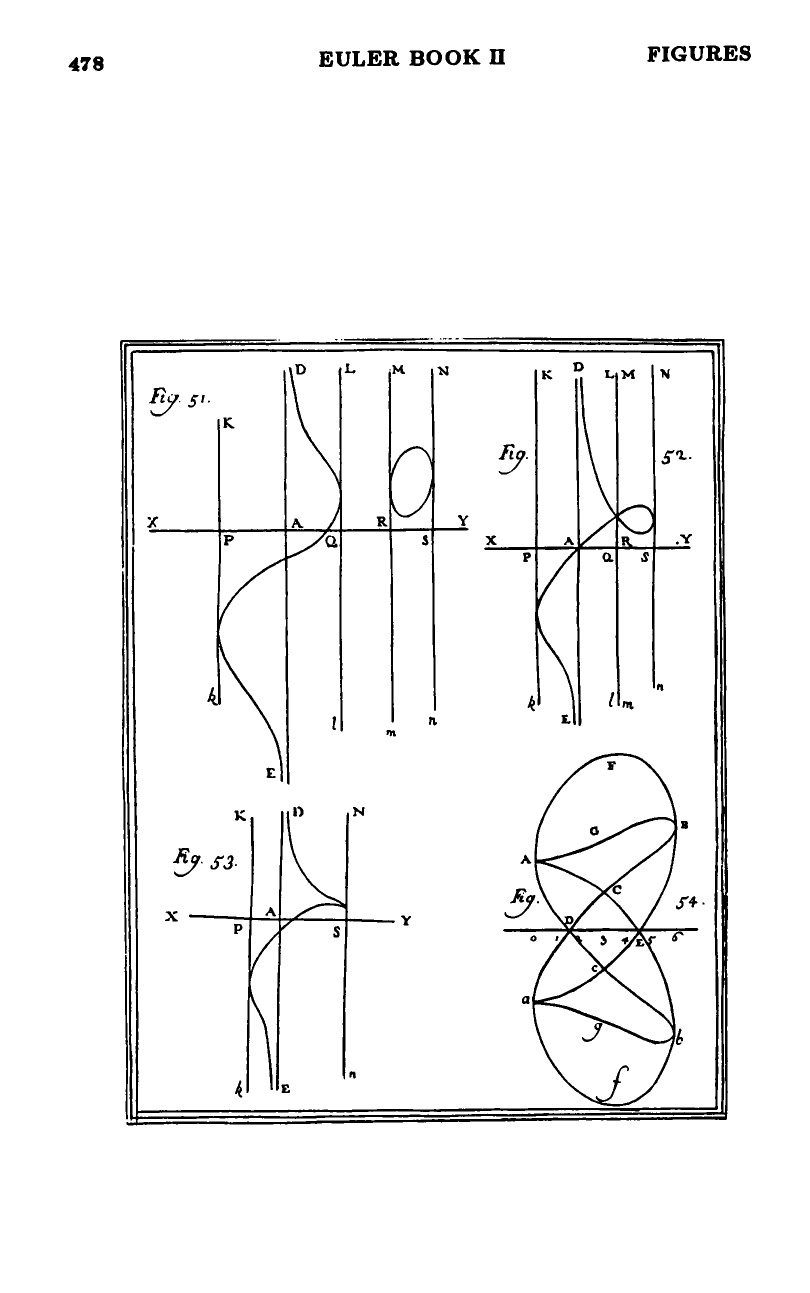 Figures 51–54
Related pages
- chapter-12-on-the-investigation-of-the-configuration-of-curves — chapter summary.
- configuration-from-discriminant — the general method that makes these collisions visible.
- first-species-cubic-configurations — the worked-out cubic case (§§275–277) where these singular points first appear.
- example-bounded-curve-eight-ordinates — §284 octic with two cusps and four double points.
- line-curve-intersection-bound — the chapter-4 intersection count, which is consistent with §282’s “double point eats two intersections” reading.