Configuration from the Discriminant
Summary: Euler’s general method for reading the bounded-region shape of a curve whose equation is quadratic in the ordinate. Writing the equation as with polynomials in , the polynomial acts as a discriminant in : its sign tells whether two ordinates are real, none are real, or two have collapsed to one. Real roots of partition the axis into alternating real and complex intervals — the source of conjugate ovals — and coincident roots produce nodes, cusps, and conjugate points.
Sources: chapter12 (§§273–274, §§278–281, §283).
Last updated: 2026-05-04.
The setup
§280 — for any equation quadratic in the resolved form is
with polynomial in . For each value of :
- : two real ordinates.
- : no real ordinate (both complex).
- : a single ordinate — the curve pinches to the axis-tangent direction or has a singular contact at this place.
The sign of the discriminant therefore controls everything that happens in the bounded region.
The interval picture
§280 — let be the real roots of . They partition the -axis into intervals on which keeps a constant sign, alternating from one to the next. Every interval where the sign is positive carries a real two-valued arc of curve; every interval where the sign is negative carries no real points. The curve is the union of as many connected pieces as there are positive-sign intervals.
This is the source of the conjugate ovals. A pair of consecutive roots flanking a positive-sign interval produces an oval (or a finite arc closed by tangency at both ends if the discriminant has a double root somewhere); one bracketing a negative-sign interval traps a complex-only region between two real-arc regions.
The single-root scenario
§§273–274 — the simplest non-trivial case is when the discriminant has only the leading even-degree term, so it goes negative in both directions far from the origin. There must then be at least two real roots. Two real roots enclose one real interval; outside it everything is complex and the curve is bounded between and (figures 49, 50). At and the two ordinates fuse, so the curve closes off there.
Outside the discriminant’s roots, “the ordinates become imaginary” — bounding the curve in the abscissa direction. This is Euler’s substitute for what would later be called the real-locus connectedness analysis.
Equal roots and singularities
§281 — collisions between consecutive roots of collapse intervals.
| Collision | Type of collapsed interval | Result |
|---|---|---|
| 2 roots equal | positive-sign interval (real ordinates) | two ovals fuse → node (figure 52) |
| 2 roots equal | negative-sign interval (complex ordinates) | conjugate oval shrinks to a single conjugate point |
| 3 roots equal | adjacent +/−/+ shrinks | node tightens → cusp (figure 53) |
| 4 roots equal | various | two separated ovals meet at a point; node grafted onto cusp; two cusps joined back-to-back |
| 5 roots equal | — | cusp with two ovals attached; “almost nothing new” |
| more | — | no genuinely new configurations |
See multiple-points-on-curves for the singular-point side of this dictionary; the present page focuses on the discriminant condition, that page on the local shape at the collision.
Linear and rational
§§278–279 — when one coordinate has degree one, with polynomial.
- never vanishes ( a polynomial): the curve is single-valued and tracks the axis to infinity in both directions.
- has a simple real root at : across with sign change — straight-line asymptote of species .
- has a double root : keeps its sign across — asymptote of species .
- has a triple root : sign-change again — like the simple case.
This is consistent with the chapter 7 and chapter 8 catalogue and is in fact the limiting case of the discriminant story when the radical degenerates.
Higher degree in
§283 — when the equation is cubic, quartic, … in , the number of real ordinates above each abscissa changes by 2, 4, 6, … at a time, and at every transition two real values fuse before they go complex (or a new pair appears from a fused state). Every such transition has the same local shape as one of the cases above. So a sample table of -values at chosen -values, with the sign-collisions noted, suffices to draw the curve. example-bounded-curve-eight-ordinates runs this on a curve with eight ordinates per abscissa.
Why this works
The discriminant analysis works because the curve, viewed as the real locus of a polynomial equation, can change topology only where the equation’s -derivative vanishes (so two ordinates fuse) or where the leading -coefficient vanishes (so a finite ordinate disappears to infinity). For a quadratic-in- equation, the first event is exactly the vanishing of and the second is the vanishing of . Euler’s chapter is in effect a complete catalogue of the local pictures at both kinds of event.
Figures
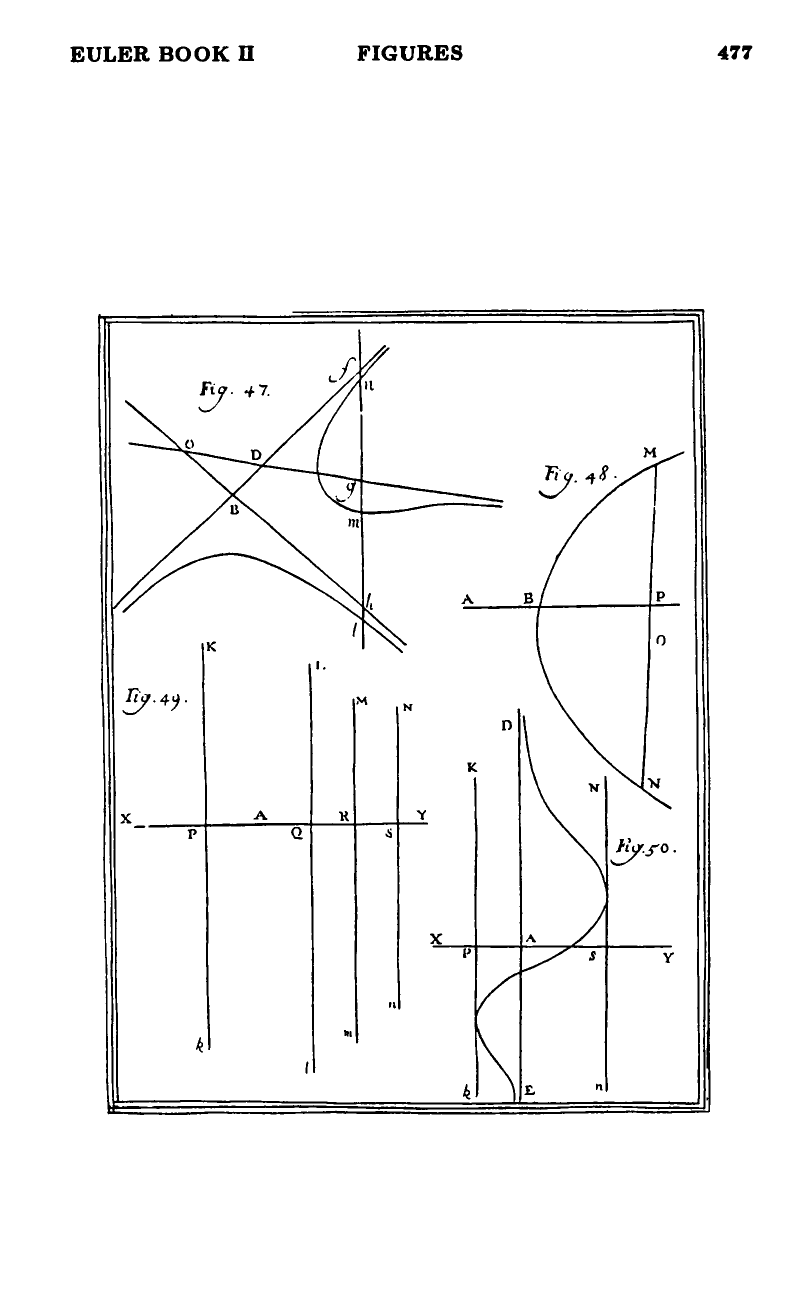 Figures 47–50
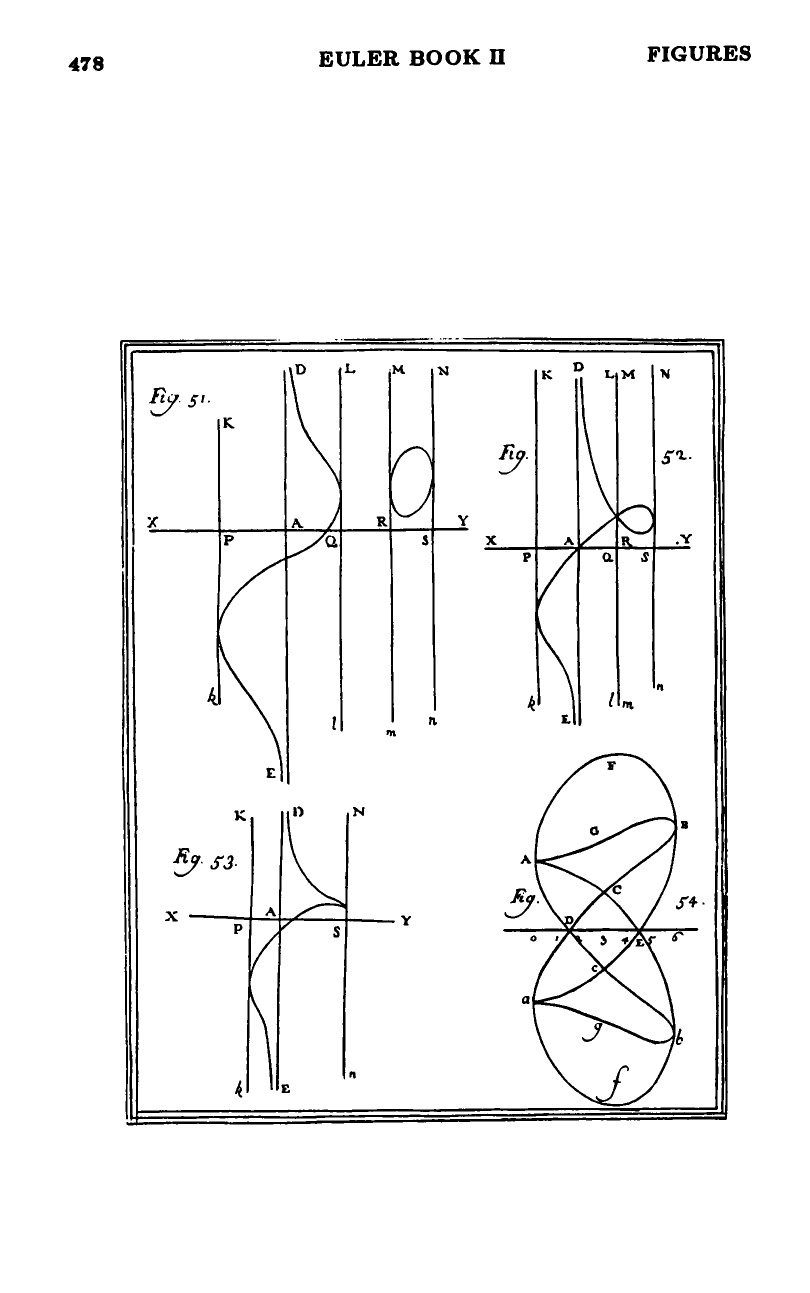 Figures 51–54
Related pages
- chapter-12-on-the-investigation-of-the-configuration-of-curves — chapter summary.
- first-species-cubic-configurations — the §273–277 worked-out cubic case.
- multiple-points-on-curves — local shapes at coincident-root events.
- example-bounded-curve-eight-ordinates — §284 octic example.
- chapter-7-on-the-investigation-of-branches-which-go-to-infinity — the dual problem, where the polynomial side of ‘s vanishing comes from.