Exponential Curves
Summary: §518. Curves with a variable in the exponent, exemplified by . Treated as belonging to the logarithmic genus because . Minimum at . Discrete points below the axis for negative (the same parity anomaly as the logarithmic-curve). Drawn as figure 102.
Sources: chapter21 §518, figures99-102 (figure 102).
Last updated: 2026-05-12
The equation (§518)
The simplest exponential curve is
equivalently for any logarithm base. Because the equation can be put into logarithmic form, it falls under the genus logarithmic curves — Euler assigns “any equation in which not only logarithms, but also any variable exponent occur” to that genus.
Shape on the positive axis (§518, figure 102)
Sample values:
| (limit) | |
| (minimum) | |
Reading figure 102: axis to the right, vertex at on the positive axis, . Between and () the curve dips below height , reaching its minimum at . From outward the curve climbs steeply to infinity.
The minimum value of the ordinate occurs when the abscissa and then the ordinate , as we shall show in what follows. (source: chapter21, §518)
The “as we shall show” is a forward reference to differential calculus — set gives , i.e. .
Negative : discrete points (§518)
For , write . The same parity rule as the logarithmic-curve applies:
- an integer or fraction with odd denominator: one real value of (positive if is even, negative if odd).
- a fraction with even denominator: two real values .
- Otherwise: complex.
Hence the negative- part of is a scatter of discrete points on both sides of the axis, dense but not contiguous, asymptotically converging to the axis — the same discrete-points-below-asymptote phenomenon. The continuous part on the positive axis “terminates abruptly at ” without algebraic continuation, in apparent violation of the law of continuity — Euler defuses this by noting the discrete points fill in the missing branch in a generalized sense.
Relation to §511
The §511 complex-exponent curve is also “exponential” — variable in exponent — but produces a bounded oscillating real curve. The same genus assignment applies.
Figures
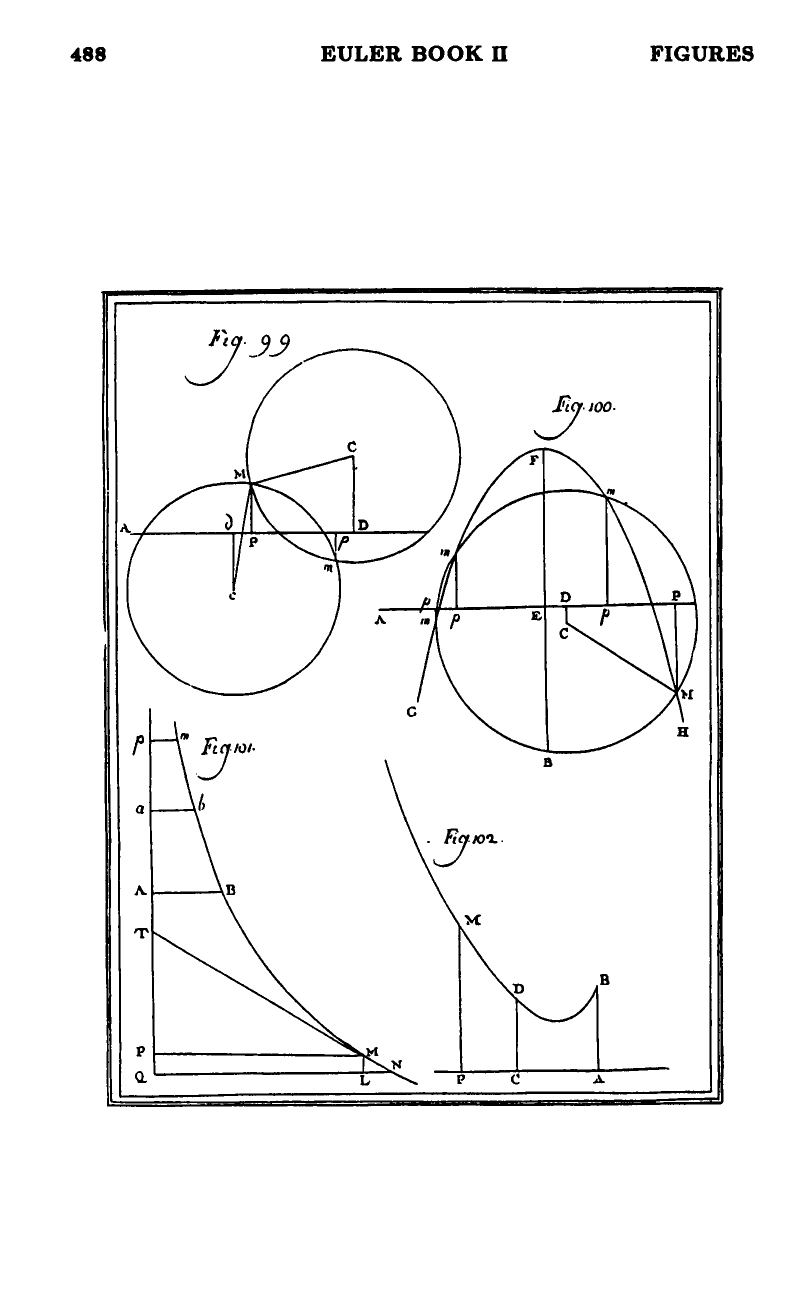 Figures 99–102
Related pages
- chapter-21-on-transcendental-curves
- logarithmic-curve — host genus.
- discrete-points-below-asymptote — the same anomaly on the negative axis.
- implicit-exponential-curve — §519’s , where both and appear in exponents.
- transcendental-curves