Logarithmic Curve
Summary: §§512–515. The curve , or equivalently , with constant subtangent everywhere. Arithmetic progression in corresponds to geometric progression in . The negative- axis is an asymptote. Drawn as figure 101.
Sources: chapter21 §§512–515, figures99-102 (figure 101).
Last updated: 2026-05-12
Equation and basic shape (§§512–513)
Euler writes the equation in two equivalent forms:
where denotes the natural logarithm (so , ) and the constant multiplies any chosen logarithm base into natural — making the chapter’s choice of base immaterial.
Geometric/arithmetic correspondence. Letting and , the equation becomes . Hence the table
extends to negative as — arithmetic progression on the abscissa produces geometric progression on the ordinate. This is the defining property.
Asymptotic behavior (§513, figure 101)
For positive , increases monotonically to infinity. For negative , but stays positive: the negative -axis is an asymptote to the curve.
Reading off figure 101: the axis is horizontal, is the origin, is the ordinate at , and the curve passes through the points The curve approaches the negative axis but never meets it.
Origin-invariance (§513)
The form is preserved under translation of the origin. If and we choose as new origin (so for ), then
where . The form is the same; only changes. Consequently
The constant (the logarithmic parameter) is intrinsic — it is the same in every choice of origin.
Constant subtangent (§§514–515)
The principal property of the logarithmic curve: the subtangent has constant length everywhere.
Derivation. At a point , take a nearby point on the curve. Then
The straight line extended meets the axis at , and similar triangles give , i.e.
As , the line becomes the tangent at , and .
The logarithmic parameter is everywhere equal to the subtangent, which thus has constant length. (source: chapter21, §514)
This is the defining property in the classical pre-calculus literature: any curve with constant subtangent is the logarithmic curve.
Paradoxes (§515 onward)
The clean picture above is only the main branch of the logarithmic curve — the continuous one going to infinity in both directions and accumulating on the asymptote. Two paradoxes complicate matters:
- discrete-points-below-asymptote (§§515, 517). When has an even denominator, has two values, one positive and one negative. So below the asymptote there are infinitely many discrete points — dense but not continuous.
- infinite-logarithms-paradox (§516). Since but , every number has infinitely many logarithms; only one is real. This connects to the previous paradox: the discrete points correspond to non-real logarithms made real by even-denominator root extraction.
Figures
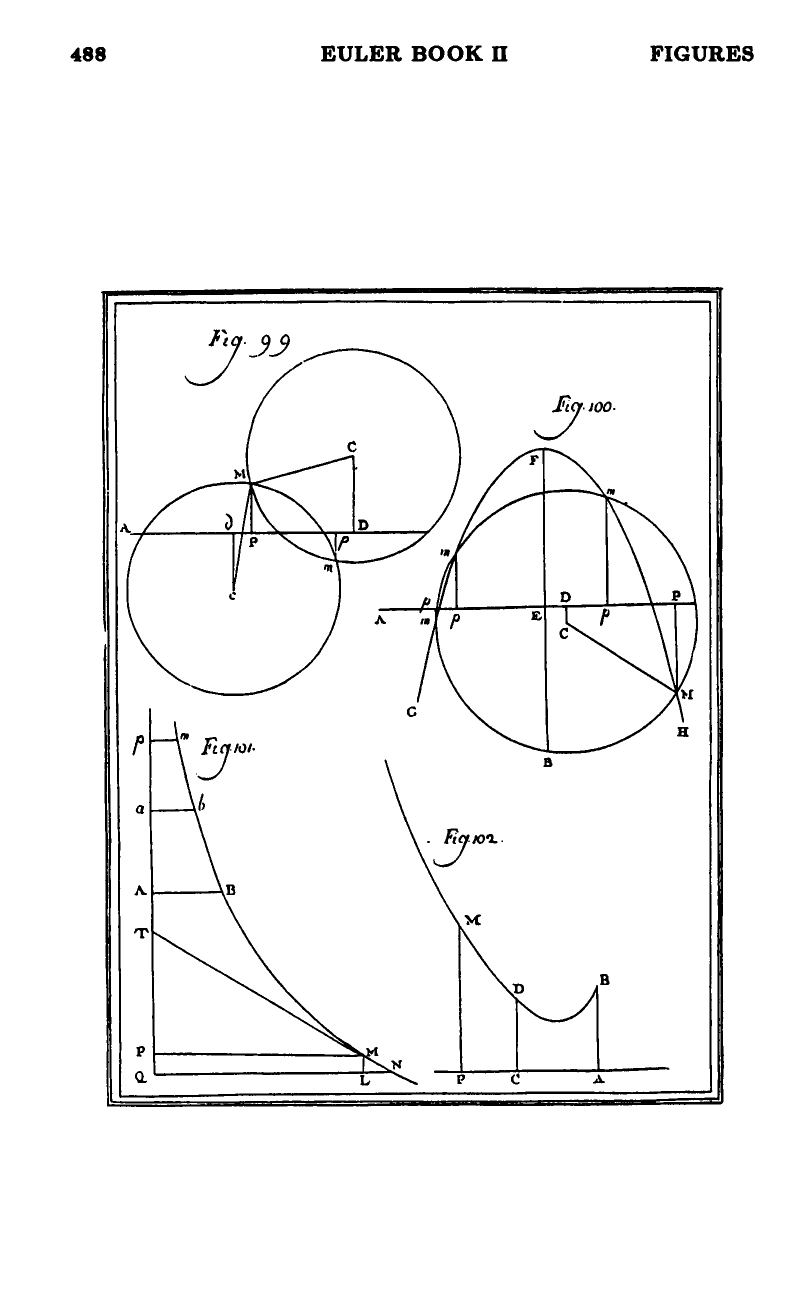 Figures 99–102
Related pages
- chapter-21-on-transcendental-curves
- transcendental-curves
- discrete-points-below-asymptote — the parity anomaly on the same curve.
- infinite-logarithms-paradox — the multi-valued nature of .
- subtangent-and-subnormal — algebraic-curve version of this calculation (chapter 13).
- logarithmic-spiral — the polar cousin of this curve.