Chapter 21 — On Transcendental Curves
Summary: Euler’s catalogue of the principal transcendental curves. After 20 chapters spent entirely on algebraic curves, he turns to the curves whose defining equation cannot be brought to polynomial form. Five clusters: definition and intercendental/complex-exponent curves (§§506–511); the logarithmic curve with its paradoxes (§§512–517); exponential curves (§§518–519); the circular-arc curves — sine line, tangent line, cycloid, epicycloid, — (§§520–525); spirals (§§526–528).
Sources: chapter21, figures99-102, figures103-105, figures106-108, figures109-110, figures111-114.
Last updated: 2026-05-12
Five strands
1. Definition (§§506–508) and exotic exponents (§§509–511)
A curve is transcendental when the relation between and cannot be written as a polynomial equation; equivalently, when is a transcendental function of (§506). The set of transcendental functions is much larger than ; analysis of the infinite produces innumerable others (§507). A non-irrational algebraic equation has only integer exponents; if some exponent in the defining equation is neither integer nor a fraction, the curve cannot be made non-irrational and is therefore transcendental (§508).
This already produces a simplest sub-genus that Leibniz called intercendental-curves: and its kin (§§509–510). Approximating by gives algebraic curves of order — so the true curve has infinite order and is decisively not algebraic. To construct it exactly requires logarithms ().
Complex exponents (§511) produce another exotic family: collapses to (using from Book I §138). Real-valued despite the imaginary exponents — and used again in §525 as the arccos-log-curve.
2. Logarithmic curve and its paradoxes (§§512–517)
The logarithmic-curve (§§512–514, figure 101) is the canonical first transcendental: arithmetic progression in produces geometric progression in . Its hallmark is constant subtangent everywhere — the logarithmic parameter realized geometrically. The axis is an asymptote in the negative- direction.
But the curve raises two paradoxes that “never occur in algebraic curves”:
- discrete-points-below-asymptote (§§515, 517). When has an even denominator, acquires a second negative value. Hence below the asymptote sit infinitely many discrete points, dense in pairs of axis-parallel lines but forming no continuous branch. The same anomaly appears starkly in (§517).
- infinite-logarithms-paradox (§516). Since but also , half of is both and . Every number has infinitely many logarithms, only one of which is real. Algebraic root extraction has choices; logarithms have .
3. Exponential curves (§§518–519)
Any curve whose equation can be put in a form involving a logarithm is assigned to the logarithmic genus — including the exponentials (§518, figure 102). On the positive axis the curve has a minimum at with ; for only discrete points exist (same parity anomaly as the logarithmic curve). The curve “terminates abruptly” at at the -axis crossing, which violates the algebraic law of continuity but is unavoidable for transcendentals.
The implicit-exponential-curve (§519, figure 103) is harder. The straight line is one component (since ), but the equation is also satisfied by an additional branch asymptotic to the axes, parametrized by . The two components meet at . Rational solution pairs are dense on the branch.
4. Circular-arc and combined curves (§§520–525)
The sine-line (§520, figure 104) is the canonical curve requiring circular arcs. Any vertical line cuts it in infinitely many points — the same multi-valued-ness as the logarithmic curve’s discrete points, but now forming a true continuous oscillation. Two diameters and parallels; periods apart. Leibniz’s name. The same curve is the cosine line with shifted by .
The tangent-and-secant-lines (§521) are (infinitely many parallel asymptotes) and (infinitely many infinite branches).
The cycloid (§§521–522, figure 105) — path of a point on a circle rolling along a line — has equation , or in centered form . Ordinary when (point on the circumference); curtate / prolate when or (point inside / outside the rolling circle).
epicycloid-and-hypocycloid (§§523–524, figure 106). A circle of radius rolling on the outside (or inside, ) of a stationary circle of radius traces , . Algebraic when is rational; otherwise transcendental. The special case degenerates to the center of the stationary circle; expanding gives a sextic .
The arccos-log-curve (§525, figure 107) is the §511 curve inverted, expressed as . Combines both logarithms and arcs. Axis intersected at (geometric progression); tangent to two axis-parallel lines at points forming another geometric progression; finite asymptote — a non-algebraic phenomenon.
5. Spirals (§§526–528)
Polar equations where is the distance from a fixed center and measures the angle along a unit circle.
- spiral-of-archimedes (§526, figure 109). Tangent at along ; intersects and at right angles infinitely many times; diameter .
- Hyperbolic spiral (§527). After infinitely many turns approaches line as asymptote at infinite distance. Named by John Bernoulli by analogy with the hyperbola-and-asymptote.
- Lemniscate spiral (§527, figure 110). Bounded; figure-eight shape tangent to lines making angle with the axis. (Both here.)
- logarithmic-spiral (§528, figure 111). Equiangular property: every radius from the center meets the curve at the same angle, . For the angle is (semi-rectangular logarithmic spiral). The single transcendental-in-the-equation curve Euler singles out.
Chapter structure
| §§ | Topic | Page |
|---|---|---|
| 506–508 | Definition of transcendental curve | transcendental-curves |
| 509–510 | Intercendental: | intercendental-curves |
| 511 | Complex-exponent: | transcendental-curves |
| 512–514 | Logarithmic curve, fig 101 | logarithmic-curve |
| 515, 517 | Discrete points below asymptote; | discrete-points-below-asymptote |
| 516 | Infinite logarithms of every number | infinite-logarithms-paradox |
| 518 | , fig 102 | exponential-curves |
| 519 | , fig 103 | implicit-exponential-curve |
| 520 | Sine line , fig 104 | sine-line |
| 521 | Tangent / secant lines | tangent-and-secant-lines |
| 521–522 | Cycloid, fig 105 | cycloid |
| 523–524 | Epicycloid / hypocycloid, fig 106 | epicycloid-and-hypocycloid |
| 525 | , fig 107 | arccos-log-curve |
| 526 | Spirals general; Archimedes, fig 108–109 | spirals, spiral-of-archimedes |
| 527 | Hyperbolic and lemniscate, fig 110 | hyperbolic-and-lemniscate-spirals |
| 528 | Logarithmic spiral, fig 111 | logarithmic-spiral |
Why the chapter sits at the end
The whole programme of Book II was the systematic study of algebraic curves: orders, asymptotes, species, configurations, tangents, curvature, symmetry, intersection, construction. Transcendental curves require analysis of the infinite (the subject of Book I) for their proper treatment — limits, series, integration — so Euler treats them only as a guided tour, deferring the analytic machinery. The chapter is descriptive and example-driven rather than systematic. The book closes (chapter 22 + appendices) with surfaces, solid geometry, and miscellaneous topics.
Figures
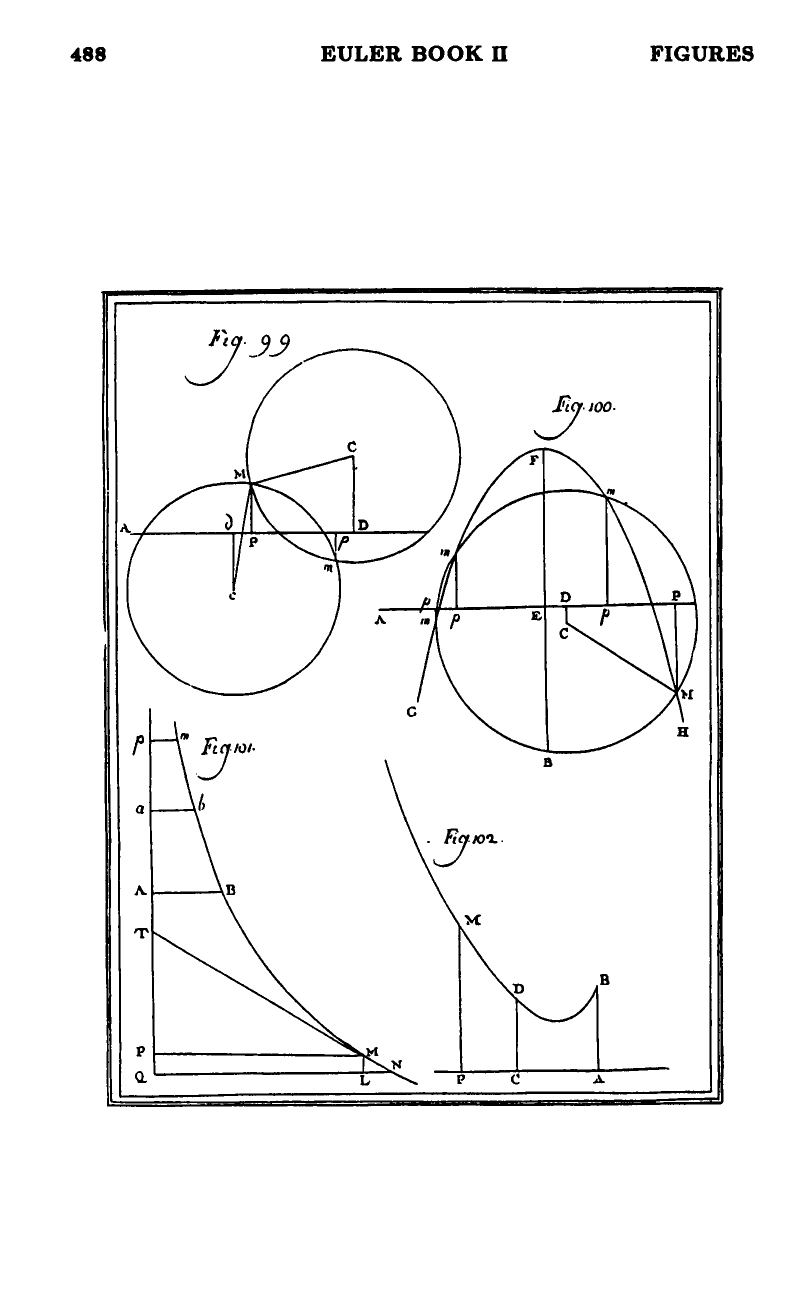 Figures 99–102
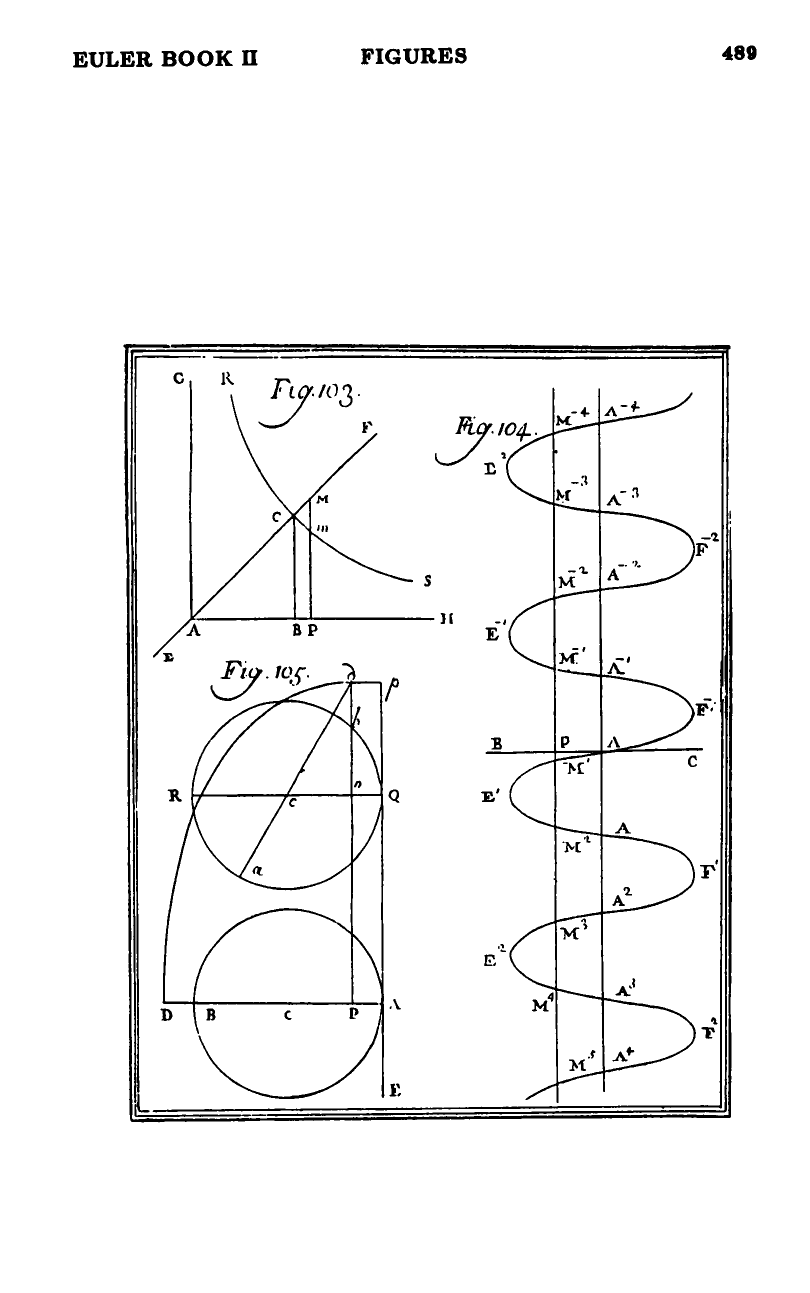 Figures 103–105
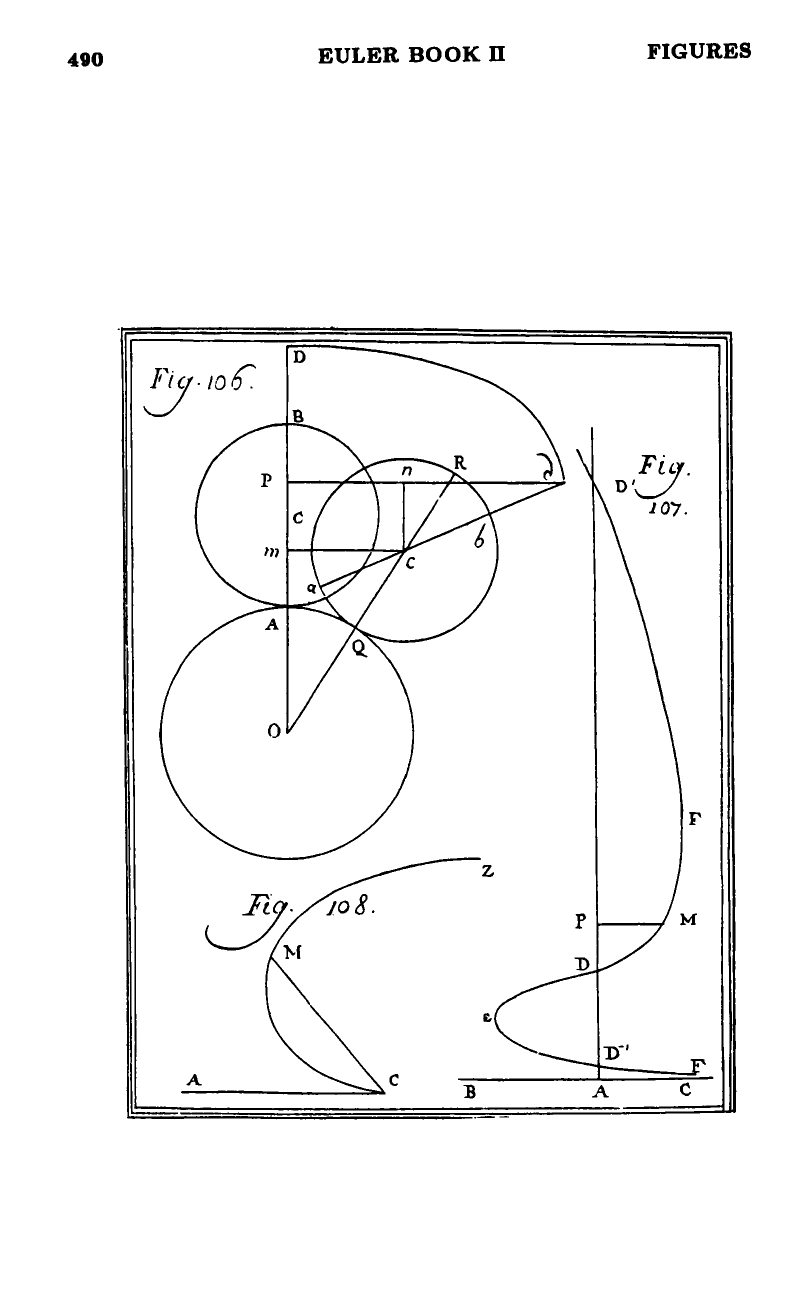 Figures 106–108
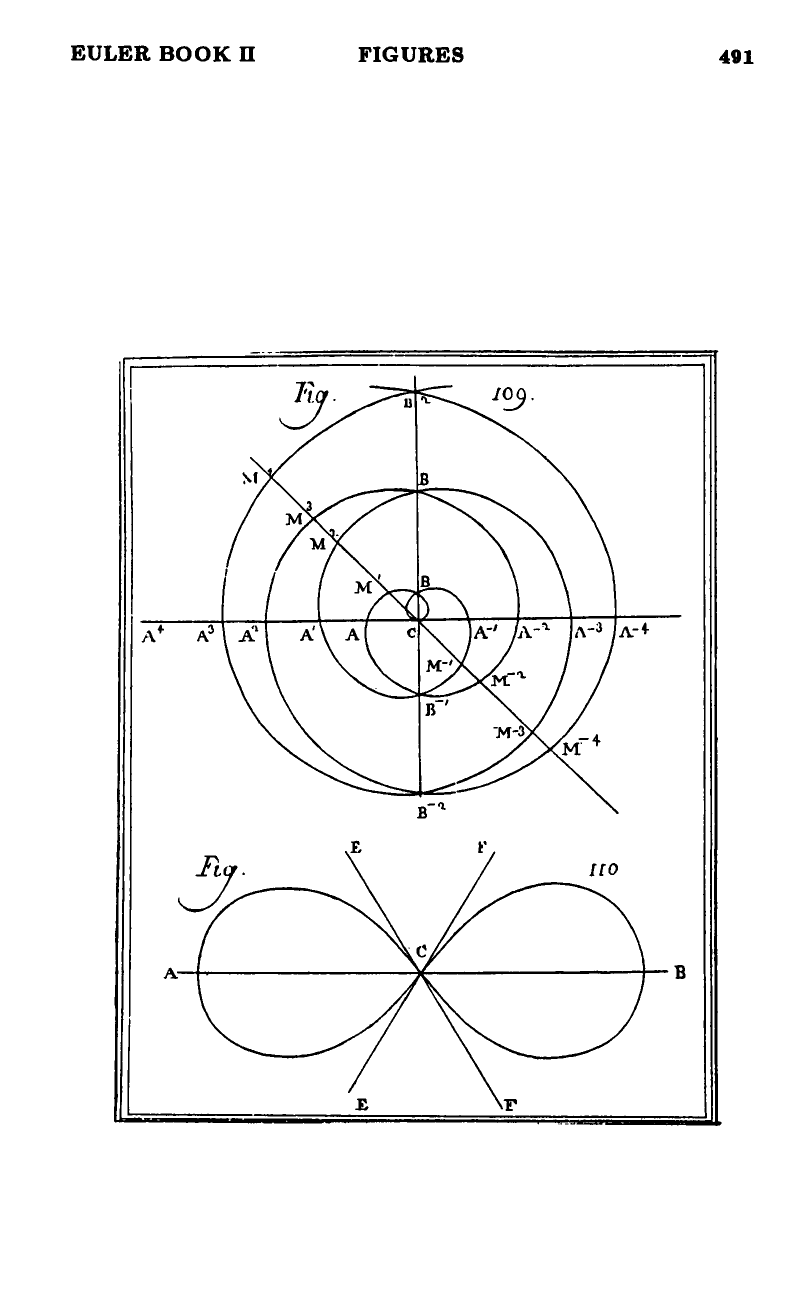 Figures 109–110
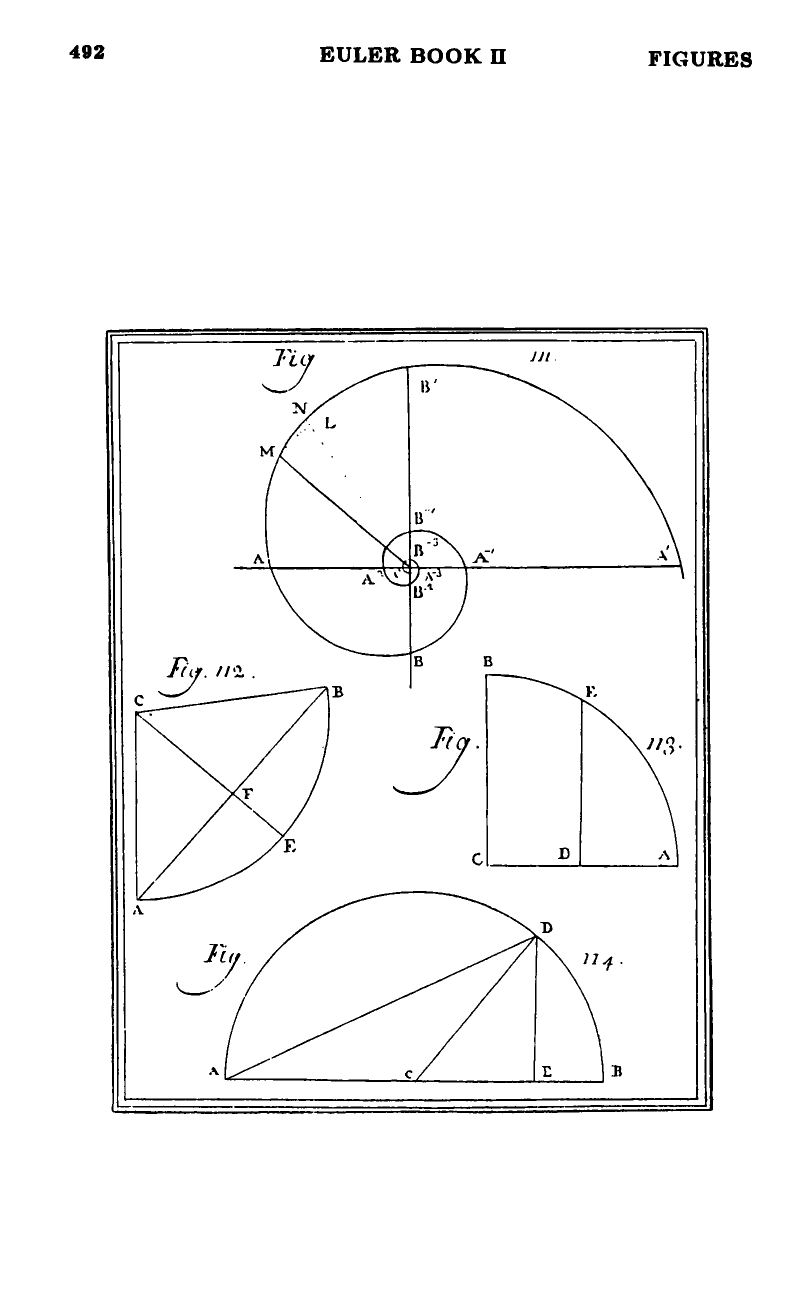 Figures 111–114
Related pages
- algebraic-and-transcendental-curves — chapter 1’s brief introduction, here developed in full.
- continuous-and-discontinuous-curves — chapter 1’s law of continuity, here strained by the discrete-points paradox.
- curves-from-polar-coordinates — chapter 17’s polar setup, here reused for the spirals.