Transcendental Curves
Summary: §§506–508, 511. A curve is transcendental when its defining relation between and cannot be brought to polynomial form. Equivalently: is a transcendental function of , or some exponent in the defining equation is neither integer nor a fraction — a non-irrational form is impossible. Complex exponents may produce real values.
Sources: chapter21 §§506–508, 511.
Last updated: 2026-05-12
Definition (§506)
A curve which is not algebraic is called transcendental. Hence a transcendental line, which is what such a curve is called, is defined to be one such that the relationship between the abscissa and the ordinate cannot be expressed by an algebraic equation. (source: chapter21, §506)
Equivalently, is a transcendental function of . Examples already familiar from Book I:
Any equation in involving these expressions defines a transcendental curve.
How many transcendental curves are there? (§507)
Innumerably more than algebraic ones. Logarithms and circular arcs are only a few examples; analysis of the infinite (the subject of Book I) produces “innumerable other transcendental expressions”. This explains why Euler defers their proper treatment — the systematic tools needed are those of Book I, not Book II.
The “non-irrational” criterion (§508)
An algebraic equation either is non-irrational, with only integral exponents, or is irrational, with fractional exponents. In the latter case the equation can always be expressed in non-irrational form. Any curve whose equation expressing the relation between the coordinates and is not non-irrational, or cannot be put into such a form, is always transcendental. (source: chapter21, §508)
In modern terms: a curve is algebraic iff it is the zero locus of some polynomial . Even irrational-looking equations like rationalize to — non-irrational. But if an exponent is irrational (e.g. ), no such rationalization is possible: the curve is transcendental. This produces the simplest sub-genus, the intercendental-curves.
Complex exponents (§511)
Imaginary exponents can still produce real-valued curves. The equation
involves two complex quantities, but their sum is real. Set , so ; then
using the identity from Book I §138. Hence
Worked numerical check: gives , so . The arc with length in a unit circle measures , and its cosine produces the listed .
The same curve, inverted to , recurs at §525 as the arccos-log-curve (figure 107). Curves of this kind, involving both logarithms and circular arcs, are “correctly referred to as transcendental”.
Where this leads
The chapter §§512–528 unfolds a guided tour:
- The logarithmic-curve (§§512–515) and its paradoxes — discrete-points-below-asymptote (§§515, 517) and infinite-logarithms-paradox (§516).
- exponential-curves (§518), (§519).
- The sine-line (§520), tangent-and-secant-lines (§521), cycloid (§§521–522), epicycloid-and-hypocycloid (§§523–524), and the arccos-log-curve (§525) mixing both.
- spirals, including the spiral-of-archimedes, the hyperbolic-and-lemniscate-spirals, and the logarithmic-spiral (§§526–528).
Figures
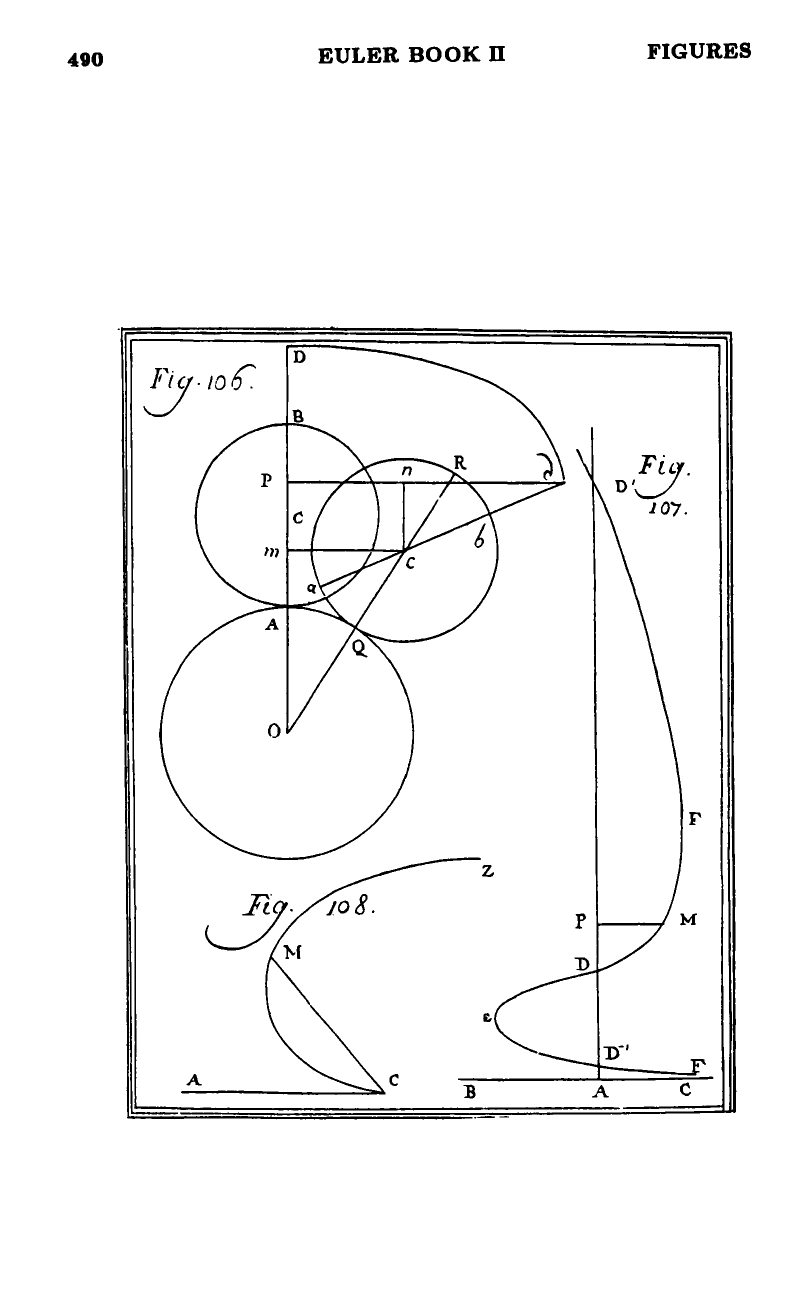 Figures 106–108
Related pages
- chapter-21-on-transcendental-curves
- algebraic-and-transcendental-curves — chapter 1’s first sketch of the principal division.
- intercendental-curves — the simplest sub-genus, with irrational exponents.