Implicit Exponential Curve
Summary: §519. A curve with both coordinates in exponents. The line is one component; the equation also has a non-trivial branch asymptotic to the axes, parametrized by , , meeting the line at . Drawn as figure 103.
Sources: chapter21 §519, figures103-105 (figure 103).
Last updated: 2026-05-12
The equation (§519)
The natural solution is the straight line (since ), but this is not the whole curve. For example also satisfies it: .
Solution by substitution (§519)
Substitute :
So , giving
Letting (so ) gives the cleaner parametrization:
As : — both factors tend to , and the extra factor . So the parametric branch meets the diagonal at .
The figure (§519, figure 103)
Reading figure 103: axis horizontal, vertical. The straight line (at ) is the diagonal . The branch is the parametric curve above; it is asymptotic to lines (horizontal) and (vertical) — i.e., to both coordinate axes. The line is a diameter of the branch , and the branch intersects at where .
So the picture has two components:
- The straight line : .
- The hyperbolic-shaped branch between the two axes, with axis of symmetry along , passing through .
There are also infinitely many discrete solution points — pairs of rational numbers as below.
Rational solution pairs
Take in , i.e. . Then
Check: and both equal .
The full table:
| 1 | ||
| 2 | ||
| 3 | ||
| 4 | ||
General: for
The square of the first equals the first raised to the power of the second:
Place in the chapter
Euler treats §519 as the technical climax of the §518 exponential-curve genus: the genus contains not just “one variable in an exponent” () but “both variables in exponents”, and the latter yields a nontrivial implicit curve requiring substitution tricks to even parametrize.
Figures
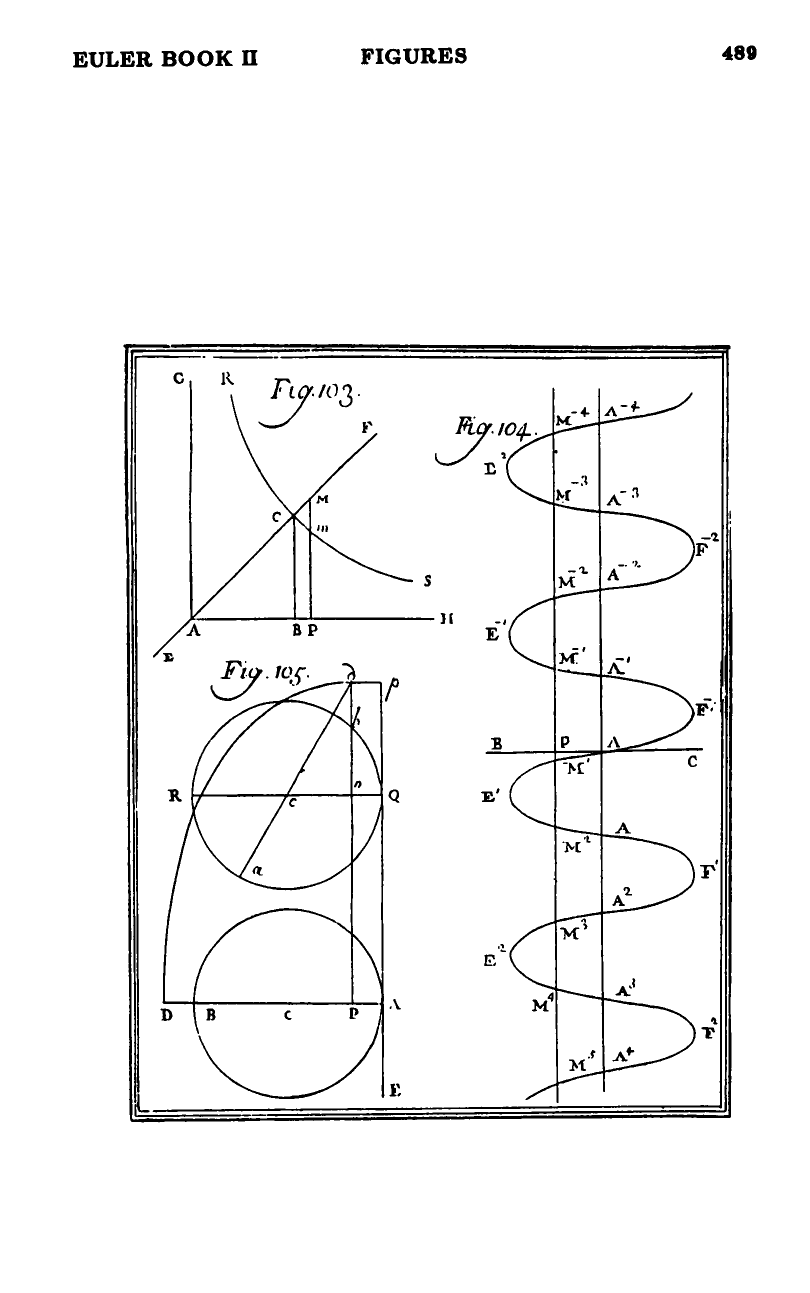 Figures 103–105
Related pages
- chapter-21-on-transcendental-curves
- exponential-curves — same genus, simpler equation .
- logarithmic-curve — overarching genus (any equation involving ).
- transcendental-curves