Cylindrical and Prismatic Surfaces
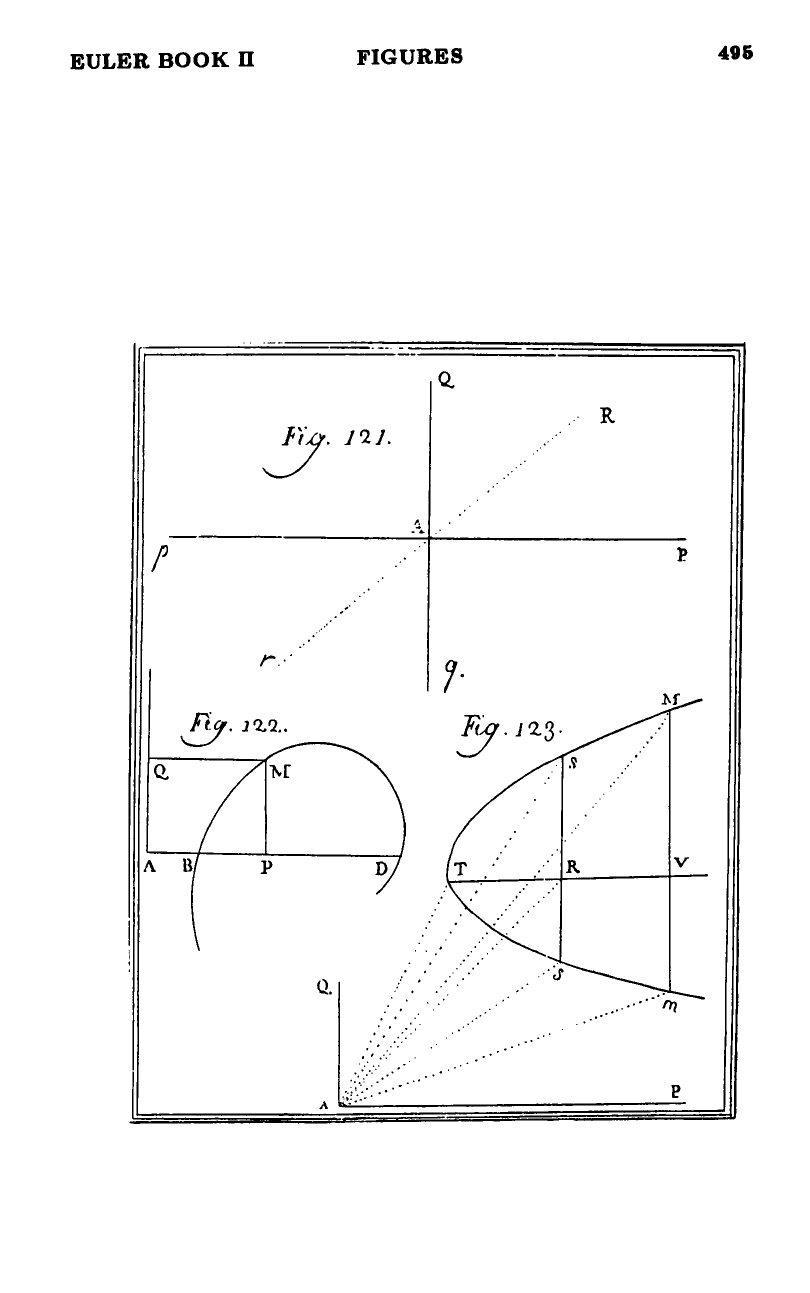
Summary: §§32–33 of the Appendix on Surfaces. The first surface genus produced by missing a variable. If is absent from the surface equation , the equation describes a curve in the plane (figure 122) and the surface is swept out by translating a vertical line indefinitely along that curve. Circle base → right cylinder, ellipse base → scalene cylinder, polygon base → prism. Either of can be the missing variable; the genus name is cylindrical when is a curve, prismatic when it is a polygon.
Sources: appendix2, §§32–33. Figure 122 in figures121-123.
Last updated: 2026-05-12.
§32 — Construction (figure 122)
If the surface equation contains no , every plane cuts it in the same curve — by sections-by-coordinate-planes §31. So pick that constant base curve in the plane (figure 122). Now imagine the straight line perpendicular to at any point of , extended indefinitely above and below; slide that line along the curve. The trace is the surface (source: appendix2, §32).
Special bases give familiar solids:
- a circle → right cylinder;
- an ellipse → (right) scalene cylinder;
- a finite straight-line broken-curve (polygon) → prism;
- a single straight line axis → plane (degenerate case).
§33 — The genus and its name
The surfaces produced by this construction form a single genus. Euler calls them cylindrical (curve base) or prismatic (polygonal base). The base curve is called the base of the surface (source: appendix2, §33).
Algebraic test for membership: any one of is missing from the surface equation. The missing variable picks out which of the three coordinate axes plays the role of “axis of the cylinder.”
The §31 condition that all sections by planes parallel to one principal plane be congruent characterizes precisely this genus — there is no broader genus with the same property.
Worked instance: the elliptical cylinder
The §53 example in the next chapter uses an ellipse base in the plane and erects perpendiculars (axis along ). The resulting surface equation is
with absent — an instance of the §32 construction. Sections parallel to the base are all congruent ellipses; sections parallel to the axis are pairs of parallel straight lines (or empty); sections oblique to the axis are larger ellipses with semiaxes and . See cylinder-sections.
Higher genus: variable scaling
Replacing the constant cross-section by one that scales with instead of staying fixed lifts cylinders to cones (§§34–38). The intermediate generalization (something in ) gives surfaces-of-revolution when the cross-section is forced to be a circle. So:
| Constraint on cross-sections | Genus |
|---|---|
| All congruent | Cylindrical / prismatic (§§32–33) |
| All similar, scaling linearly | Conical / pyramidal (§§34–36) |
| All similar, scaling by | Generalized family (§§37–38) |
| All circles, centers on one axis | Turned solids (§39, surfaces-of-revolution) |
Cross-references
- §31 single-variable absence → congruent parallel sections: sections-by-coordinate-planes.
- Worked elliptical-cylinder section analysis: cylinder-sections (§§52–67).
- Conical generalization: conical-and-pyramidal-surfaces (§§34–38).
- Plane-curve analogue: a translate-along-a-line cylinder is the surface counterpart of a chord-translation infinite-copies-of-curve (Book II Chapter 18) — both produce one equation for an infinite family of congruent shapes.
Figures
 Figures 121–123