The Equation of a Straight Line
Summary: Euler proves that every first-degree equation in two orthogonal coordinates, , represents a straight line — and that conversely every straight line has such an equation. The proof runs the general-equation machinery of chapter 2 backwards: start from the simplest case (a line parallel to the axis), transform by the general rigid motion, and find that every transformed version remains first-degree.
Sources: chapter2 (figures 12–13)
Last updated: 2026-04-24
The simplest case (§39)
A straight line parallel to the axis at perpendicular distance has equation
since every ordinate has the same length (figure 12).
Every straight line has a first-degree equation (§39)
Apply the general rigid motion (§§33–34 of coordinate-transformations): pick any axis , with , angle having sine and cosine . The new abscissa and new ordinate are related to by
so the condition becomes
Multiplying through by a constant , set , (i.e. ), . The equation takes the form
which is the general first-degree equation in the coordinates of the new axis. “It is clear that every first degree equation in two coordinates exhibits not a curve but a straight line” (source: chapter2, §39).
Every first-degree equation is a straight line (§40)
Conversely, given in orthogonal coordinates relative to some axis , read off two points on the locus and use similar triangles to recover the line (figure 13):
- setting : the locus crosses the axis at ,
- setting : the locus reaches ordinate at the origin.
The two points and determine a unique straight line. For any third point on this line, the similar triangles and give , i.e.
which rearranges to . Every such satisfies the equation, and the argument is reversible, so the locus is exactly the straight line .
Degenerate cases (§41)
The general argument breaks down when or vanishes, but each degenerate case is geometrically clear:
| Equation | Line |
|---|---|
| , i.e. constant | parallel to the axis at distance |
| the axis itself | |
| , i.e. constant | perpendicular to the axis at distance from the origin |
In the last case the ordinate is no longer variable — the abscissa takes a single value and every ordinate corresponds to it.
Relation to degree invariance
The result is a corollary of the degree-invariance theorem (§§37, 46 — see degree-invariance). A straight line, being definable in some coordinate system by a first-degree equation (), has a first-degree equation in every coordinate system, and no curve with a higher-degree equation can be a straight line. This is why “first-degree equation” and “straight line” are synonymous, regardless of the coordinate system in which the equation is written.
Figures
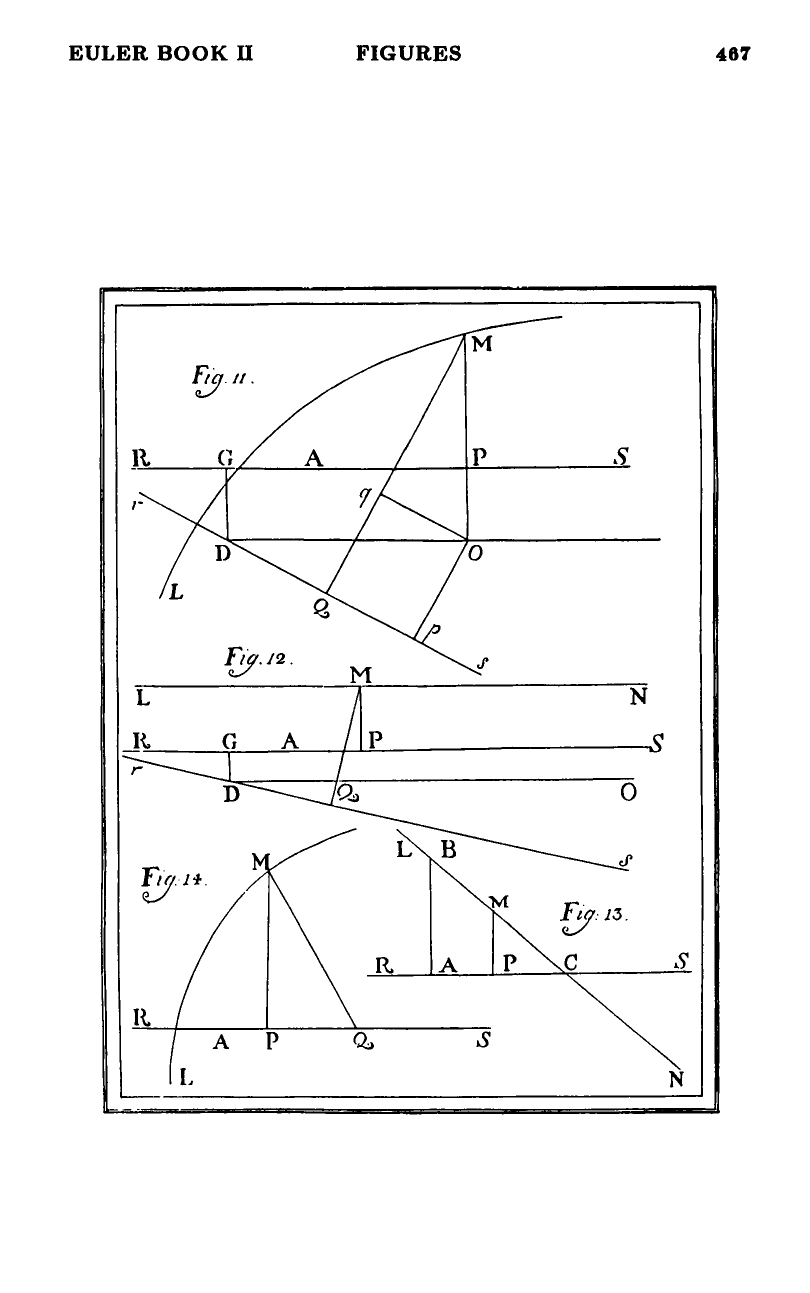 Figures 11–14