Tangent Plane to a Surface
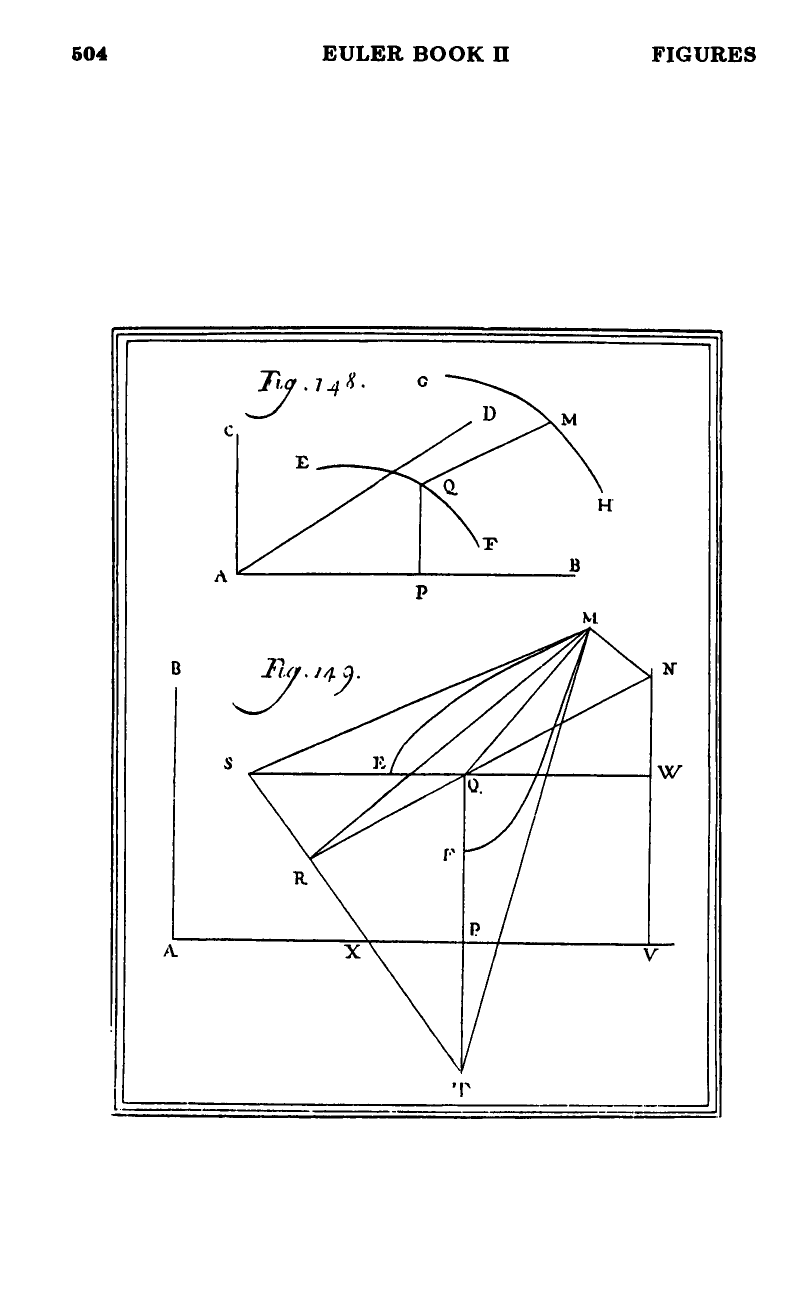
Summary: §§147–149 of the Appendix on Surfaces. Construction of the tangent plane at a point on a surface (figure 149). Cut the surface with two perpendicular planes through — one perpendicular to along parallel to , the other perpendicular along . Each gives a plane curve whose tangent at can be computed by Book II’s tangent-by-translation method, with subtangents . The tangent plane is the plane spanned by these two tangents. From the construction Euler reads off the trace direction , the inclination , and the normal direction.
Sources: appendix6, §§147–149. Figure 149 in figures148-149.
Last updated: 2026-05-12.
§147 — Heuristic
There is a much simpler way of finding the tangent plane for any surface. We use the method of finding tangents to curves… we suppose that the nature of the surface, whose tangent plane we are seeking, is given by an equation in the three coordinates , and . (source: appendix6, §147)
The key idea: a tangent plane is determined by any two tangent lines through the point. Take two plane sections through (using two different cutting planes that intersect in some line through ), compute the tangent to each section at using the plane-curve method tangent-by-translation from Book II Chapter 13, and the tangent plane is spanned by these two tangents.
§148 — Construction (figure 149)
Setup: surface point . Drop perpendicular .
First cutting plane: perpendicular to , containing the line in parallel to the axis . The section of the surface by this plane is a plane curve in the cutting plane; its tangent at is the line , meeting the line at . The intercept is the subtangent of this section.
Second cutting plane: perpendicular to , containing the line (the ordinate line). Section is the plane curve ; tangent at is with the subtangent.
The tangent plane is the plane (the plane through the three points ).
§149 — Reading off slopes, inclinations, and normals
From the two subtangents:
where is the intersection of the tangent-plane trace with the axis in the plane .
Slope of the tangent plane’s trace in :
Length :
Inclination of the tangent plane to : dropping perpendicular from to ,
Then , so
Normal to the tangent plane at : drop tangent plane. Then lies in the plane at the foot of the perpendicular from , with
giving its position in the plane . The straight line is normal to both the surface and the tangent plane at .
Modern reading: gradient as normal
In modern vector notation, the surface is . The tangent plane at has normal . The subtangents correspond to the partial derivatives:
Euler’s two-subtangent construction is the implicit-function-theorem computation of the gradient, two centuries early.
Cross-references
- 3D lift of tangent-by-translation (Book II §§286–291) — that method substitutes into a plane curve and truncates to linear order; here it is applied twice (once for each cutting plane) to extract a tangent plane.
- The tangent plane construction is dual to the tangency-of-surfaces perspective: there, two surfaces tangent at a point share their tangent plane; here, a tangent plane is constructed for a single surface at a single point.
- The normal direction is the analogue of the normal line in Book II subtangent-and-subnormal.
Figures
 Figures 148–149