Plane Inclination Angles
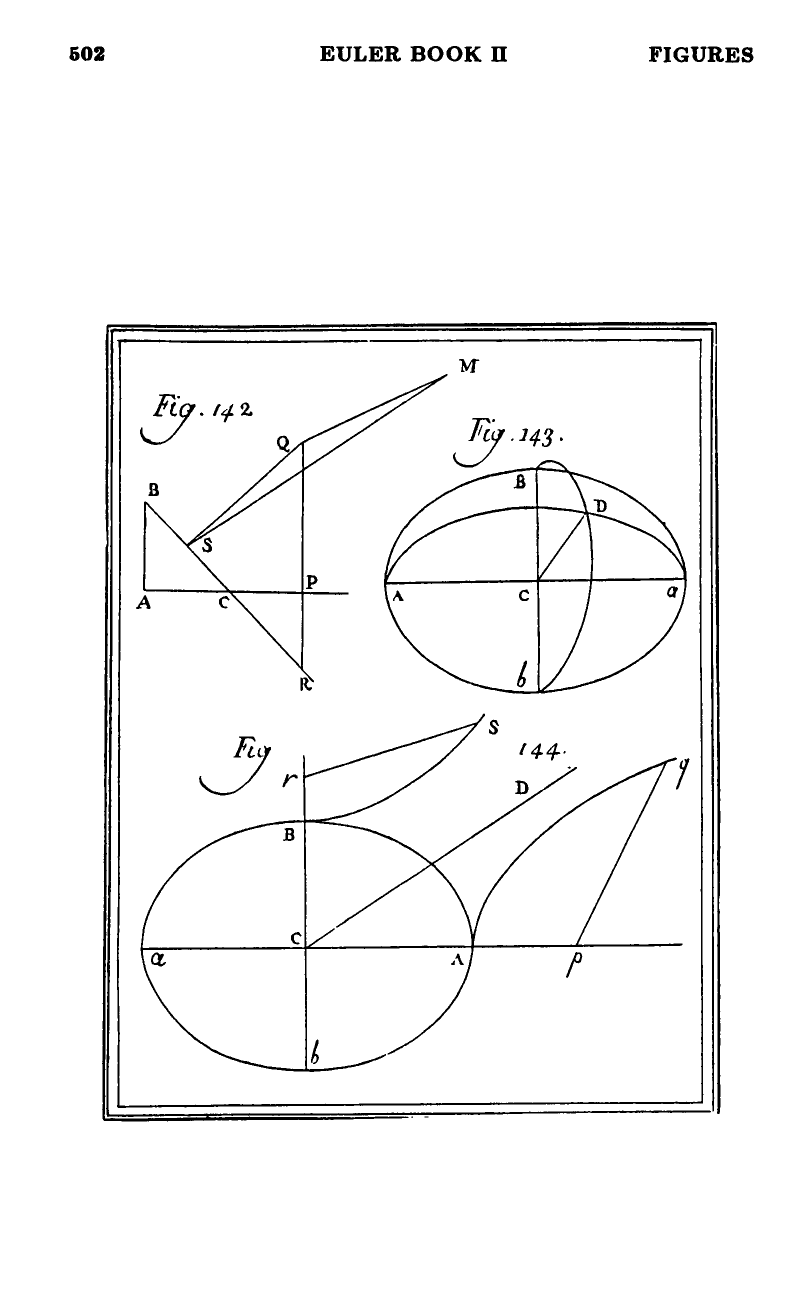
Summary: §§97–100 of the Appendix on Surfaces. First-order surfaces are exactly planes (§§96–98) — the 3D analogue of straight-line-equation. Given the plane , Euler then computes its angles of inclination to all three coordinate planes (§§99–100, figure 142): the tangent of the inclination to the plane is , with cyclic versions and . These are the direction-cosine computations in elementary 3D analytic geometry.
Sources: appendix4, §§97–100. Figure 142 in figures142-144.
Last updated: 2026-05-12.
§§96–98 — Planes = first-order surfaces
A surface whose intersection with a plane is always a straight line must be a plane. (source: appendix4, §97)
The argument:
- Curve analogue: a plane curve whose intersection with every line is a single point is itself a line (Book II, line-curve-intersection-bound converse).
- By degree-invariance-surfaces §95, every plane section of a first-order surface is a first-order curve, i.e., a straight line.
- If any convexity or concavity existed, some section would be a curve — contradiction. So the surface is flat.
§98’s algebraic confirmation: starting from , the change-of-coordinates-3d §92 substitution has enough freedom to reduce this to (a plane parallel to the -plane) or even (the -plane itself).
§99 — Trace in the principal plane (figure 142)
Set : the trace is the line in the plane . Geometrically this line cuts:
- The axis at .
- The perpendicular through at .
Hence
Extending the ordinate to meet the trace at :
§100 — Inclination to the coordinate plane
From drop in the plane , and join (on the surface, with ) to . The angle measures the plane’s inclination to .
Computing in two ways:
(using ). Since :
Hence
So
Three inclinations by cyclic symmetry
The same calculation with the plane or playing the role of “principal plane” gives:
In modern terms: is the unnormalized plane normal; the three tangents above are the ratios of horizontal-component magnitude to vertical-component magnitude for each coordinate plane choice.
Cross-references
- §§96–98 lifts straight-line-equation one dimension up.
- The angles here are the analytic substrate of the projection method in oblique-plane-section-method — the inclination angle in §49’s substitution is precisely for the cutting plane.
- The expressions are the same direction-cosine ratios that appear in in modern vector analysis.
Figures
 Figures 142–144