Subtangent and Subnormal
Summary: From the linear truncation at the point , the subtangent is the segment on the axis from (foot of ordinate at ) to (where the tangent meets the axis). Dropping the normal at to the axis (rectangular coordinates) gives the subnormal , with . Tangent length and normal length . Three worked examples: the parabola yields (recovering [[parabola|chapter 6’s ]]); the ellipse yields ; a third-order seventh-species cubic yields .
Sources: chapter13 (§§289, 292). Figures 55, 59, 60 (in figures55-60).
Last updated: 2026-05-07.
Subtangent (§289)
The tangent at meets the original axis at a point . From the similar right triangles (with legs , ) and (with legs , ):
But from the linear truncation, so
The portion of the original axis between and is called the subtangent. The sign records on which side of the point lies.
Rule for finding the subtangent (§289)
In the equation for the curve, after finding that the ordinate corresponds to the abscissa , substitute and . After the substitution, keep only the terms in which and appear with exponent 1, and neglect all other terms, to obtain the equation . From this we know and , and so the subtangent .
Worked examples (§289)
Example I — parabola
Curve: (vertex at origin, principal axis as -axis).
Take , , so . Substitute , :
Keep only the linear terms: , so , giving , (up to a common factor 2). Then
So the subtangent of the parabola is twice the abscissa — exactly [[parabola|the §150 result from chapter 6]].
Example II — ellipse
Curve: (center at origin, principal axes).
Take , , so . Substitute , and keep linear terms:
so , giving , . Then
(using ). The negative sign places on the opposite side of from , in agreement with the ellipse tangent geometry of chapter 6.
Example III — third-order line of the seventh species
Curve: .
Take , , so . Substitute , and expand:
Drop superfluous terms to obtain , i.e.,
Then
(after multiplying top and bottom by and using to write via , so ).
Subnormal (§292)
If the original coordinates are rectangular, the line through perpendicular to the tangent meets the axis at — this is the normal. From similar right triangles (legs ) and (legs , ):
so
The portion between the foot of ordinate and the foot of normal is the subnormal.
From subtangent (§292)
In rectangular coordinates the subnormal can be obtained from the subtangent without redoing the similar-triangle argument. Right triangles and share the altitude , so
This is the geometric-mean relation between the two segments cut off by the foot of the altitude in a right triangle.
Tangent and normal lengths (§292)
If the angle is right, then by the Pythagorean theorem
Combining (similar triangles with the common acute angle at ) gives
Why this matters
The subtangent and subnormal are the geometric outputs of the local jet : they convert the algebraic ratio into segments along the axis. Every classical conic theorem about tangents lands on a specific value of — for instance, [[parabola|the parabola’s ]], or the constant subnormal on the parabola (recovered here too). For curves where , this method is complete; for points where both and vanish, see singular-points-by-jet.
Figures
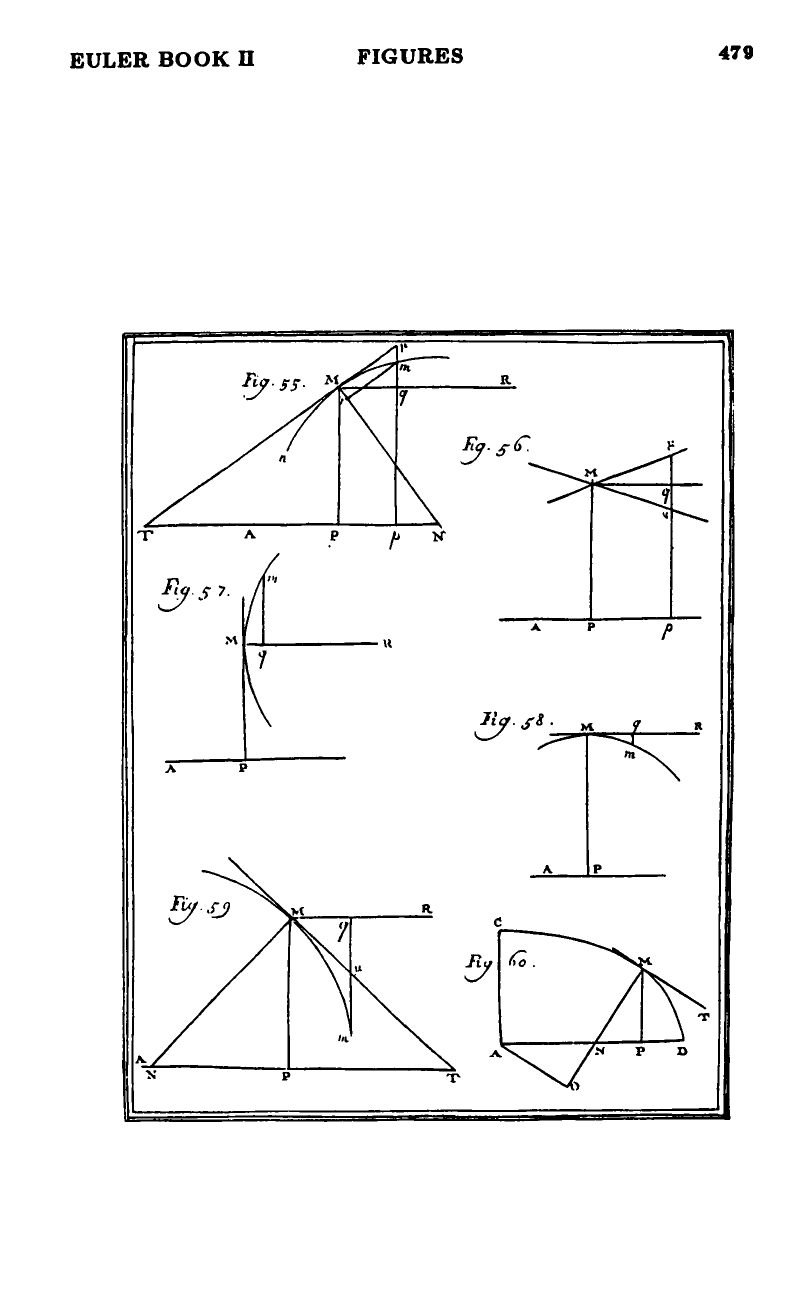 Figures 55–60
Related pages
- chapter-13-on-the-dispositions-of-curves — chapter summary.
- tangent-by-translation — the underlying algorithm that supplies .
- singular-points-by-jet — the case where and no subtangent is defined.
- parabola — §150’s , recovered as Example I.
- ellipse — chapter 6’s tangent property, recovered as Example II.
- cubic-species-classification — the seventh-species cubic of Example III.