Tangent by Translation
Summary: Euler’s algebraic algorithm for the tangent line to an algebraic curve at a point . Substitute , where ; constants cancel because lies on the curve; collect by total degree in ; keep only the first-degree truncation . As this straight line through coincides with the curve, so it is the tangent. The inclination is . Special cases: → tangent parallel to the axis (figure 58); → ordinate is itself the tangent (figure 57).
Sources: chapter13 (§§286–291). Figures 55, 57, 58 (in figures55-60).
Last updated: 2026-05-07.
The substitution (§§286–287)
Let be a point on the curve with abscissa and ordinate . Through , draw the line parallel to the axis , taken as a new axis (figure 55). Let be the new abscissa along this line and be the new ordinate, so a generic point near is .
Substitute , into the curve’s equation. Since lies on the curve, the constant terms cancel. The remaining equation, sorted by total degree in , takes the form
where the coefficients are constants in and the original coefficients of the equation. This is the equation of the curve in the new coordinates, with origin at and the -axis parallel to the original axis.
Linear truncation (§288)
For the curve’s behavior in a small neighborhood of , take as small as possible. Then are smaller still; smaller yet. So all but the linear terms can be omitted, leaving the equation
This is a straight line through . As along the curve, coincides with the curve. Hence is the tangent to the curve at (§289).
Why the truncation is legal (§290)
Euler frames a curve as the path of a moving point with continuously changing direction. If the direction did not change at , the line would describe the curve everywhere; the curve curves precisely because the direction changes. So the tangent records the instantaneous direction at . The linearization captures this direction because as the higher-degree terms vanish faster than the linear ones.
This is the algebraic prototype of the differential-calculus tangent algorithm. For curves whose equations are irrational or contain fractions, the same idea applies after appropriate modifications — and “those modifications give us differential calculus” (§290).
The inclination ratio (§§289, 291)
From , the slope of the tangent in the new coordinates is
When the original axes are orthogonal, this is also the slope in the original coordinates, since the new - and -axes are parallel to the original axes. When the original axes are oblique, the angle is fixed by the original obliquity together with the ratio via plain trigonometry.
Two diagnostic special cases:
- : , so the tangent is parallel to the new -axis — i.e., parallel to the original axis (figure 58). The ordinate is at a local extremum.
- : the inclination is infinite, so the tangent is parallel to the ordinate direction — that is, the ordinate itself is tangent to the curve at (figure 57).
Algorithm
Given a curve and a point on it, the tangent at is found by:
- Substituting , and expanding;
- Discarding all terms of degree in ;
- Reading the tangent as in translated coordinates, with slope .
The geometric quantities derived from — subtangent, subnormal, normal length — appear in subtangent-and-subnormal. The case where this algorithm fails because at — meaning is a singular point — is treated in singular-points-by-jet.
Figures
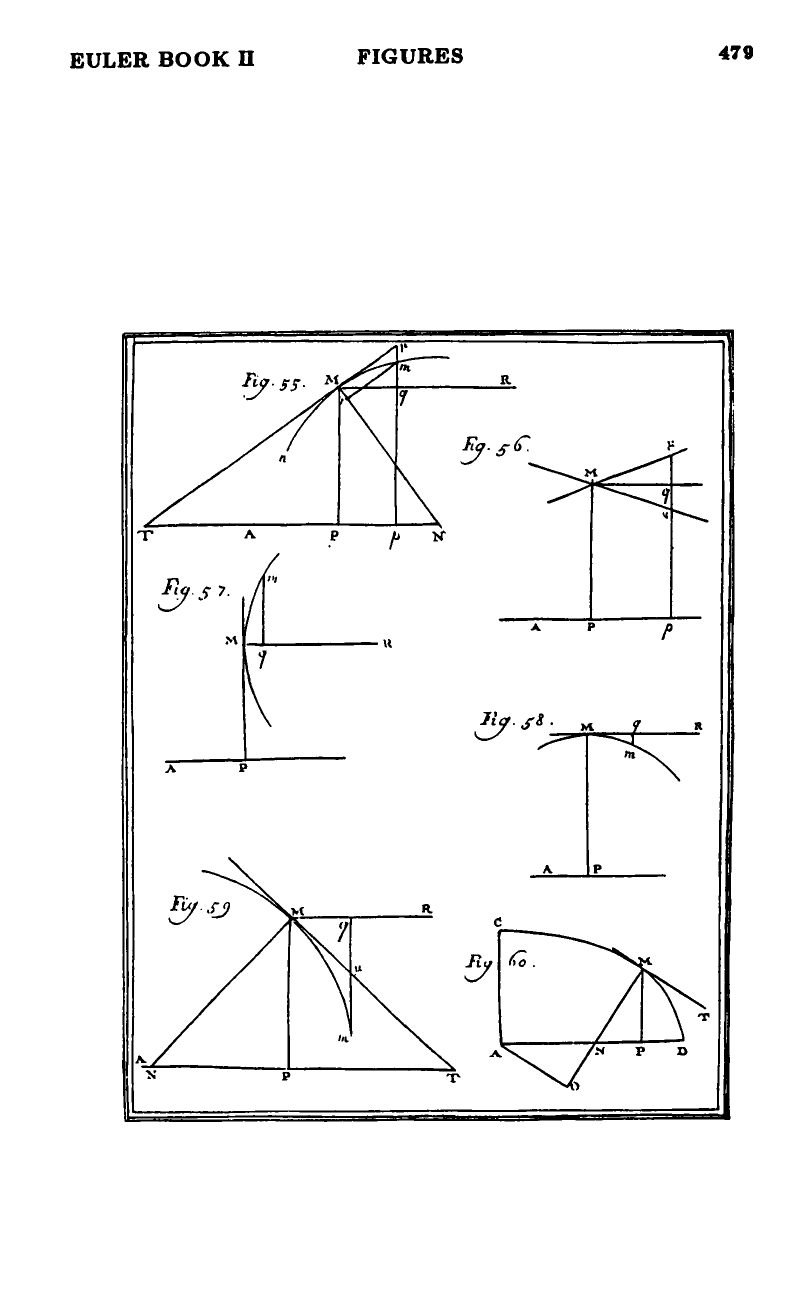 Figures 55–60
Related pages
- chapter-13-on-the-dispositions-of-curves — chapter summary.
- subtangent-and-subnormal — rectangular invariants , derived from this .
- singular-points-by-jet — what happens when both and at .
- parabola — §150’s tangent property , recovered in §289 Example I as the simplest application.