Triangular-Section Solids (Wedge-Cone, Affine Sections)
Summary: §§40–44 of the Appendix on Surfaces. Three more genera characterized by the shape of cross-sections perpendicular to a coordinate axis. Wallis’s wedge-cone (§40, figure 124): every section perpendicular to the -axis is a triangle whose vertex slides along a fixed straight line parallel to . Right-triangle sections (§41, figure 125): vertex slides on a curve . Affine-section solids (§§42–44, figure 126): adjacent sections related by an affine scaling rather than a similarity. Each is to the cone what the next dimension up of “shape constancy” allows.
Sources: appendix2, §§40–44. Figures 124–126 in figures124-127.
Last updated: 2026-05-12.
§40 — Wallis’s wedge-cone (figure 124)
Setup: every section perpendicular to the -axis is a triangle with vertex on a fixed straight line parallel to the axis , at perpendicular distance . Let be the base curve in the plane , and let at abscissa have length . From the similar triangles ,
so the surface equation is
This solid differs from a cone in that it is defined on the straight edge , while the cone is defined on a single point. If the base happens to be a circle, then the resulting solid is that which Wallis discussed and called a wedge-cone. (source: appendix2, §40)
The wedge-cone is the cone with its vertex stretched into an edge — the simplest non-conical, non-cylindrical, axis-aligned solid.
§41 — Right-triangle sections on a curved guide (figure 125)
Generalization: the vertex now slides on a curve in the plane perpendicular to , with the section right angle at . Let at abscissa be and be . Similar triangles give , or
When and each appear to first power only, the solid belongs to this genus (source: appendix2, §41).
§§42–44 — Affine-section solids (figure 126)
Cross-sections need not be similar: it suffices that they be affine to one another (corresponding abscissas have proportional ordinates — the affine-curves relation, lifted to one dimension up).
Setup with three principal sections . Take (base), (altitude). Let the principal section have ordinate equation . For a parallel section at , let the base length be and altitude . Affinity of to gives
Substitute , into the relation to get the surface equation in .
The §44 special case: if and have the same exponent in every term of the surface equation, then sections perpendicular to are all straight lines — and the surface has two-fold symmetry across the planes and in the way set out in octants-and-region-symmetries §20.
Where this genus sits
| Genus | Cross-section shape | Equation hallmark |
|---|---|---|
| Cylindrical/prismatic | All congruent | one variable absent |
| Conical/pyramidal | All similar, scaling linearly | homogeneous in |
| -generalization | All similar, scaling by | homogeneous in |
| Turned (revolution) | All circles, axis-aligned | |
| Wedge-cone | All triangles, vertex on a straight line | |
| Right-triangle | All right triangles, vertex on a curve | |
| Affine-section | All affine to a fixed plane curve | , |
Cross-references
- The affine-section construction is the direct lift of affine-curves (Chapter 18 §§442–446) to one higher dimension. There two coordinates were independently scaled; here the cross-section curves are independently scaled with .
- Wallis appears in the historical note attached to the wedge-cone (§40); his name is the only one Euler attributes to a specific surface in this Appendix.
- The Apollonian conic-section trichotomy emerges from the cone genus, not from these triangle-section genera, see cone-sections.
Figures
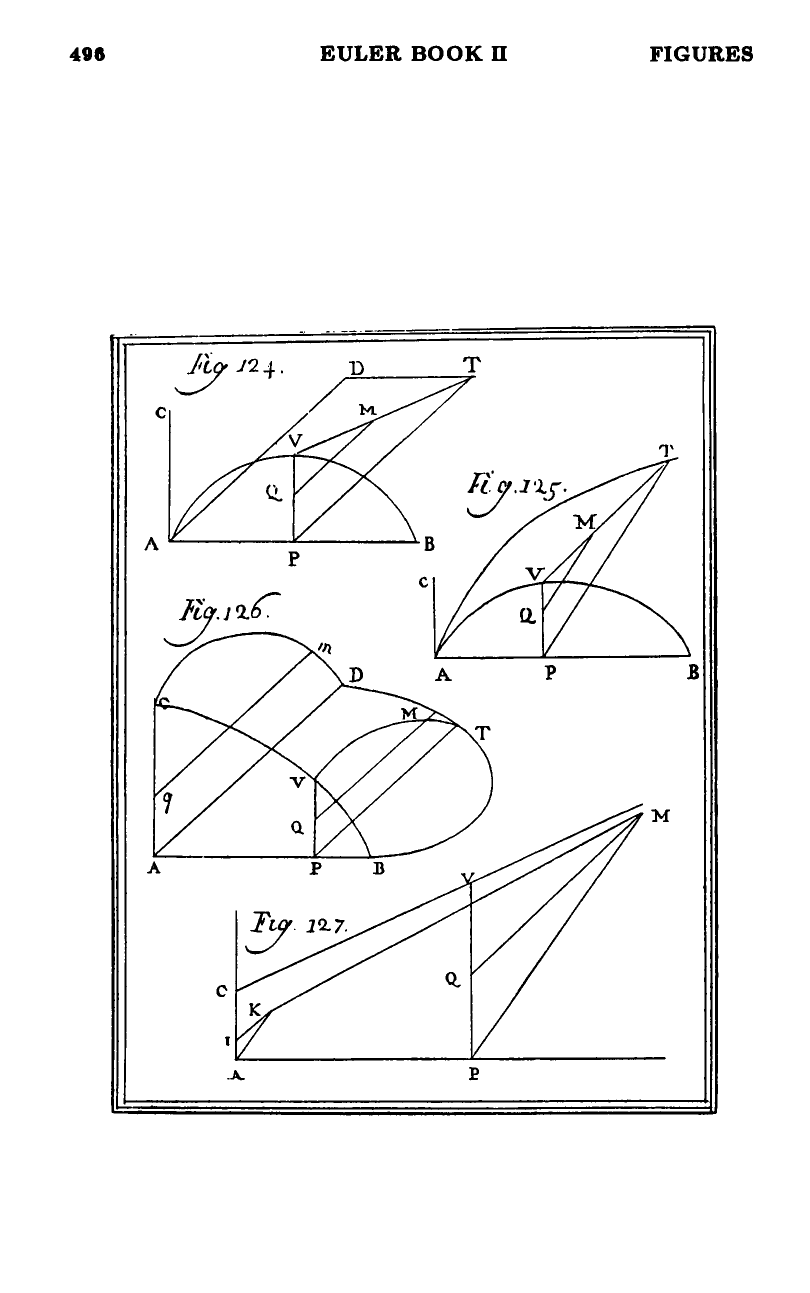 Figures 124–127