Cone Sections
Summary: §§68–80 of the Appendix on Surfaces. The algebraic Apollonius. Working from the canonical scalene cone with vertex at the origin (figure 134), every plane section is derived by direct substitution and classified by sign of : parabola at the borderline (§73), ellipse when (§74) with a subcontrary-circle condition , hyperbola when (§75). The right cone is the specialization; the equilateral hyperbola appears at the boundary .
Sources: appendix3, §§68–80. Figures 134–137 in figures133-134 and figures135-137.
Last updated: 2026-05-12.
§68 — Equation of the cone (figure 134)
Cone with vertex at the origin and axis perpendicular to the base. Let be parallel to the principal axes of any section perpendicular to the axis with (relabelling). With and (proportional semiaxes), the surface satisfies (source: appendix3, §68):
Every term has joint degree 2 — confirming the §34 conical-and-pyramidal-surfaces homogeneity property.
The right cone is (sections perpendicular to axis are circles).
§69 — Sections perpendicular to a base axis
Substituting const gives an ellipse — already known.
Substituting (perpendicular to one base axis) gives
a hyperbola with center on , transverse semiaxis , conjugate semiaxis . The same for const (source: appendix3, §69).
§§70–71 — Section perpendicular to the base, oblique to both base axes (figure 135)
The cutting plane meets the base in with . Following the §49 oblique-plane-section-method substitution and reducing:
Hyperbola with center , transverse semiaxis , conjugate semiaxis , asymptote angle (source: appendix3, §71). Equilateral hyperbola when , i.e. .
§§72–75 — Section oblique to the axis, perpendicular to (figure 136)
Cutting plane intersects base in at , inclined to base at . After the §49 substitution and reduction:
The coefficient of determines the type:
| Sign of | Cutting line in figure 134 | Section |
|---|---|---|
| , i.e. | intersects on opposite side of cone | ellipse (§74) |
| , i.e. | parallel to (cone’s slant) | parabola (§73) |
| , i.e. | diverges from on opposite side | hyperbola (§75) |
This is the algebraic Apollonius trichotomy. The cone’s half-angle is at the base intersection of — so the trichotomy is whether the cutting plane is shallower, parallel, or steeper than the cone’s own slant, exactly the synthetic Greek classification.
Parabola case (§73)
: section is parabola with vertex at where , latus rectum .
Ellipse case (§74)
Semiaxis along : . Conjugate semiaxis: . Semilatus rectum: .
Subcontrary-section circle (§74). Circle when , i.e.,
Requires . So an oblique cone admits a non-axial circular section iff its base ellipse has (the “wider” semiaxis is the one perpendicular to the cutting line’s projection).
Hyperbola case (§75)
Transverse semiaxis . Conjugate semiaxis . Asymptote-axis angle has tangent .
Equilateral hyperbola when , i.e.,
Requires .
§§76–80 — General oblique section (figure 137)
The fully general cutting plane is perpendicular to neither base axis. The base intersection makes angle with , , , plane inclination .
After the §49 substitution and a long reduction (§§77–80), the section equation is
where are auxiliary semidiameters depending on and . The trichotomy condition collapses to
Ellipse for , parabola for , hyperbola for .
The §73 perpendicular-to- formula is recovered by setting .
Cross-references
- Algebraic test for cone: homogeneous in . Genus: conical-and-pyramidal-surfaces.
- Section method: every formula is a special case of oblique-plane-section-method.
- Plane-side classification of conics: classification-of-conics, ellipse, parabola, hyperbola — every species of conic arises here as a section of a cone.
- The §51 universal-quadric-section theorem (general-quadric-surface) is here verified for the cone — every section is a conic, and every conic species is realized, in contrast to the cylinder which only gives ellipses (and degenerate lines).
Figures
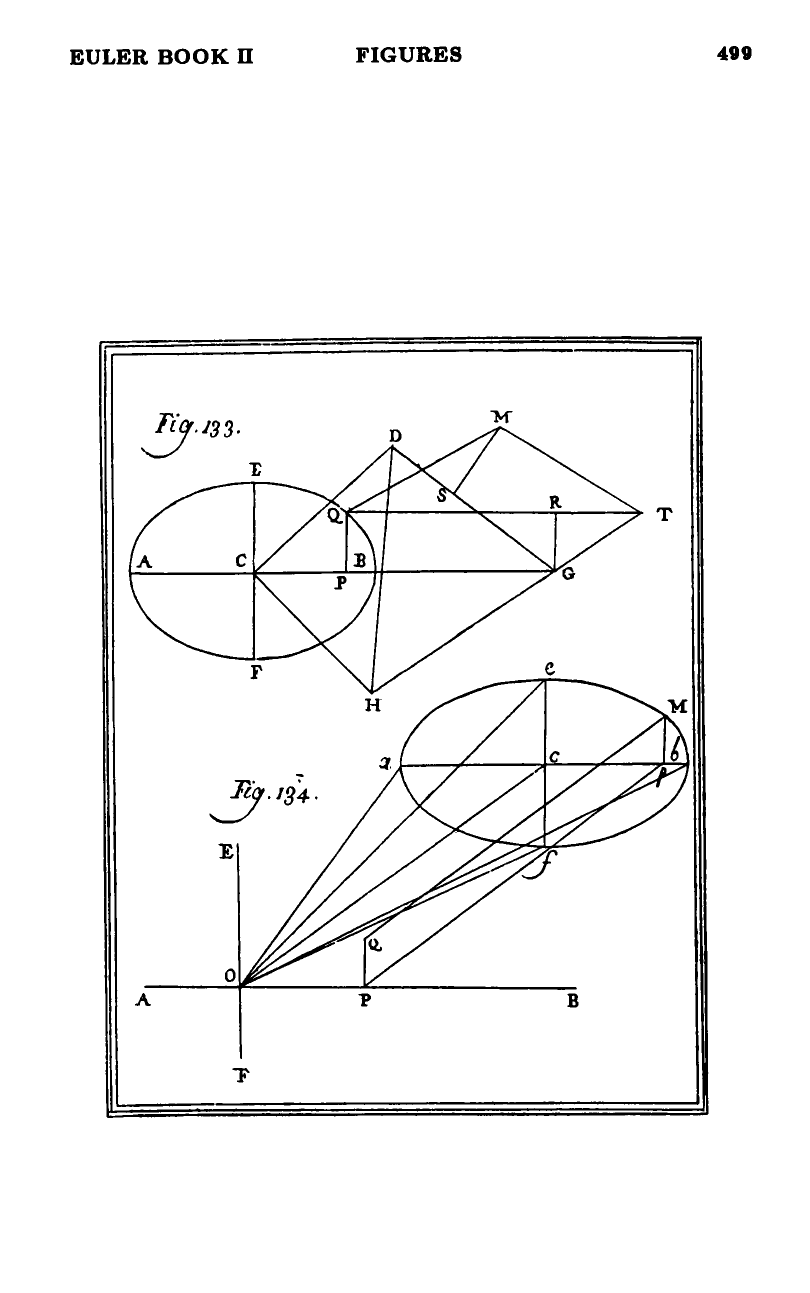 Figures 133–134
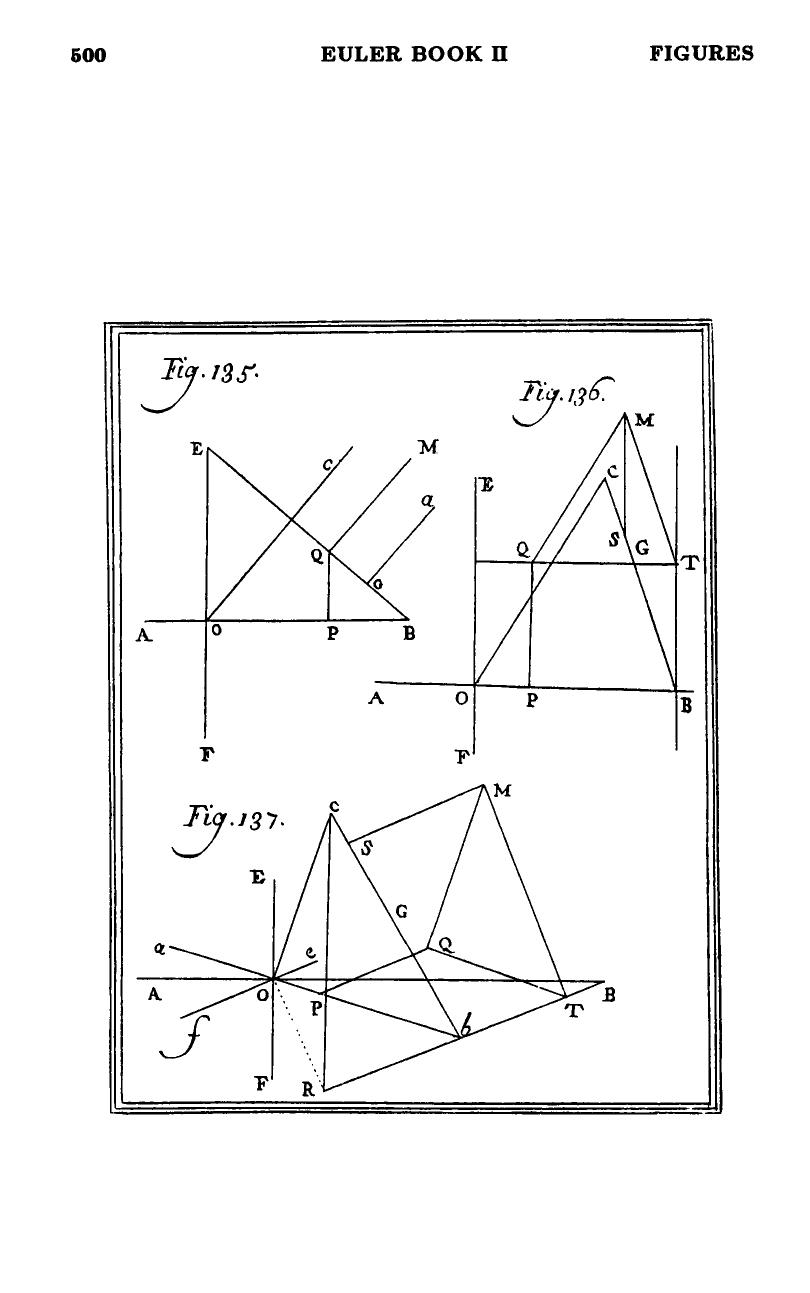 Figures 135–137