Appendix Chapter 2 — On the Intersection of a Surface and an Arbitrary Plane
Summary: Cuts by every flat. Sections by the three principal planes (set one variable to zero) and by parallel planes (set it to a constant) reveal the surface’s basic geometry. Genera defined by what those sections look like: a missing variable gives cylindrical / prismatic surfaces; a homogeneous equation gives conical / pyramidal surfaces; the unified form covers both; gives the turned solids (surfaces of revolution); various triangle-section solids include Wallis’s wedge-cone; an axis-containing-section condition yields ; and the chapter closes with the §51 universal observation that every plane section of a quadric is a conic.
Sources: appendix2, §§26–51. Figures 121–129 in figures121-123, figures124-127, and figures128-130.
Last updated: 2026-05-12.
§§26–31 — Sections by the three coordinate planes and parallels to them
Setting in the surface equation gives the curve where the surface meets the plane ; gives the curve in ; gives the curve in . For the sphere each of these is a great circle (§28).
Setting instead of gives the section by the plane parallel to at distance . As runs through all reals, these parallel sections sweep out the whole surface, sharing one parametric equation in (§§29–30). They are all congruent iff is absent from the equation (§31). See sections-by-coordinate-planes.
§§32–33 — Cylindrical and prismatic surfaces
If the variable is missing, the surface is generated by sliding a vertical line along the base curve in the plane (figure 122). Special cases: circle base → right cylinder, ellipse base → scalene cylinder, polygon base → prism. Either of or can play the role; the surface is named cylindrical or prismatic accordingly. See cylindrical-and-prismatic-surfaces.
§§34–38 — Conical, pyramidal, and the unified generalization
If the equation is homogeneous in (every term of equal joint degree), every section by a plane parallel to a principal plane is similar to every other and grows proportionally with distance from the origin (§34). Geometrically this is a cone (curved base) or pyramid (polygonal base), with vertex at the origin (§35). Circle base + central axis = right circular cone; otherwise scalene cone (figure 123).
The unifying generalization (§§37–38): replace by and ask only that the equation be homogeneous in . With this is the cone; with the cone has vertex displaced from the origin; with — i.e., absent — the surface is cylindrical. So the cone-and-cylinder genus is one homogeneous family. See conical-and-pyramidal-surfaces.
§39 — Turned solids (surfaces of revolution)
When an equation has the form — sections perpendicular to the -axis are concentric circles whose centers lie on the axis — Euler calls the solid turned (lathed). Right cone: . Cylinder: . Sphere: . See surfaces-of-revolution.
§§40–44 — Triangular-section solids
Several genera defined by what triangle every cross-section looks like:
- Wallis’s wedge-cone (§40, figure 124): every section perpendicular to the -axis is a triangle whose vertex slides along a fixed straight line parallel to . Equation with a function of . Reduces to a cone when the line collapses to a point.
- Right-triangle sections (§41, figure 125): vertex slides on a curve .
- Affine-section solids (§§42–44, figure 126): adjacent sections related by an affine scaling rather than a similarity. See triangular-section-solids.
§§45–46 — Axial-section solids
If every section containing the axis is a straight line, the surface satisfies with linear in (§45, figure 127). General-axis-section formula (§46): substitute , to read off the section in plane . See axial-section-solids.
§§47–50 — General oblique section
The master substitution that lets you read off the section by any flat. Two warm-ups (figures 128, 129) build to the full formula:
Substituting these for in the surface equation gives the equation of the section in coordinates of the cutting plane. Algebraic surfaces have algebraic sections, of equal or smaller total degree (§50). See oblique-plane-section-method.
§51 — Every section of a quadric is a conic
The quadric
has the property that every plane section is a curve of order at most 2 — i.e., a (possibly degenerate) conic. The §51 theorem closes the chapter and motivates the next: the next chapter studies what those conic sections actually look like for the three classical quadrics. See general-quadric-surface.
Cross-references
- Cylindrical/prismatic and conical/pyramidal surfaces import the homogeneity calculus of similar-curves and affine-curves (Book II Chapter 18) one dimension up.
- §51’s universal-conic-section property is the bridge to chapter 5–6 of Book II (chapter-5-on-second-order-lines, chapter-6-on-the-subdivision-of-second-order-lines-into-genera) and is fully cashed out in appendix-3-on-sections-of-cylinders-cones-and-spheres.
Figures
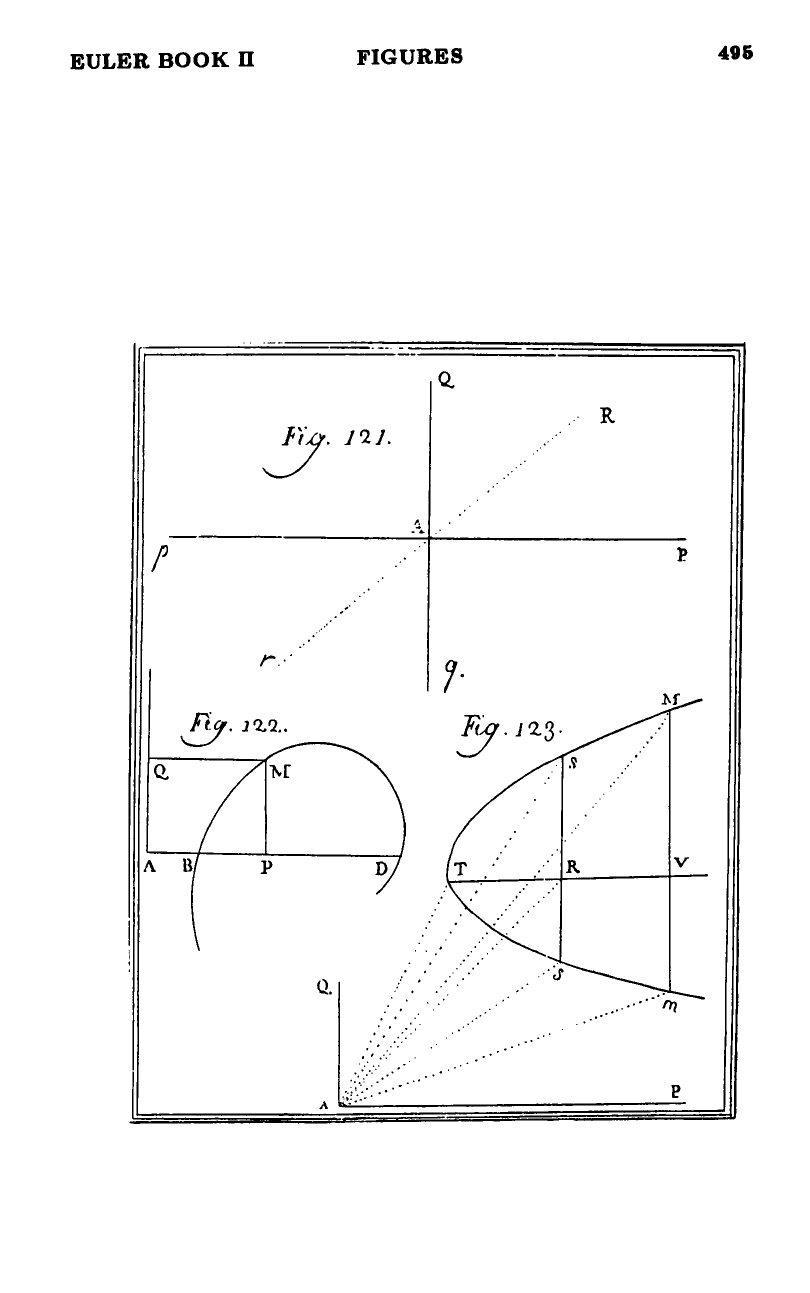 Figures 121–123
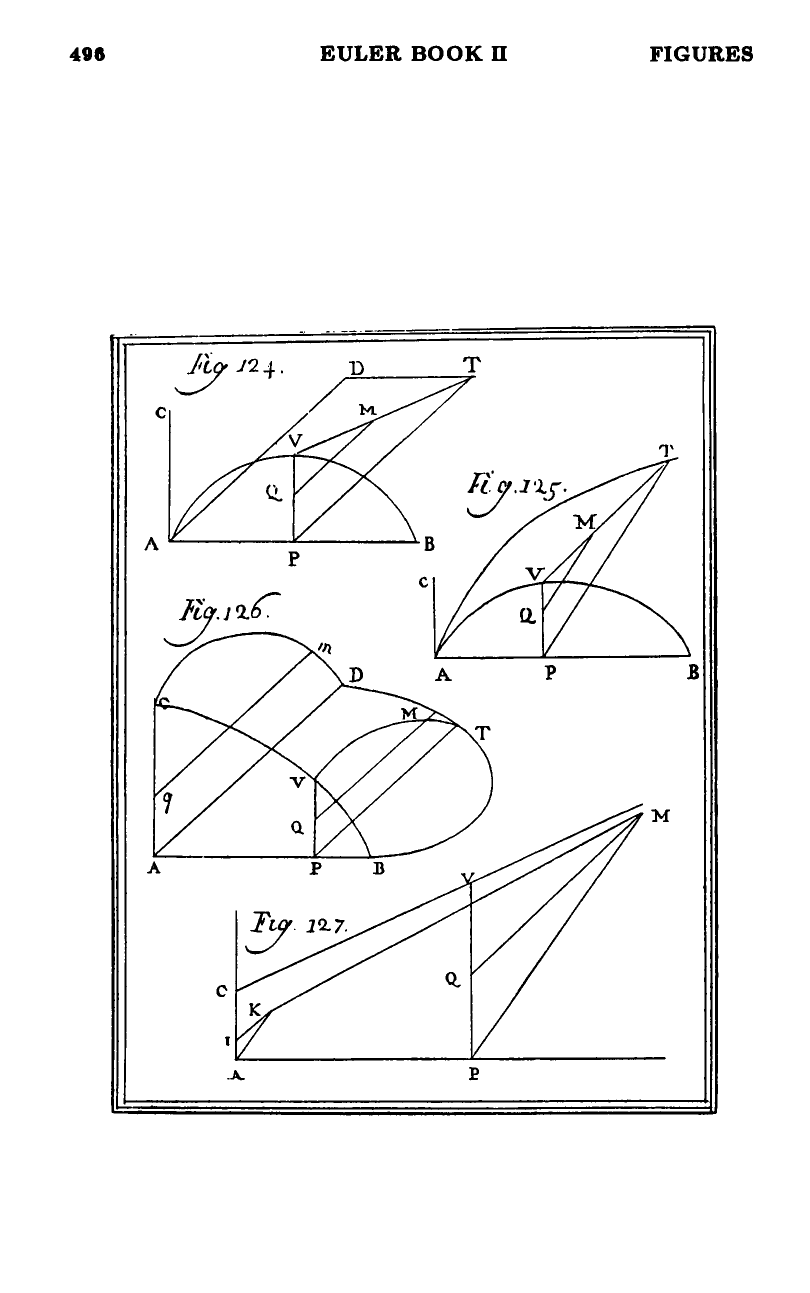 Figures 124–127
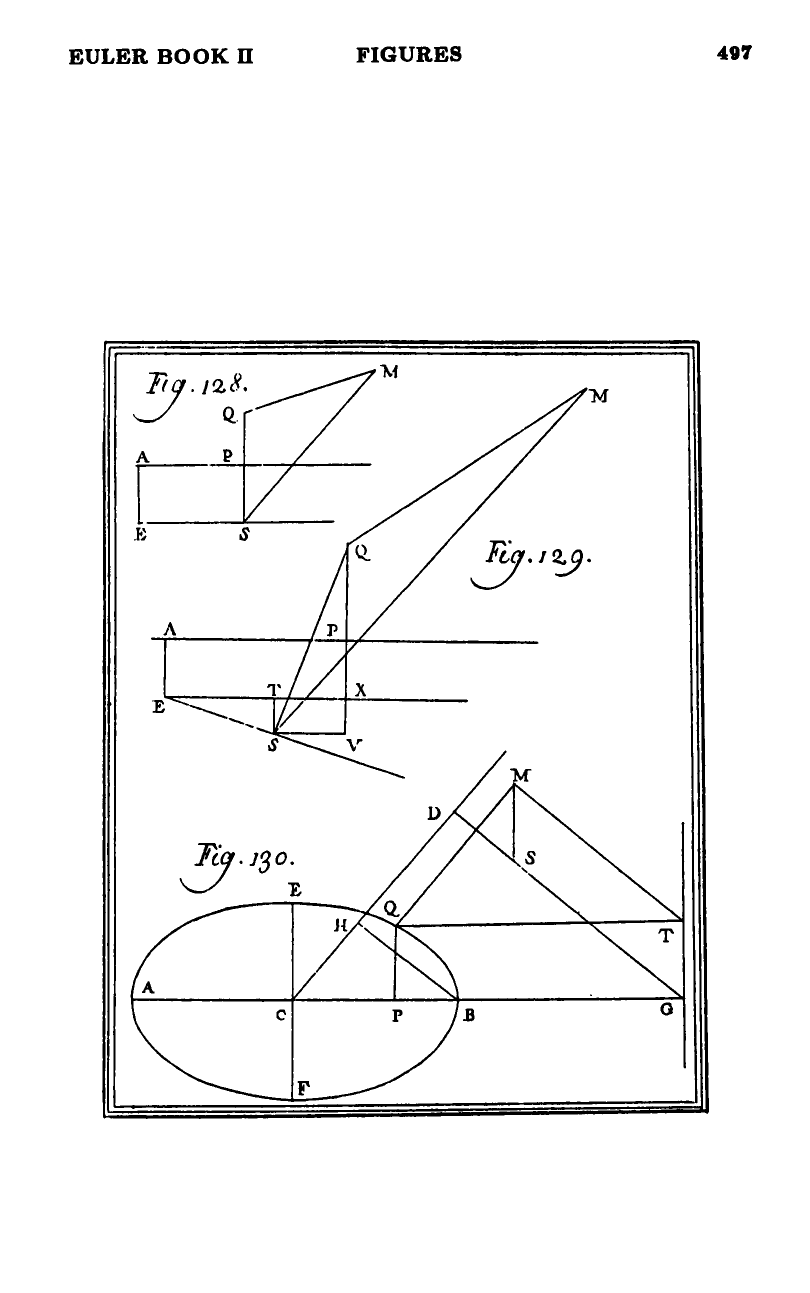 Figures 128–130
Related pages
- sections-by-coordinate-planes
- cylindrical-and-prismatic-surfaces
- conical-and-pyramidal-surfaces
- surfaces-of-revolution
- triangular-section-solids
- axial-section-solids
- oblique-plane-section-method
- general-quadric-surface
- appendix-1-on-the-surfaces-of-solids
- appendix-3-on-sections-of-cylinders-cones-and-spheres