Octants and Region Symmetries
Summary: §§15–25 of the Appendix on Surfaces. Three perpendicular coordinate planes divide space into eight octants (figure 120, §§15–16). Two octants are conjugate if they share a tangent plane (one coordinate sign flipped), disjoint if they share only a tangent line (two flipped), opposite if they share only the point (all three flipped). Parity-of-exponent conditions on the surface equation determine which octants contain congruent parts — the higher-dimensional generalization of diameter-and-center-from-equation for plane curves.
Sources: appendix1, §§15–25. Figure 120 in figures119-120.
Last updated: 2026-05-12.
§§15–16 — The eight octants
Three planes meeting at partition space into eight regions, identified by which side of each plane they lie on. Letters (uppercase) mark the positive sides, (lowercase) the negative. The eight octants and their coordinate sign tables (source: appendix1, §16):
| # | Region | |||
|---|---|---|---|---|
| I | ||||
| II | ||||
| III | ||||
| IV | ||||
| V | ||||
| VI | ||||
| VII | ||||
| VIII |
§§17–18 — Conjugate, disjoint, opposite
Two octants are:
- Conjugate if they share a face — one coordinate sign flipped (3 conjugates per octant);
- Disjoint if they share only an edge — two coordinate signs flipped (3 disjuncts per octant);
- Opposite if they share only the point — all three signs flipped (1 opposite per octant).
Each octant has 3 conjugates, 3 disjuncts, and 1 opposite. Euler tabulates the relationship explicitly (source: appendix1, §17–18); the symbolic table is the symmetric group acting by sign flips.
§19 — Single-variable parity (mirror across one plane)
If a single variable has only even exponents in the surface equation, the surface has matching parts on either side of the plane perpendicular to that variable. This gives four pairs of congruent octants.
| Variable with all-even exponents | Octant pairings |
|---|---|
| even | |
| even | |
| even |
(Source: appendix1, §19.) The ” even” row recovers the diametral-plane criterion of §13.
§§20–21 — Joint-degree parity (rotation about an axis)
If two variables taken together have joint total degree everywhere even or everywhere odd in each term of the equation, the surface is invariant under simultaneous sign flip of those two variables — i.e. under a 180° rotation about the third coordinate axis. This gives another four pairs of congruent octants:
| Variable pair with parity-fixed joint degree | Octant pairings |
|---|---|
(Source: appendix1, §20.) These are the disjoint pairings — the surface analogue of concurrence-of-diameters for plane curves with rotational symmetries.
§§21–23 — Combined parity (multiple-fold congruences)
If two of these conditions hold simultaneously, four octants contain congruent parts — partial symmetry. Several combinations and their octant 4-tuples are tabulated in §§21–23.
If all three single-variable parity conditions hold (each of has only even exponents in every term), then all eight octants are congruent (source: appendix1, §24) — full central symmetry. The sphere is the canonical example.
§25 — The substitution test
It is easy to check whether each variable has even exponents (look term by term) and whether all three taken together have constant-parity joint degree. The middle case — only two variables taken together have constant-parity joint degree — is harder to read off. Euler’s test: substitute , , or and ask whether the resulting equation has (resp. ) with even exponents only (source: appendix1, §25). Affirmative answers detect the joint-degree symmetry.
Cross-references
- The single-variable mirror condition (§19) is exactly the diametral-plane criterion of §13.
- The joint-degree rotation conditions (§§20–21) generalize the §§337–343 parity calculus in diameter-and-center-from-equation to the third dimension.
- The full 8-fold symmetry condition (§24) is the surface analogue of a plane curve having both reflective diameter and central symmetry, e.g. an ellipse has all four quadrants congruent.
Figures
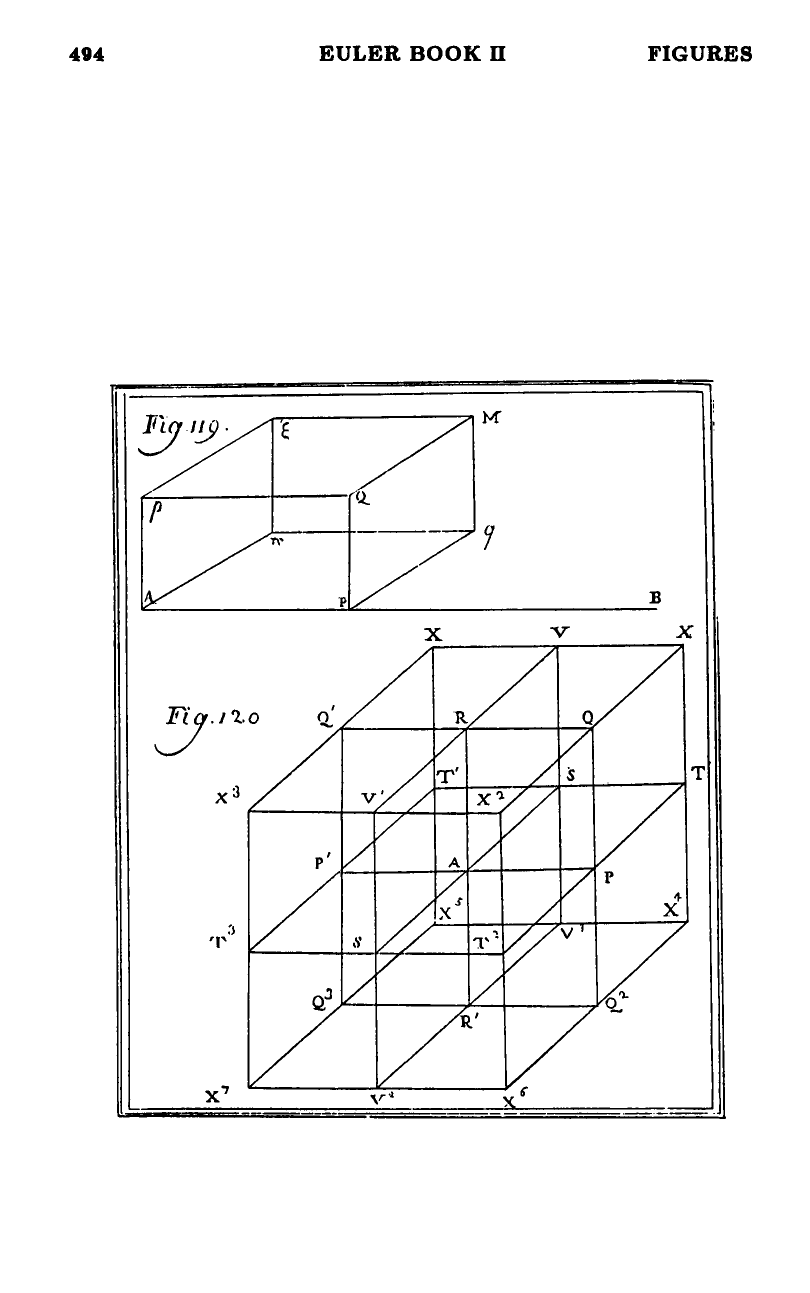 Figures 119–120