Conical and Pyramidal Surfaces
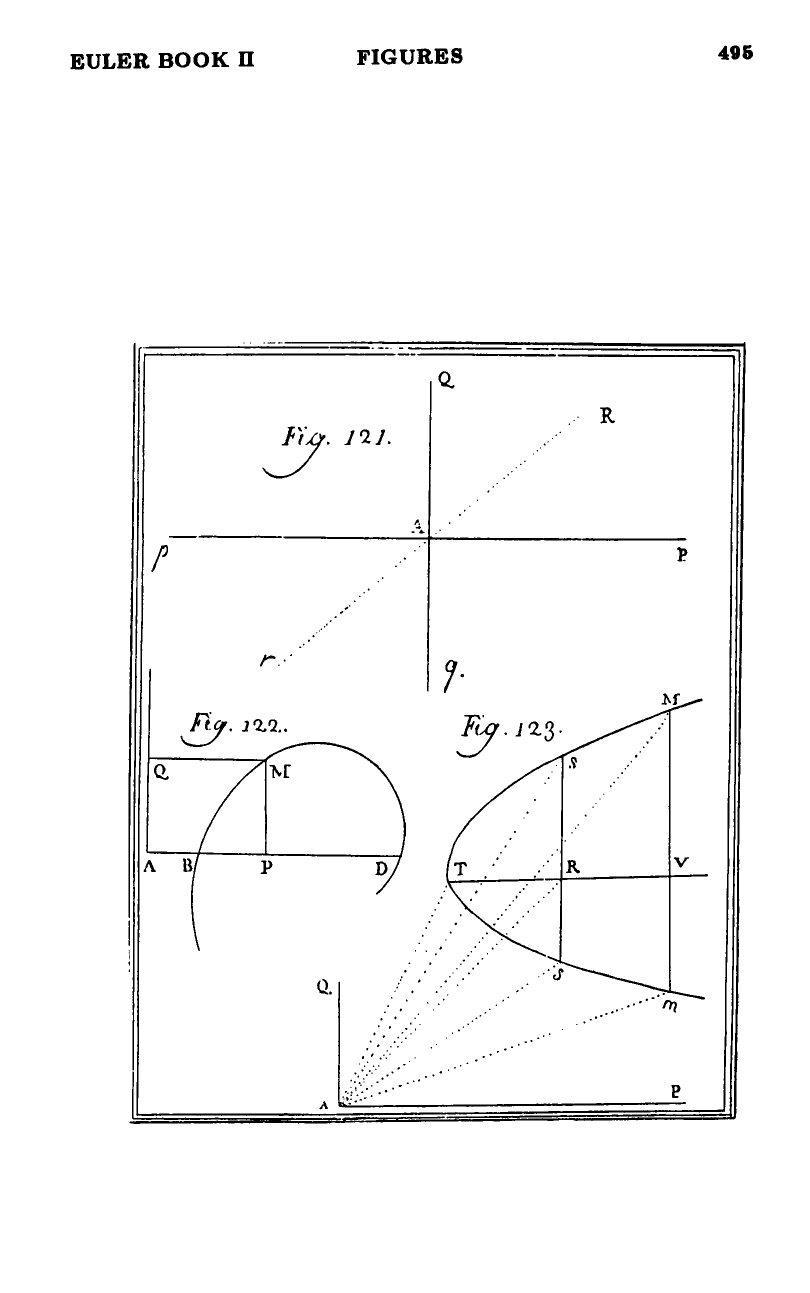
Summary: §§34–38 of the Appendix on Surfaces. The second surface genus, characterized by a homogeneous equation in . Sections by planes parallel to a principal plane are then all similar and grow proportionally with distance from the origin (figure 123). Curve base → cone (right or scalene), polygonal base → pyramid; vertex always at the origin . The unifying generalization (§§37–38): replace by an arbitrary single-valued and require homogeneity in . With this is the cone; with the cone has vertex displaced; with — i.e., absent — the surface degenerates to a cylindrical-and-prismatic-surfaces one. So cones and cylinders form a single homogeneous-equation family.
Sources: appendix2, §§34–38. Figure 123 in figures121-123.
Last updated: 2026-05-12.
§34 — Homogeneous equation ↔ similar sections
The next [genus] most worthy of notice is that which arises from a homogeneous equation in the three variables , and . That is, in the equation the joint degree in each term is the same. (source: appendix2, §34)
Example: (each term joint degree 2). Substituting a constant gives
and the same shape rescales as varies. Sections parallel to are not just similar: they grow proportionally to , so corresponding points lie on straight lines through the origin (source: appendix2, §34).
§35 — The cone-and-pyramid construction (figure 123)
Pick the section at , parallel to . Pass an indefinite straight line through the origin and through any point of . As that point sweeps the section, the line sweeps the surface (source: appendix2, §35):
- a circle centered at → right circular cone;
- a non-centered ellipse → scalene cone;
- a polygon → pyramid.
Vertex always at . Hence the genus name conical or pyramidal.
§36 — All-direction similarity
The same homogeneity gives similarity-and-proportional-scaling for sections parallel to any of the three coordinate planes — and indeed to any plane through (anticipated here, fully derived in chapter 3 §§68–80, see cone-sections):
All sections by planes parallel to any plane through the point , will be similar to each other and proportional to the distance of the plane from the vertex . (source: appendix2, §36)
The cone and the pyramid are the two surface genera that have this scaling-with-distance property.
§§37–38 — The unified generalization
The conical genus generalizes by replacing with an arbitrary single-valued function and requiring homogeneity in . Setting then gives and the section is similar with scaling proportional to (not ) — so the lines through corresponding section-points are no longer straight but are curves following as a function of (source: appendix2, §37).
This -generalization contains both elementary genera as special cases (source: appendix2, §38):
| Choice of | Surface |
|---|---|
| cone with vertex at origin | |
| cone with vertex at origin (scalar) | |
| cone with vertex at | |
| cone with vertex at | |
| (limit ) | absent → cylinder |
So a cylinder is a cone with vertex at infinity — algebraically, the limit of the homogeneous-in- family as the -dependence of degenerates to a constant.
Worked instance: the canonical scalene cone
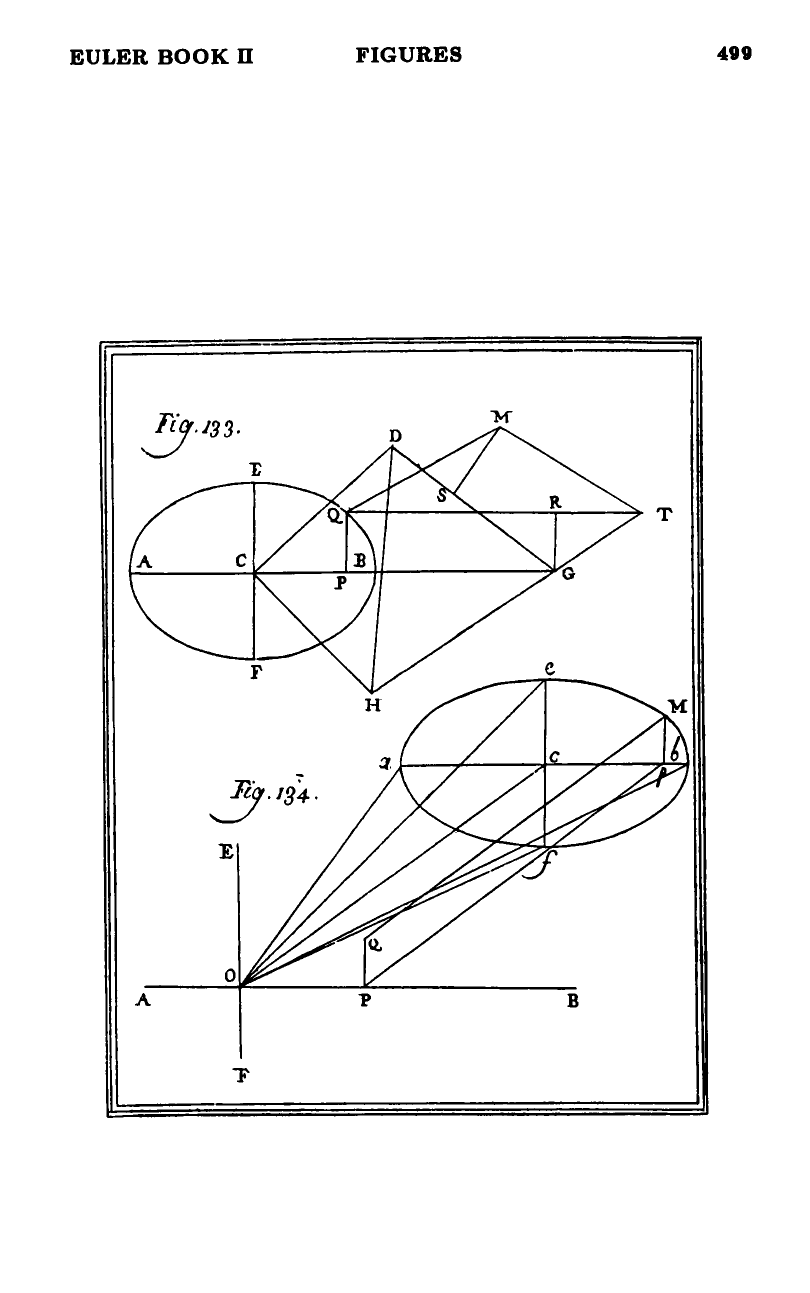
In the next chapter (§68, figure 134) Euler studies the canonical scalene cone with vertex at the origin and elliptical base:
Each term is joint degree 2 — the §34 homogeneity condition. Sections perpendicular to the axis are ellipses with semiaxes proportional to . The full conic-section trichotomy of oblique cuts (parabola at , ellipse below, hyperbola above) is developed in cone-sections.
Cross-references
- Cylinder limit recovers cylindrical-and-prismatic-surfaces — both genera are unified §38.
- The scaling-with-distance property (§§35–36) is the surface analogue of similar-curves (Chapter 18) for plane curves with a single thread-degree-homogeneous parameter.
- Worked-out section behaviour for the canonical cone: cone-sections (§§68–80).
- The “cylinder as cone with infinite vertex” trick mirrors the “parabola as ellipse with infinite axis” framing in parabola (Chapter 6).
Figures
 Figures 121–123
 Figures 133–134