Triple-Factor Asymptote Cases
Summary: When the highest member factors as — multiplicity 3 — the rotated leading equation has four possible alternatives at infinity, depending on which terms of are present: I. (cubic, figure 41); II. (parabola plus refinable straight line); III. (cubic, figure 42); IV. (up to three parallel straight lines, each refinable). Equal-root sub-cases of IV demand higher refinements: a double root reduces to the double-factor-asymptote-cases family ; a triple root produces or the general . The shape follows the same parity rule as the simple-factor case.
Sources: chapter8 (§§210–214), figures40-43 (figures 41, 42), figures35-39 (figures 36, 37 reused for cubic shape).
Last updated: 2026-04-28
Setup
§210. With , the rotated members in are
and so on. (Reused letters denote different coefficients in different members.) The leading -coefficient of is .
The leading equation at infinity has four alternatives, depending on which of the terms in vanish:
I. ‘s top term present: , i.e.
II. absent but and present: , i.e.
III. Above two also absent, but and (or equivalent) present:
IV. All "" contributions in low-power positions absent, leaving a polynomial in alone:
Equation I: cubic asymptote (§211, figure 41)
is a third-order line — a semicubical-parabola–like cubic in . Take the asymptote axis with the origin (figure 41). The cubic has two branches (upper) and (lower) going to infinity in quadrants and — the branch shape is a cusp at the origin opening in the direction.
This case generalises the parabolic asymptote of parabolic-asymptote one degree higher and is a representative of the hyperbolic-and-parabolic-branches parabolic family at species .
Equation II: parabola plus refinable straight line (§211)
admits a root (taking dominates), but for finite the equation must also have — and at infinity it factors as
approximately (Euler resolves it as two equations). Concretely:
- — a straight-line asymptote, parallel to .
- — a parabolic asymptote (as in equation I of double-factor-asymptote-cases), with two branches.
The straight-line component admits the refinement procedure of curvilinear-asymptote-refinement. Substituting and everywhere else:
leading to refinements for , exactly as in curvilinear-asymptote-refinement.
So equation II gives a double asymptote: one parabolic and one straight-line (refinable), in different directions through the origin.
Equation III: cubic, two opposite branches (§212, figure 42)
. As , the only way to balance the equation is , which makes negligible compared to . The dominant equation reduces to
a third-order (cubic) asymptote (figure 42). Its two branches (in quadrant ) and (in quadrant ) go to infinity in opposite quadrants — figure 42.
Equation IV: parallel-line family (§§212–214)
is a cubic in alone, with one or three real roots. Three sub-cases, corresponding to the double-factor-asymptote-cases discriminant analysis but at one degree higher.
Three distinct real roots: three parallel straight lines
Three roots give three parallel-line asymptotes. Each is refined individually by the curvilinear-asymptote-refinement procedure. Substituting and everywhere else, the refinement is
whence as before.
Double root (§213)
The factor has multiplicity 2, the other root is (a single straight-line asymptote, refinable as in curvilinear-asymptote-refinement).
For the double root: substituting everywhere except in :
— exactly the form analysed in double-factor-asymptote-cases §207–208. The three sub-cases on vs apply.
Triple root (§213)
All three roots coincide at . The leading equation collapses, and the refined equation has the form
where are coefficients of the lower members evaluated at . Substituting in the lower members may again reveal factors. Several refined forms can arise:
- If : simplest case, .
- If is divisible by (i.e. is also a root of the next coefficient): keep one factor and add the next term, giving .
- If is divisible by : keep and add the next:
- The general form, after exhausting all such cascading divisibilities:
where is less than , is less than , and is less than .
Shape catalogue for triple-root refinement (§214)
§214. The general triple-root refinement produces three roots in , each of one of the three forms:
- Three of the form (three hyperbolic-rate refinements);
- Or one of that form and one of the form (mixed);
- Or a single (all three roots merge at the same rate). This last occurs when both and in the general form above. Two of the three could also be complex, giving no asymptote in those rates.
For the cubic shape : setting and choosing the asymptote line as axis (origin at ), the parity of determines the quadrant pattern, exactly as in curvilinear-asymptote-refinement §203:
- odd: two branches , in opposite quadrants — figure 36 reused.
- even: two branches , in adjacent quadrants (both above the asymptote, say) — figure 37 reused.
The same parity rule that applied to the simple-factor refinement applies here, simply lifted to the cubic exponent on .
Summary of cases
| Equation | Asymptote(s) | Branches | Figure |
|---|---|---|---|
| I. | cubic | 2 in | 41 |
| II. | parabola + straight line (refinable) | 2 + 2 | — |
| III. | cubic | 2 in | 42 |
| IV. , distinct real roots | three parallel lines, each refinable | 2 + 2 + 2 | — |
| IV. double root | line + double-factor case | per double-factor-asymptote-cases | — |
| IV. triple root | per parity (§214) | 36, 37 |
Beyond multiplicity 3
§215. Quadruple, quintuple, and higher coincident factors follow the same logic — leading equation is a polynomial of the corresponding degree in , and refined forms are — but Euler does not develop them in detail. The chapter ends with the example in example-curve-eight-branches.
Figures
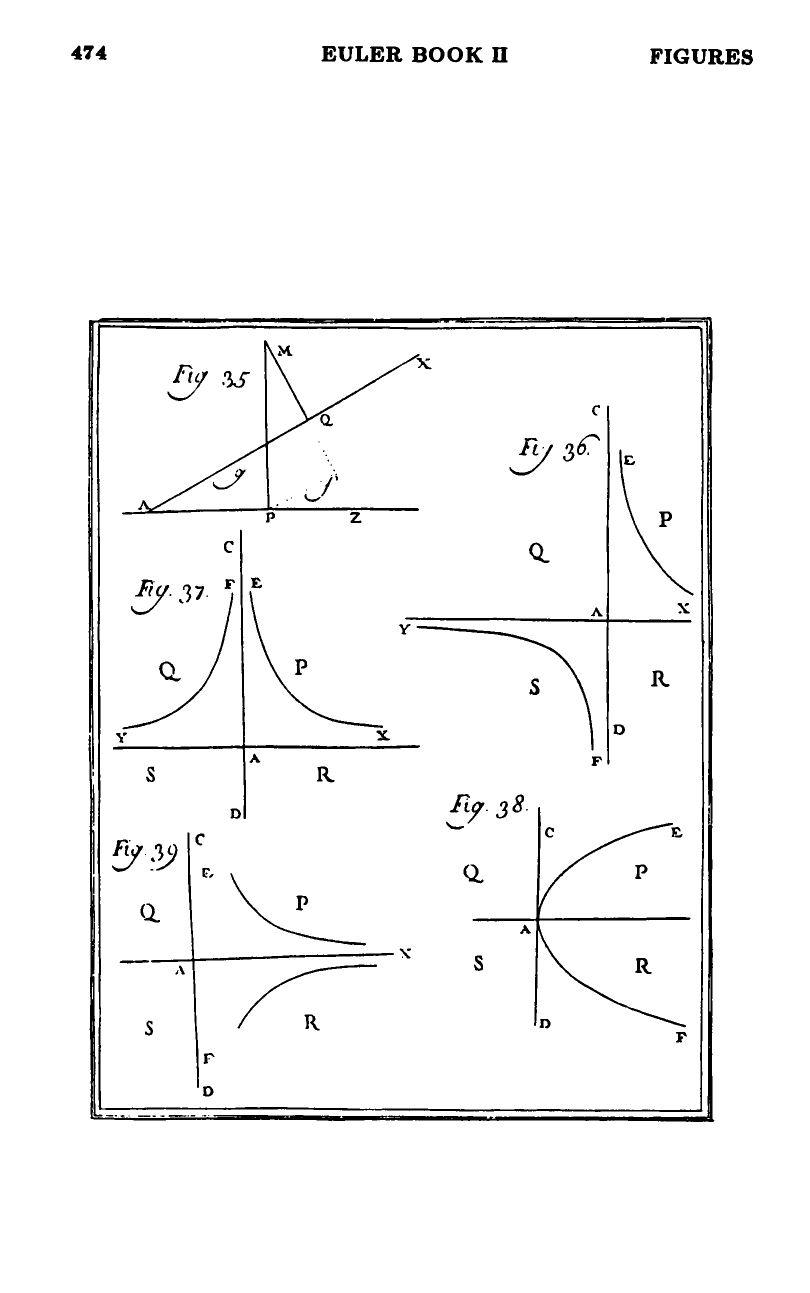 Figures 35–39
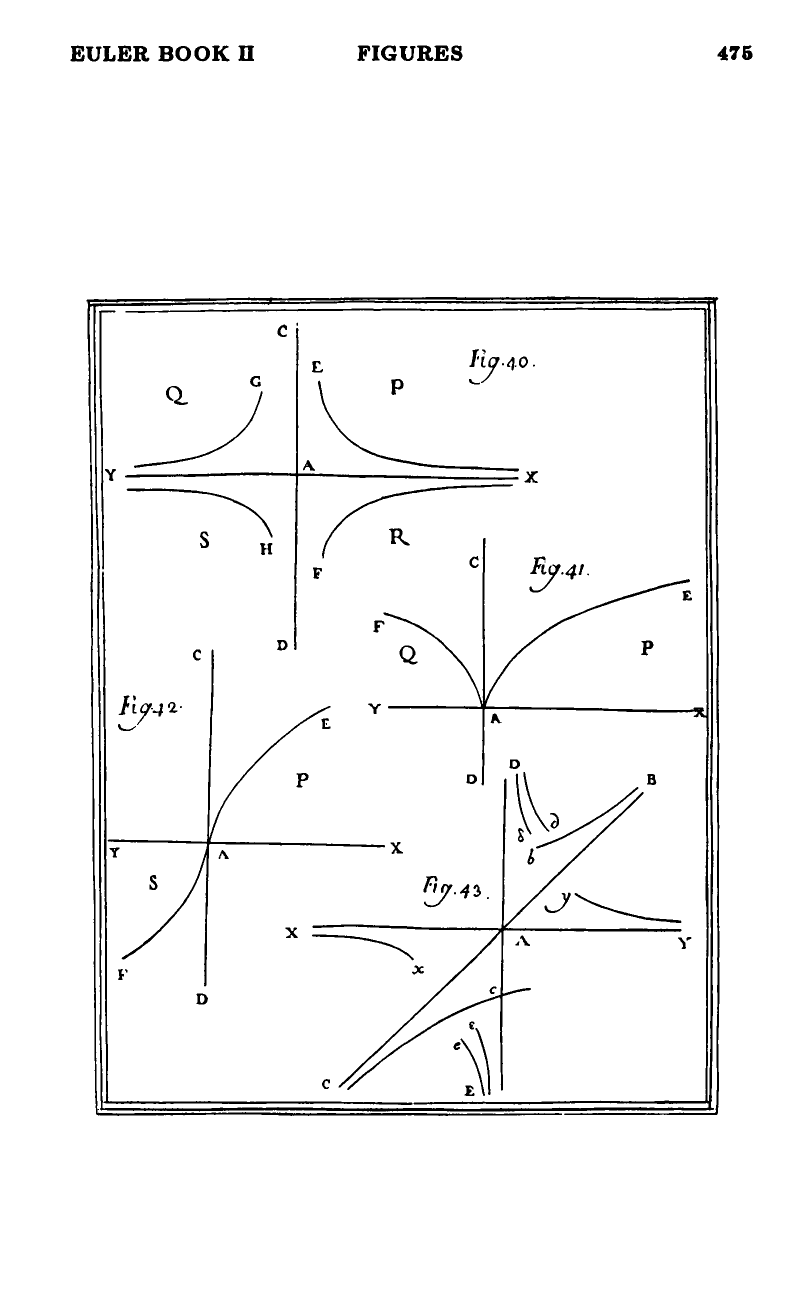 Figures 40–43