Curvilinear Asymptote Refinement
Summary: The master move of chapter-8-concerning-asymptotes. Given a straight-line asymptote produced by a simple real linear factor of the highest member , refine it to a curvilinear asymptote that approximates the original curve more closely. The procedure: rotate axes onto the asymptote direction, expand in descending powers of with coefficients in , substitute everywhere except in the term that vanishes when , and read off a sequence of refinements for . The first non-vanishing tells how fast and on which side the curve approaches .
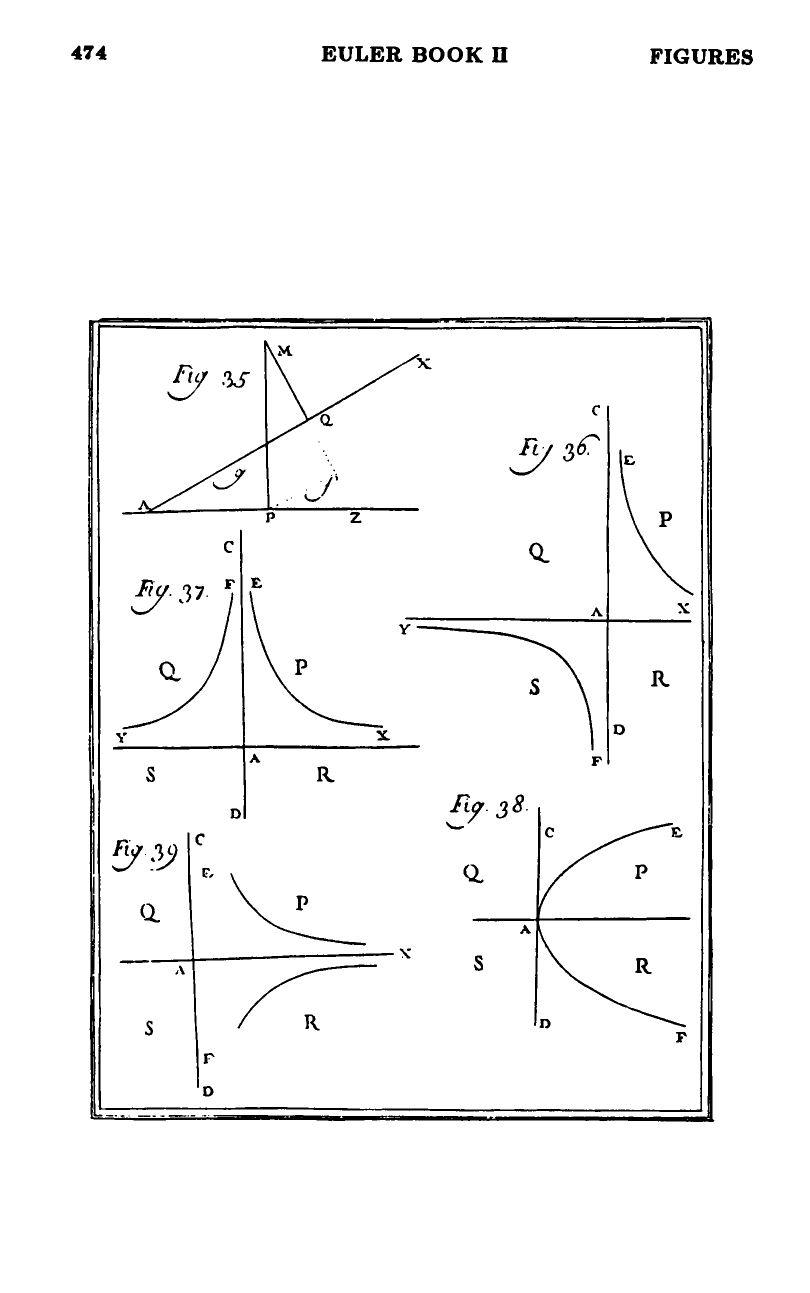
Sources: chapter8 (§§200–203), figures35-39 (figures 35, 36, 37).
Last updated: 2026-04-28
Setup: rotate onto the asymptote direction
§200. Suppose where is homogeneous of degree and not divisible by . Let be the original abscissa axis with , (figure 35). Choose a new axis through the origin at angle to — the direction of the asymptote. So
On the new axis, take abscissa and ordinate . With , the new and old coordinates relate by
So — the new ordinate — is, up to the constant , the very factor of . The straight-line asymptote will become a horizontal line .
Member expansion in
§201. Substitute , into and group by powers of . The members take the schematic form (relabelling coefficients for cleanliness):
and so on. (The recycled letters refer to different coefficients in each member.) Note that at this stage, so contributes ; multiplied by , the -coefficients land one column to the left.
As , in any given member only the first non-vanishing term survives; subsequent terms in the same member are smaller by a factor of (which tends to zero on a branch approaching the asymptote , since stays bounded while ).
The straight-line asymptote (§202)
Since is not divisible by , its first term is present: starts with . So starts with , and starts with . The leading equation at infinity is
This is the straight-line asymptote: the line parallel to and at distance from the new axis .
Refinement: substitute everywhere except in the leading term
§202. To find a closer-fitting curvilinear asymptote, set in every member except the term — the term that records the deviation . The equation reduces to
Using to factor out :
Divide by :
where .
Reading off the refinement. Truncate at the first non-vanishing coefficient. Denote it and its position :
- If : refinement is .
- If but : refinement is .
- Generally: for the smallest with .
- If : then the equation becomes , meaning divides the original polynomial. The straight line is then part of the curve — the curve is reducible (see complex-curves).
Canonical form (§203)
Setting — choosing the asymptote line itself as the new axis (figure 36) — every refined asymptote takes the form
The four quadrants formed by (the asymptote, horizontal) and the perpendicular line at the origin are labelled counterclockwise from upper-right (figure 36).
Parity rule for the quadrant pattern
The shape depends on the parity of :
- odd (e.g. ): has the same sign as , which flips with the sign of . Two branches in quadrant (, if ) and in quadrant (, ). Branches lie in opposite quadrants — figure 36.
- even (e.g. ): has the fixed sign of regardless of . Two branches and both above (if ) or both below (if ) the asymptote, in adjacent quadrants and — figure 37.
The convergence is faster for larger : as , so the curve hugs the asymptote more tightly.
What’s gained over the straight line alone
The straight-line asymptote tells you the limiting direction and limiting position. The curvilinear refinement additionally tells you:
- The side of approach. Sign of (and parity of ) decides whether the branch is above or below the line, and whether the two branches lie on the same side or opposite sides.
- The rate of approach. The exponent : is “hyperbolic” (slow); larger is faster.
- Whether the branches cross the line. Only the parity of together with the sign can flip — but never crosses for finite , only at .
This gives qualitative information — quadrant pattern, side, rate — that the straight-line asymptote cannot encode.
Worked structure
The refinement is mechanical once the rotation is in place:
- Compute and (substitute into the coefficients of the dominant terms in and ). The asymptote is with .
- Compute . If non-zero, the refinement is .
- If , compute . If non-zero, the refinement is .
- Continue until the first non-vanishing is found.
Figures
 Figures 35–39