Chapter 8: Concerning Asymptotes
Summary: Chapter 7 catalogued which asymptotic curves arise from each multiplicity profile of real linear factors of the highest member but deferred their shape. Chapter 8 closes the loop in two complementary directions. (a) For every straight-line asymptote already found, refine it: take the simple-factor case , drop into rotated coordinates , substitute everywhere except the leading term, and read off a sequence of curvilinear asymptotes that approach the curve faster than the straight line itself. (b) Repeat the operation for double, triple, and higher factors, getting in each case a complete sub-classification of the resulting branches by shapes. The chapter ends with a worked 8-branch curve that exercises every case (single, double, triple factor) and a final §218 dichotomy: every infinite branch of an algebraic curve is either hyperbolic (converges to a straight line) or parabolic (does not), with infinitely many species in each class.
Sources: chapter8, figures35-39 (figures 35, 36, 37, 38, 39), figures40-43 (figures 40, 41, 42, 43).
Last updated: 2026-04-28
Why this chapter
chapter-7-on-the-investigation-of-branches-which-go-to-infinity showed that a real linear factor of the highest member of produces an asymptote whose order matches the multiplicity of the factor. Multiplicity 1 gives a straight line (rectilinear-asymptote-from-equation); multiplicity 2 gives a parabola (parabolic-asymptote); multiplicity gives a higher-order asymptotic curve (curvilinear-asymptote). Two questions remain:
- Refinement. Given a straight-line asymptote , can we find a curve that approximates the original even more closely? Euler observes (§198) that whenever a straight line is an asymptote, there is always a curve with the same straight line as its own asymptote that hugs the original curve more tightly — capturing not just the limiting direction but also the side of approach (above/below) and any oscillation about the line.
- Shape catalogue. The asymptotic curves of curvilinear-asymptote are abstract algebraic equations in . What do they actually look like as ? In which quadrants do their branches lie? Do they cross the asymptote, lie always to one side, or oscillate?
Chapter 8 answers both. The refinement is a single algebraic move (substitute into all but the leading term, repeat); the shape catalogue is a quadrant analysis of the canonical forms and .
Structure of the chapter
§§198–199 — programme. Asymptotes come from individual factors of ; classify by multiplicity; degree of the equation is .
§§200–203 — single linear factor: refinement to curvilinear asymptotes. curvilinear-asymptote-refinement.
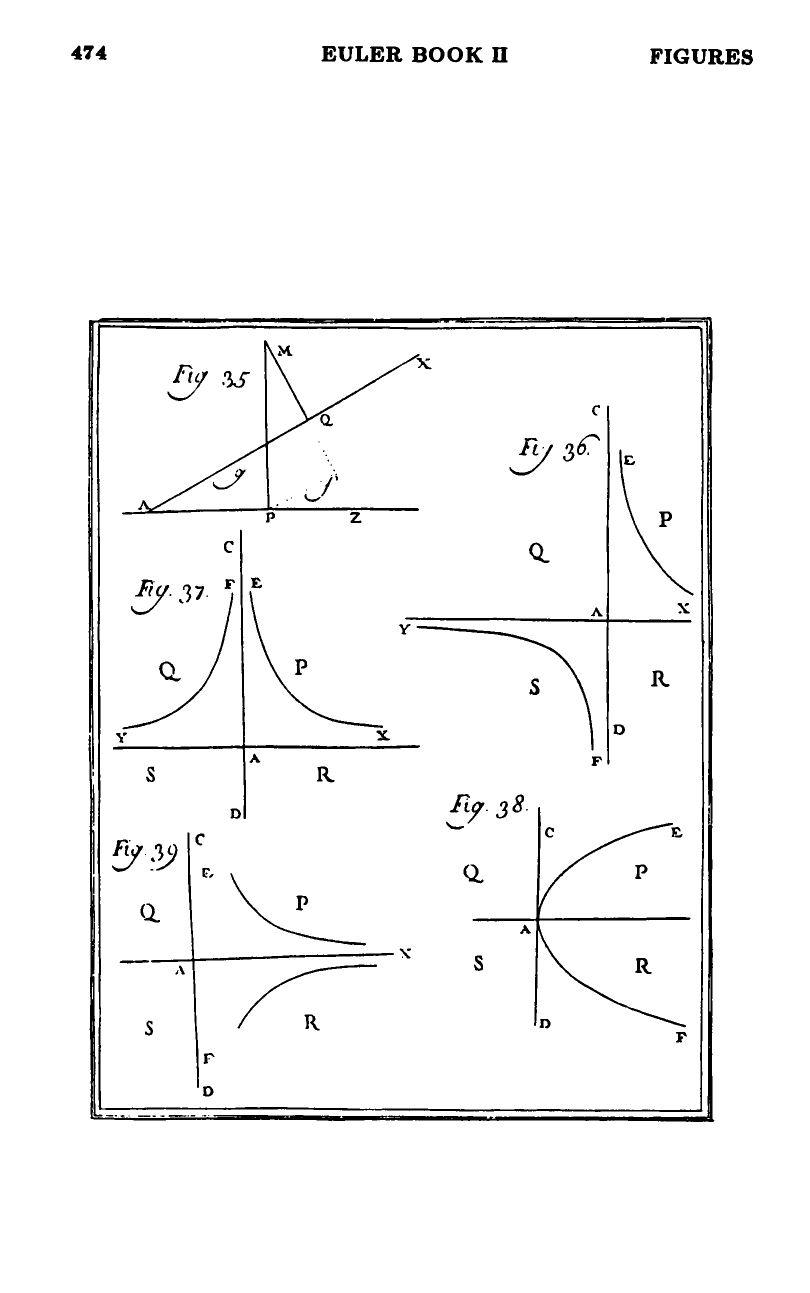
- §200: take , rotate axes by to , where . The new ordinate is itself a factor of (figure 35).
- §201: substitute , into ; expand each member in descending powers of with coefficients in .
- §202: at infinity the leading equation gives the straight-line asymptote where . Substituting everywhere except the first term yields the refinement sequence .
- §203: the canonical curvilinear asymptote shape with . Quadrant analysis: odd → branches in opposite quadrants (figure 36); even → branches in adjacent quadrants (figure 37).
§§204–209 — double linear factor: detailed refinement. double-factor-asymptote-cases.
- §204: gives, depending on the leading terms of , either
- I. (parabola, figure 38); or
- II. (parallel lines, complex, or double).
- §205: equation II with two real distinct roots → two parallel-line asymptotes; refinement of each by the §202 procedure.
- §206: equation II with double root → refinement gives for .
- §207: subtler cases when vanishes — equation where , .
- §208: general form with three sub-cases: (two distinct curvilinear asymptotes, four branches), (real ⇔ ; gives two similar asymptotes ), (middle term dominates near infinity, ).
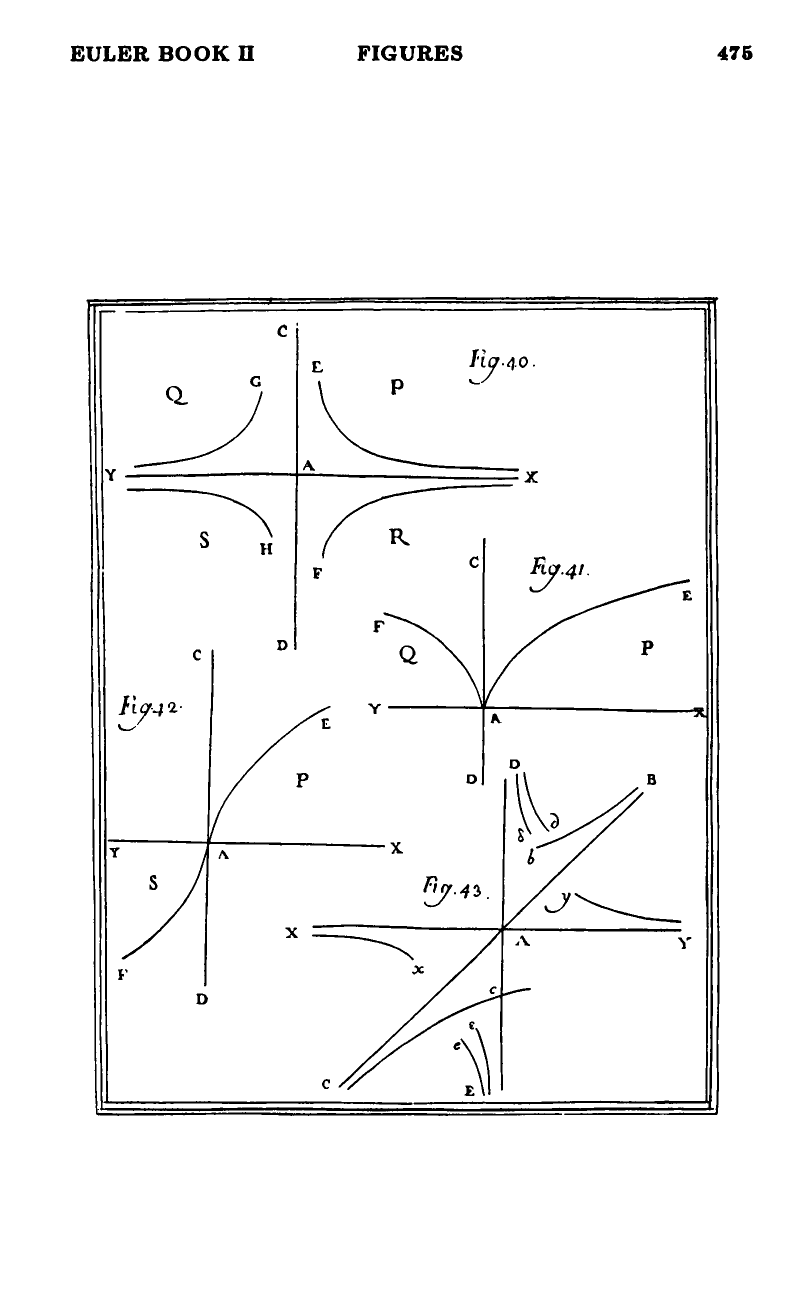
- §209: shape catalogue for . With straight asymptote as axis: odd → branches in (figure 39); even and → four branches in all four quadrants (figure 40); even and → no real branch.
§§210–214 — triple linear factor: detailed refinement. triple-factor-asymptote-cases.
- §210: . The four leading-equation types depending on which coefficients of are present:
- I. .
- II. .
- III. .
- IV. .
- §211: I is a third-order line, two branches in quadrants (figure 41). II resolves into a parabola plus a (refinable) straight line.
- §212: III becomes the cubic (figure 42, two branches in ). IV gives up to three parallel straight lines, each refinable.
- §213: equal-root sub-cases of IV — double root reduces to the §207 family; triple root produces or the general .
- §214: shape catalogue. The cubic — odd → opposite quadrants (figure 36 again); even → adjacent quadrants (figure 37 again).
§215 — beyond multiplicity 3 the same logic continues, and Euler stops. Final example.
§§215–217 — worked example. example-curve-eight-branches: with three multiplicities (single , double , triple ) and 8 branches at infinity, drawn as figure 43.
§218 — final classification. hyperbolic-and-parabolic-branches. Hyperbolic branches converge to a straight line; parabolic branches do not. Each class has infinitely many species, indexed by exponents in (hyperbolic) and (parabolic).
Cross-cutting techniques
Substitute-in-all-but-the-leading-term
§202, §205, §206, §211, §213. The single algebraic move that does all the work in this chapter. To refine an asymptote , replace by everywhere except the term that vanishes when (the term containing ). What remains is an equation of the form , where is a polynomial in and the constants . Truncating at the first non-vanishing power of yields the refined equation. Repeated application produces the entire sequence of refinements.
Quadrant analysis of
§203, §209, §214. With the straight-line asymptote as axis, the curve in rotated coordinates is read off by sign analysis:
- — odd flips sign with , so branches are in diagonally opposite quadrants (figures 36, 41 for cubic, 39 for ). Even preserves sign of , so both branches are on the same side of the asymptote (figure 37 for ).
- — same parity rule but doubled. For even and , on both sides of the asymptote in all four quadrants (figure 40).
Polynomial division by
§§207, 213. When the next-order coefficient itself contains as a factor, polynomial division of the leading equation by shifts attention to the next coefficient and produces a mixed equation with both and terms. This is how the equations and analogous higher-multiplicity forms arise.
Notable points
- The straight-line asymptote is a degeneracy. §198 reframes the chapter-7 result: every straight-line asymptote is the limiting case of a more informative curvilinear asymptote. The straight line tells you the limiting direction; the curvilinear refinement tells you the side, the rate, and any crossings.
- Refinement always terminates. §202 ends with the alarming-sounding observation: if every refinement coefficient vanishes, then would be a part of the curve (the original equation would be divisible by ), making the curve complex in the sense of complex-curves. So for an irreducible curve, the refinement chain always stops at some finite with .
- Three sub-cases by parity. Whenever the asymptotic equation factors as a square , the sign analysis splits into three: odd gives two branches; even with gives four; even with gives none. This trichotomy plays the role for refined asymptotes that the conic trichotomy played for in classification-of-conics.
- Branches need not pair. Where a hyperbola has 2 + 2 = 4 branches and a parabola has 2 branches, a higher-order curve can have any even number — and the example in §§215–217 has 8. The number of branches at infinity is the sum over factors of of the species-specific count: 2 per simple straight-line refinement, 2 or 4 per double-factor case, 2 per cubic asymptote, etc.
- The §218 dichotomy is exhaustive. Every asymptotic-curve form arrived at in chapters 7 and 8 has the shape or (after centering on the appropriate constant). The first family is hyperbolic — the curve approaches the line as — and the second is parabolic — the curve recedes from as . There is no third class.
- Foreshadowing infinitesimal calculus. The refinement procedure is precisely a Taylor expansion of in powers of about . Euler does it without the language of differentials, but the algebraic content is identical: , and chapter 8 is about reading the first non-vanishing correction to the constant value .
What this buys for the rest of Book II
- Chapter 9 onwards classifies higher-order curves species by species — the cubic species in particular (already initiated by Newton), where each cubic is identified by its asymptotic profile drawn from chapters 7 and 8.
- Chapter 8 closes the asymptotic theory of algebraic curves for Book II. Subsequent chapters use the catalogue without extending it further.
- For modern readers, this chapter is the analytic precursor of the theory of Newton polygons and Puiseux expansions: every infinite branch admits a fractional-power expansion in , and the leading exponent classifies the branch type.
Figures
 Figures 35–39
 Figures 40–43
Related pages
- chapter-7-on-the-investigation-of-branches-which-go-to-infinity
- branches-at-infinity
- rectilinear-asymptote-from-equation
- parabolic-asymptote
- curvilinear-asymptote
- curvilinear-asymptote-refinement
- double-factor-asymptote-cases
- triple-factor-asymptote-cases
- example-curve-eight-branches
- hyperbolic-and-parabolic-branches
- asymptotes-of-hyperbola
- complex-curves
- order-of-an-algebraic-curve